The best retrospective tools for agile teams, compared
Sixteen retrospective tools compared on pricing model, free plans, anonymity and health checks, with the scenario each one wins and the one we lose. Reviewed September 2026.
If you’re comparing online retrospective tools, the hard part isn’t finding one. It’s matching the tool to how your team actually works. A distributed scrum team that needs anonymous input and health-check trends wants something different from a co-located team that just needs a quick board once a sprint.
This guide compares the retrospective tools teams evaluate most often, with pricing, standout features and what each one is best for, so you can shortlist quickly and pick with confidence. We re-checked every tool’s pricing and features against its own site in September 2026.
We make TeamRetro, so read this the way you would read any vendor’s comparison. Every price and feature below was checked against the vendor’s own site in September 2026.
What to look for in a retrospective tool
- Templates and facilitation: enough formats to keep retros from going stale, with guided steps so anyone on the team can run one. If you want to try formats first, browse retrospective templates.
- Anonymity and voting: honest input depends on people feeling safe; check whether both come on every plan or only higher tiers.
- Health checks: tracking team health over time is what turns a retro board into a continuous-improvement habit.
- Integrations: Jira, Slack and Teams, so the actions you agree on land where the work happens.
- Pricing model: this matters more than the headline number. Most dedicated retro tools price per team (cost is flat no matter how many people join); Miro, Parabol and ScatterSpoke price per user, which is cheaper for a tiny team but grows with headcount.
- Security: SOC 2 and SSO start to matter the moment more than one team is involved.
Retrospective tools at a glance
| Tool | Best for | Pricing model | Free plan | Health checks |
|---|---|---|---|---|
| TeamRetro | Retros, health checks and estimation in one | Per team, from $250/team/year | 30-day trial | Yes |
| EasyRetro | Simple board-based retros, big template library | Per team | Yes | Limited |
| Retrium | Structured, facilitator-led distributed retros | Per team room, from $39/mo | Trial only | Yes (Team Radar) |
| Parabol | Open-source, self-hostable retros plus poker | Per active user, free–$8/mo | Yes | Yes (paid plans) |
| Neatro | Facilitation-first guided retros | Per team, from $23.20/mo | Yes | Yes (radar) |
| Miro | Whiteboard-first teams who also run retros | Per user, from $8/mo | Yes | No (not a retro tool) |
| GoRetro | Retros tied to sprint metrics | Per team, from $29/mo | Yes | Sprint analytics |
| Echometer | Recurring team-health measurement, EU hosting | Per team, from €29/mo | Yes | Yes |
Pricing was verified against each vendor’s site in September 2026; plans change, so always check the vendor for current details. Here’s each tool in more depth.
The best free retrospective tools
“Free” covers a lot of ground in this category, so the useful question is what each free plan gives up. These rows were re-checked against each vendor’s own pricing page in September 2026.
| Tool | What the free plan gives you | Where it stops |
|---|---|---|
| IdeaBoardz | Unlimited boards, no account at all, PDF and Excel export | No paid tier and no active development since 2020, with no stated security or data guarantees |
| RetroTool | Anonymous boards with no signup, unlimited cards and participants, secret voting, 12-month retention | 3 basic templates free; the advanced set (SWOT, DAKI, Three Little Pigs) is paid |
| Neatro | Up to 10 members forever, unlimited retros and Team Radars, every ready-to-use template | 30 days of data history; Premium facilitation features are a 14-day trial |
| Parabol | Unlimited users across 2 teams, 10 meetings a month | 30-day history, 2 custom templates, 3 AI retro summaries a month, and no team health checks (Team plan and up) |
| EasyRetro | 2 public boards a month, unlimited participants, the full 100+ template library | No teams or team boards, and only 2 boards on the dashboard including archived ones |
| GoRetro | 1 team, 5 public boards and 2 team boards per 31-day cycle, unlimited users and guests | Exports, retro analytics, Jira sync, happiness index, polls and icebreakers are all paid |
| Echometer | 1 team, 25 workspace members, unlimited retro guests | 1 retro a month once the trial ends, and a 2-retro archive |
| Retrospected | Unlimited retrospectives, full customization, anonymous accounts, 40 posts | Sessions are public until you pay; encryption and private boards are Pro |
For a one-off retro where nobody wants an account, IdeaBoardz and RetroTool are the shortest path. For a free plan a small team can actually live on, Neatro’s 10-member tier and Parabol’s 10 meetings a month go furthest before the ceiling bites.
TeamRetro is deliberately not in that table, and it is worth saying why: there is no free forever plan. The 30-day trial carries every feature, health checks and estimation included, and asks for no card. If a permanent free tier is a hard requirement, one of the eight above is a better fit, and it is worth knowing that upfront.
Where another tool may fit better
Four situations where another tool on this list is likely the better fit, worth knowing before you start a trial.
- You need a permanently free plan. We do not have one. The 30-day trial carries every feature and asks for no card, and then it stops. Neatro’s 10-members-forever tier and Parabol’s 10 meetings a month are the two free plans a small team can actually live on; IdeaBoardz and RetroTool need no account at all.
- Your team is under about five people and you pay per seat elsewhere. Per-team pricing is our advantage at 15 people and our disadvantage at three. Parabol at $8 per active user, or Miro if you are already paying for it, will cost you less.
- You want a blank canvas, not a guided session. If a confident facilitator designs the workshop anyway, our guided stages are in the way. Miro and Spreo give you the infinite canvas and get out of the way, and Spreo’s facilitation extras (a shared jukebox, timers, spinners, confetti) lift the energy of a live room.
- You want to run it on your own infrastructure. We are closed source and hosted. Parabol is AGPL-3.0 with documented Docker and Kubernetes self-hosting, and Retrospected is GPL-3.0 with a $599 one-time self-hosting license. If self-hosting is a hard requirement, one of those two is the better starting point.
If one of those describes your team, the tool named is worth looking at first. Everything below assumes none of them does.
In this guide
- TeamRetro
- EasyRetro
- Retrium
- Parabol
- Miro
- Neatro
- GoRetro
- Echometer
- ScatterSpoke
- RetroTool
- TeleRetro
- Reetro
- IdeaBoardz
- Metro Retro (now Spreo)
- RetroTime
- Retrospected
- Frequently asked questions
TeamRetro
Overview
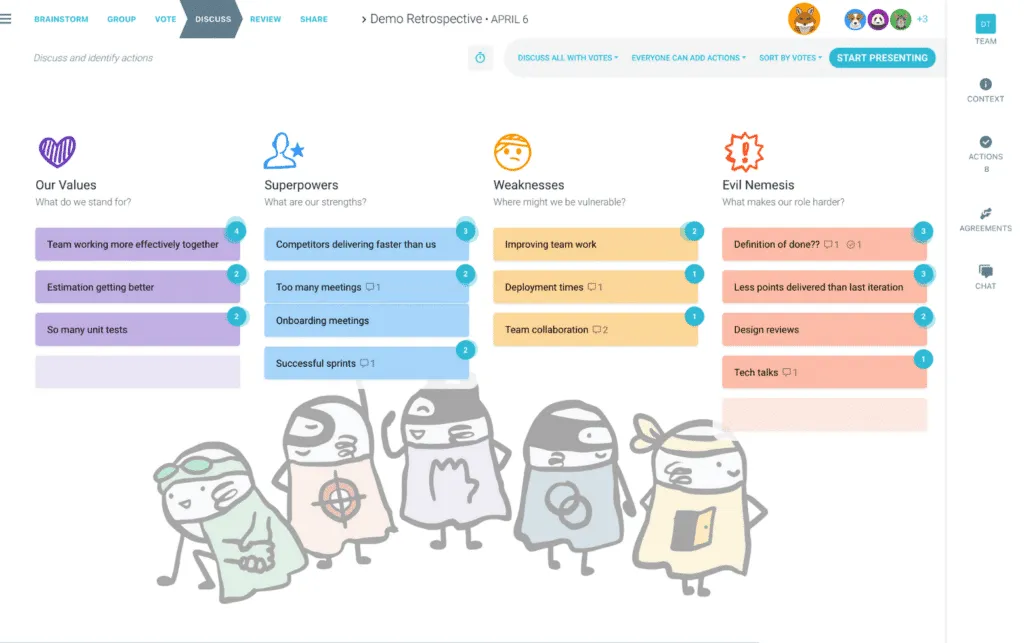
TeamRetro runs guided retrospectives, team health checks and estimation in one place, so the conversation, the trends behind it and the follow-up actions live together instead of scattered across three tools. Retros are template-led with anonymous input and independent voting, and health checks let you track how the team feels over time, which is what turns a retro board into a continuous-improvement habit rather than a one-off meeting.
It’s SOC 2 Type 2 and GDPR compliant, offers SSO on every plan, can be hosted in the US or EU, and has a wide range of integrations including Jira, Confluence, Azure DevOps, Slack and Microsoft Teams. Pricing is per team, not per seat, so the cost stays predictable as the team grows.
Top three features
- Guided facilitation with anonymous input and independent voting.
- Team health checks and Insights dashboards that track trends over time.
- Estimation (planning poker) built into the same tool.
Trial: Yes – 30 days, no credit card required.
Price: Per team, from $250/team/year (about $20.83/month) for a single team of up to 25 members; organization plans start at $50/month. There’s no free-forever plan, but the 30-day trial includes every feature.
What customers say
“There is no other product on the market that delivers this number of features at this level of quality at this price. It is extremely valuable for remote teams, but we also found value using it for in-person retros for its organization, anonymous capabilities, and reporting.” – Source Forge
Great for
Best when retros, health checks and estimation should live in one place and you expect to add teams. The catch: no free forever plan. See TeamRetro for enterprise teams for scaling across an organization.
EasyRetro
Overview
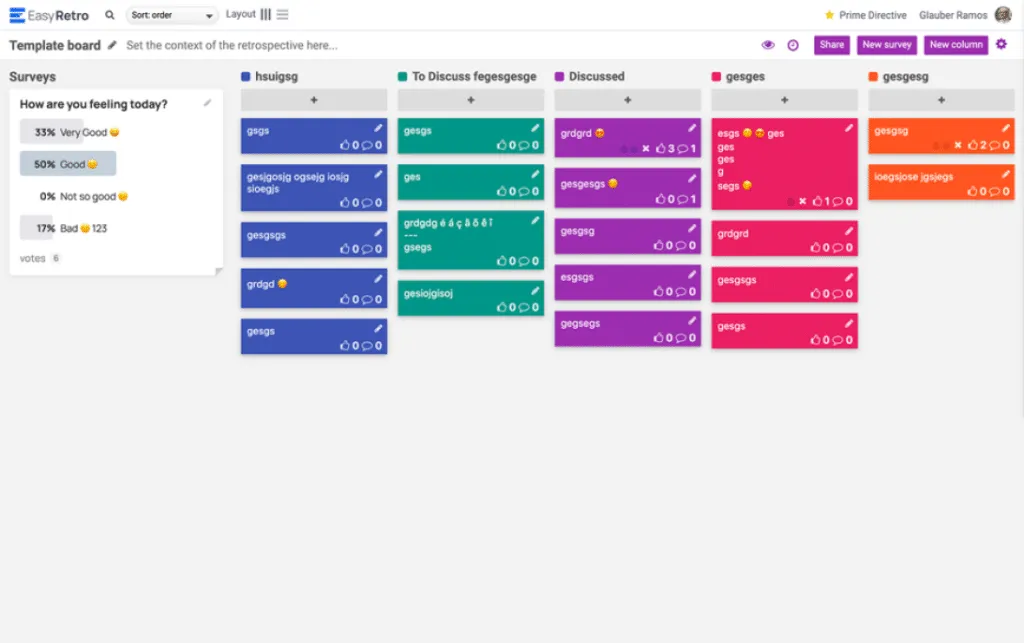
EasyRetro is a lightweight, board-based retrospective tool with a large template library (100+) and a usable free plan. Its public-board model lets an unlimited number of participants join a single board, and it offers free team-building extras like a Kudos Generator and Icebreaker Bingo.
It integrates with Slack and Confluence on paid tiers.
Top three features
- 100+ retrospective templates.
- Public boards with unlimited participants.
- Free team-building tools and surveys.
Trial: Free plan available.
Price: Free plan (2 public boards a month, plus the full template library); paid tiers add private and team boards. EasyRetro doesn’t publish transparent pricing on its site, so check the vendor for current paid rates.
What customers say
“We began using this software before the pandemic, but it was critical during that period. We needed a lightweight tool to conduct retros, and it was nice to not have to figure it out with drawing tools or messy Notion pages. This tool does one job and one job really well. Very worth it.” – Capterra
Great for
Best free-plus-cheap retro board with a big template library. The catch: no scheduling, no health checks, no action carry-over, and no SOC 2 audit of its own.
Compare EasyRetro with TeamRetro in our side-by-side breakdown.
Retrium
Overview
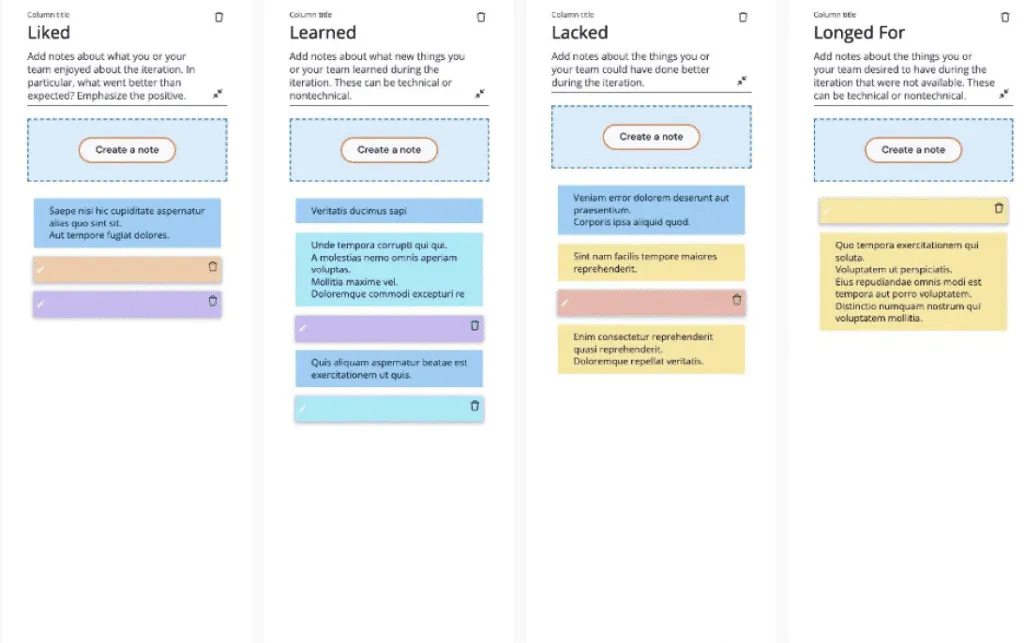
Retrium is a facilitation-focused retrospective tool built around a library of guided techniques and its “Team Radar” health-check format. Anonymous feedback and real-time collaboration help teams surface honest input, and each Team Room holds an unlimited number of users.
Retrium integrates with Jira Cloud on every plan.
Top three features
- Structured “Team Radar” health-radar retros.
- Guided retrospective technique library.
- Unlimited users per Team Room.
Trial: Yes – 30 days.
Price: $39 per Team Room per month; the Business plan is $715 per Team Room per year (about $59/month) and adds SAML SSO and SOC report access. There’s no free plan.
What customers say
“I like how quickly you can get a meeting started with Retrium. When my team needs to start a retrospective, we can invite who needs to be there, select our format, and get started.” – G2
Great for
Best for a facilitator who wants to be walked through a technique. The catch: priced per Team Room, which gets awkward past a handful of teams.
Compare Retrium with TeamRetro in our side-by-side breakdown.
Parabol
Overview
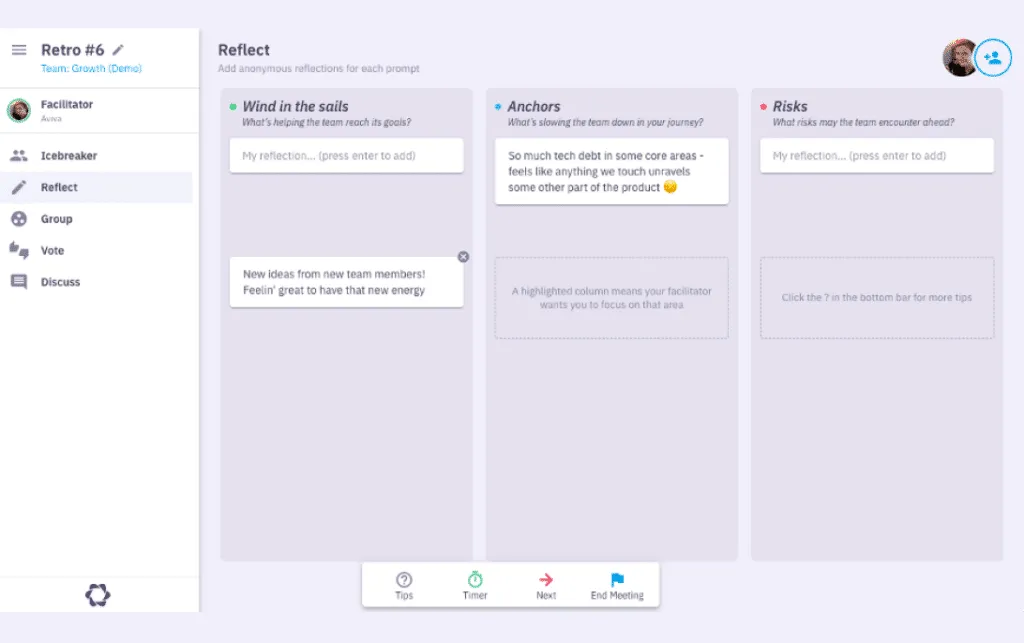
Parabol is an open-source tool that runs retrospectives, sprint poker and standups, and emails a meeting summary to attendees afterwards. Because it’s open source, the codebase is fully auditable, and Enterprise customers can self-host. It bills only for active users, so people who go quiet for a month aren’t charged.
Team health is a recurring meeting of its own since Parabol rebuilt it in 2026, with 10 built-in question packs (Project Aristotle, Edmondson, Lencioni, the Spotify squad health check, Gallup Q12 and more) plus your own questions. As of September 2026 it is still rolling out, asks five Likert questions per cycle across five fixed categories, shows a streak rather than a trend line, and is on the paid Team and Enterprise plans only.
It integrates with Jira, GitHub, Azure DevOps, Slack, Microsoft Teams and Google Calendar.
Top three features
- Open-source, fully auditable codebase.
- Retros, sprint poker, standups and team health checks in one tool.
- Active-user-only billing.
Trial: Free Starter plan (no separate trial needed).
Price: Free Starter tier (2 teams, 10 meetings a month); the Team plan is $8 per active user per month. Self-hosting and single-tenant deployment are available on Enterprise.
What customers say
“We primarily use Parabol for running our retros. We love the intuitive UX, great design and lot’s of templates to use for your team’s retrospectives summaries emailed to the team are a great feature, too!” – G2
Great for
Best if you want one open-source tool for retros, poker, standups and team health checks, and you might self-host it. The catch: $8 per active user per month, so the bill tracks headcount, and team health is not on the free tier.
Compare Parabol with TeamRetro in our side-by-side breakdown.
Miro
Overview
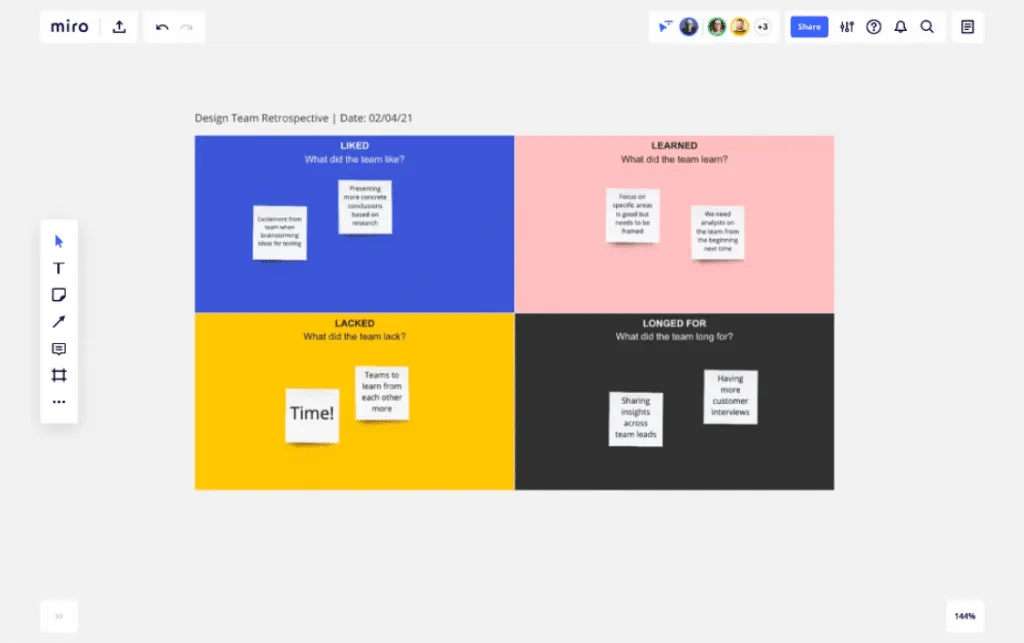
Miro is a general-purpose infinite whiteboard where retrospectives are one use-case among many, run from templates rather than a dedicated retro workflow. It’s strong when a team wants a single flexible canvas for ideation, mapping, planning and retros, and it has one of the deepest integration catalogues on this list.
Miro integrates with Jira, Asana, Linear, ClickUp, Azure DevOps, Slack, Microsoft Teams and Google Workspace (250+ integrations in total), and is SOC 2 Type II and ISO 27001 certified.
Top three features
- Infinite freeform whiteboard.
- 250+ integrations.
- AI-assisted workflows.
Trial: Free plan available.
Price: Free plan (3 editable boards); paid plans from $8 per member per month (billed annually). Priced per user.
What customers say
“Miro is an invaluable tool for optimizing collaboration and project management. Its benefits in efficiency, communication and dynamism of meetings are widely productive. I recommend Miro to any team that wants to improve their work processes and collaboration.” – Capterra.
Great for
Best if the team already lives on a whiteboard and retros are one of ten things you do there. The catch: it is not a retro tool, so nothing structures the session or remembers last time.
Compare Miro with TeamRetro in our side-by-side breakdown.
Neatro
Overview
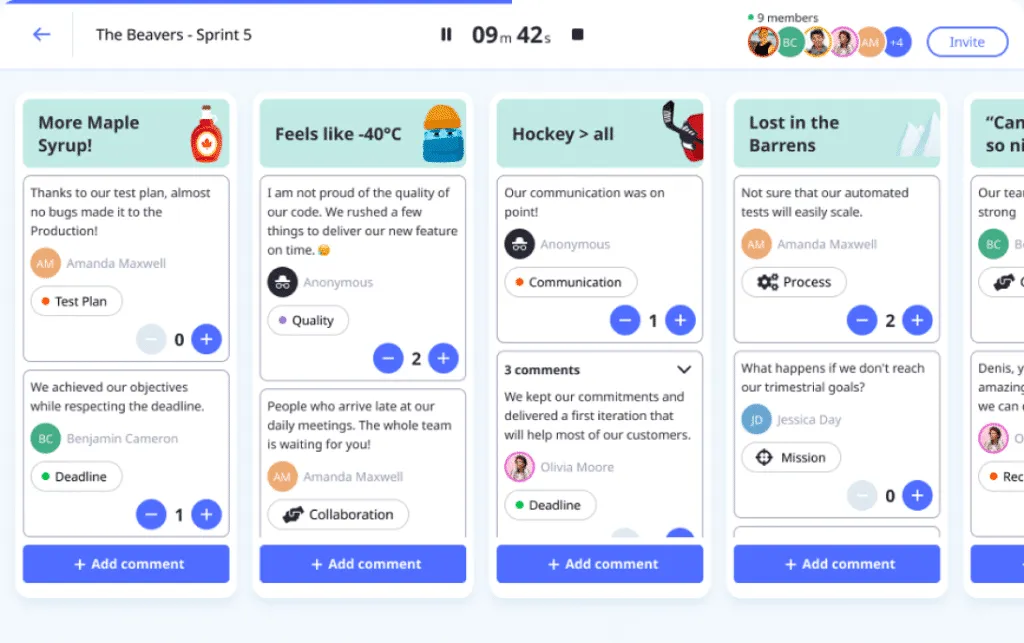
Neatro is a facilitation-first retrospective tool that keeps psychological safety front of mind: people brainstorm privately first, then share anonymously. It offers 70+ templates and a team “radar” health check, with a polished guided flow that walks a team through each step.
Top three features
- 70+ retrospective templates plus a team radar.
- Strong guided facilitation flow.
- Unlimited custom templates and exports (paid).
Trial: Yes – 14 days, no credit card.
Price: Free plan (up to 10 members, 30-day history); Premium is $23.20/team/month and Pro $31.20/team/month (billed annually). Priced per team.
What customers say
“The tool is super easy to use. Also I really like the created templates as I can join my retrospective and choose with the team which one to use, depending on our topics.” – G2
Great for
Best free plan a small team can live on, at 10 members forever. The catch: 30 days of history on that plan.
Compare Neatro with TeamRetro in our side-by-side breakdown.
GoRetro
Overview
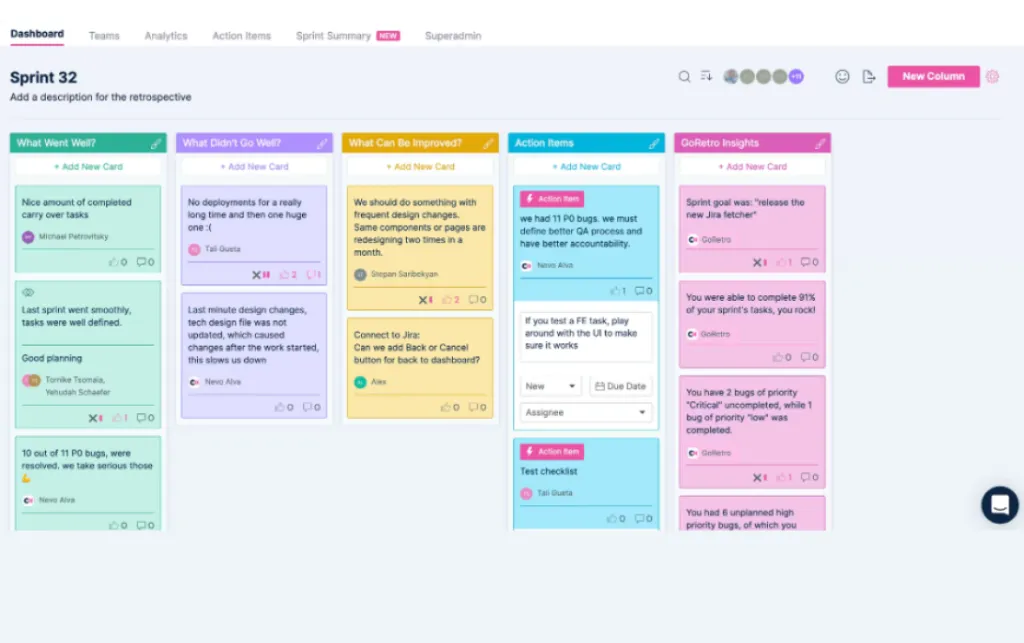
GoRetro ties retrospectives to sprint data, pairing anonymous feedback and templates with sprint monitoring and analytics. Its Sprint Pro tier adds planning poker and a capacity calculator, so retros sit alongside the numbers they’re reacting to.
It integrates with Slack and Jira Cloud, and is SOC 2 Type II and ISO 27001 compliant.
Top three features
- Sprint monitoring and analytics.
- Planning poker and capacity calculator (Sprint Pro).
- Advanced action-item tracking.
Trial: Yes – 30 days, full features, no credit card.
Price: Free plan plus a 30-day trial; Premium is $29/team/month and Sprint Pro $49/team/month (billed annually). Priced per team, with unlimited users.
What customers say
“My team and I use GoRetro for team retrospectives at the end of each sprint. It allows writing feedback anonymously, commenting on the cards, “likes” and even gifs for a touch of humor. It does its job perfectly.” – G2
Great for
Best if you want the retro sitting next to sprint metrics. The catch: exports, analytics, Jira sync and polls are all behind the paywall.
Compare GoRetro with TeamRetro in our side-by-side breakdown.
Echometer
Overview
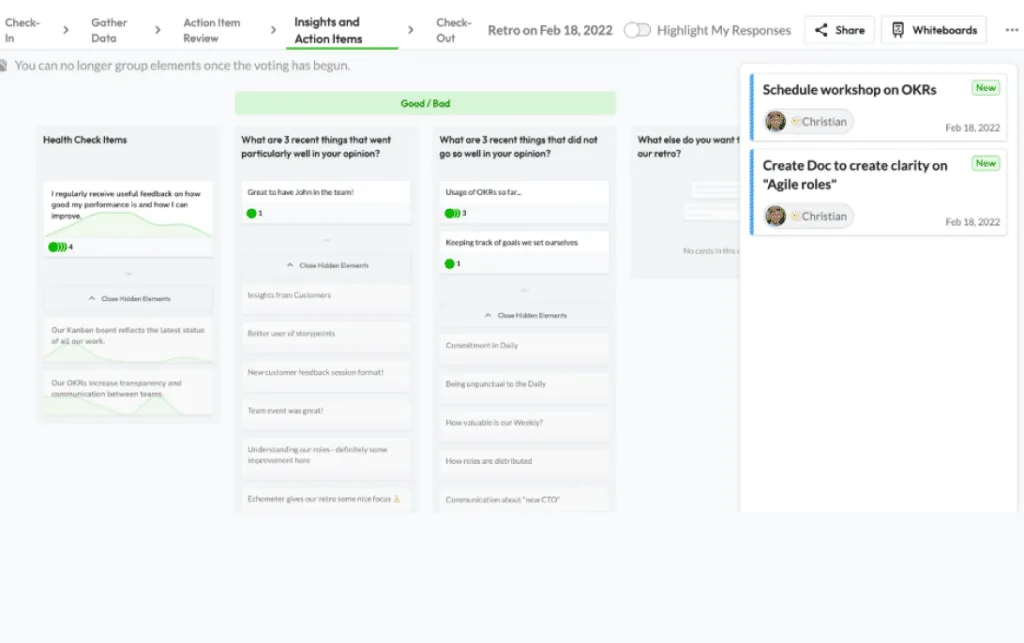
Echometer pairs retrospectives with psychology-based team health checks, using scheduled surveys and a cross-team dashboard to measure how teams are doing over time. It’s hosted in Germany, which makes it a natural fit for EU teams with data-residency requirements.
Echometer is GDPR compliant with a DPA, and integrates with Jira.
Top three features
- Psychology-based health checks with automated scheduling and a cross-team dashboard.
- Custom anonymous survey builder.
- 50+ templates with a collaborative board.
Trial: Yes – free plan available.
Price: Free plan (one retro a month); Pro is €29/team/month and Business €49/team/month (billed annually). Priced per team, in EUR, with German hosting.
What customers say
“What we like best is usability, modern design and the basic attitude behind the tool – giving responsibility to the teams.” – Capterra
Great for
Best if EU hosting and recurring team-health measurement are the requirement. The catch: one retro a month once the trial ends.
Compare Echometer with TeamRetro in our side-by-side breakdown.
ScatterSpoke
Overview
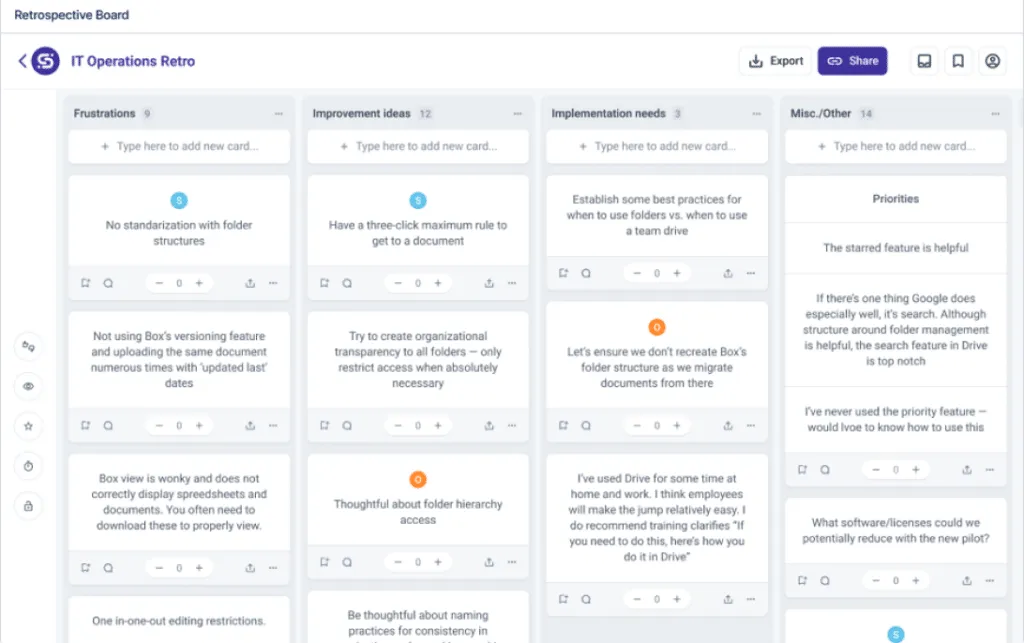
ScatterSpoke has repositioned itself as an AI feedback platform for engineering leaders. It still runs retrospectives, but the emphasis is on rolling up feedback from retros, standups and surveys into AI-synthesized themes, sentiment metrics and prioritized action items.
Top three features
- AI-generated themes and sentiment.
- Prioritized action items across retros, standups and surveys.
- AI “Agent Surveys”.
Trial: Yes – free plan available.
Price: Free (1 seat); Pro is $29 per seat per month (up to 5 seats); Business is $149/month including 5 seats. Priced per seat.
What customers say
“I’ve tested several multi-purpose tools, but I like that this one is focused specifically on retrospectives. It’s awesome to see the data-driven approach!” – Product Hunt
Great for
Best if you want retro data rolled up across many teams. The catch: per-user pricing.
Compare ScatterSpoke with TeamRetro in our side-by-side breakdown.
RetroTool
Overview
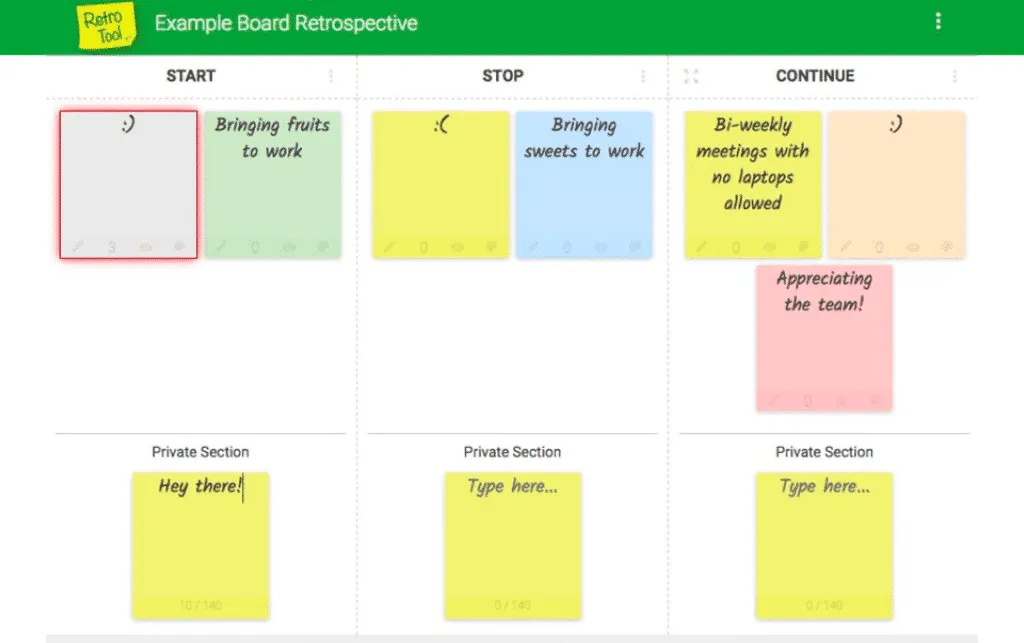
RetroTool is a simple, whiteboard-style retrospective board you can start without signing up. It includes a private area to gather thoughts before sharing, drag-and-drop grouping, dot voting and a timer. It’s functional but appears to be lightly maintained.
Key features
- Single-page retrospective.
- Private area before sharing.
- Zero-knowledge encryption (top tier).
Trial: Yes – 90 days on paid plans.
Price: Free (Anonymous plan, unlimited cards and participants); Individual $10/team/month; Company $20/team/month. Flat per-team pricing.
What customers say
“Easy to use – very intuitive – setup in just a few seconds – easy to share.” – Capterra.
Great for
Best for a retro nobody wants an account for, today. The catch: three templates free, and the advanced set is paid.
Compare RetroTool with TeamRetro in our side-by-side breakdown.
TeleRetro
Overview
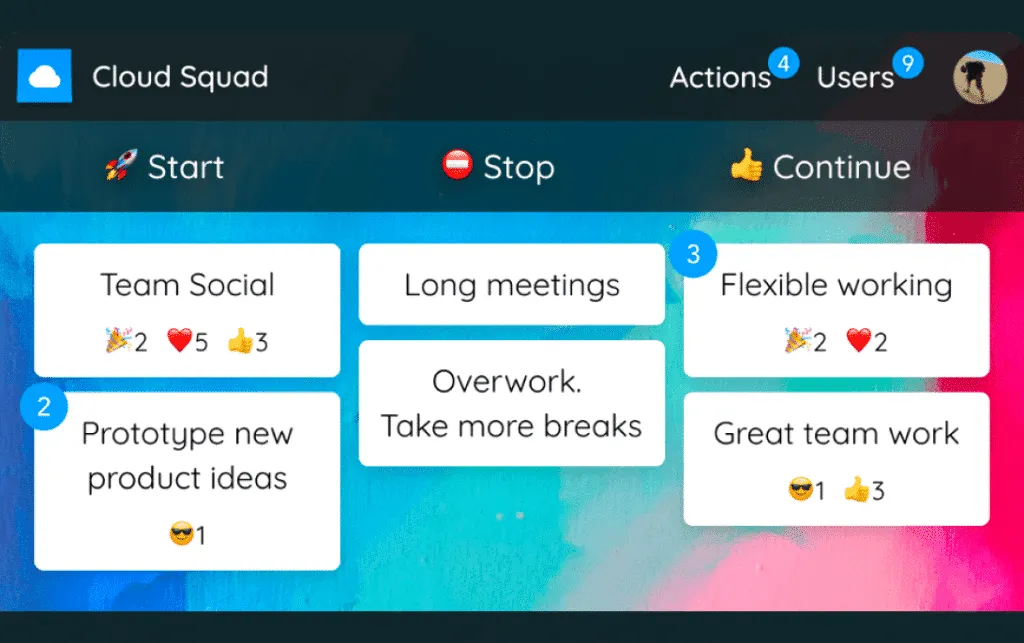
TeleRetro offers polished, engaging online retrospectives with an AI retro bot, pulse/health checks and analytics. You can bring images and music into the session, vote with emojis, and keep things on track with a timer and icebreakers.
Top three features
- AI retro bot.
- Pulse and health checks.
- Icebreakers with music and video.
Trial: Yes – free plan (1 team, 3 retros).
Price: Team is £26/month (£21/month billed annually); Business is £72/month (£58/month billed annually). Priced in GBP.
What customers say
“Cool background images. Ease of customizing the board with different columns. Best tool to work on virtually. Helps running retrospection meetings online.” – Capterra
Great for
Best if you want the retro itself to feel lively, with an AI bot, music and icebreakers built in. The catch: the free plan stops at 3 retros, and pricing is in GBP.
Compare Teleretro with TeamRetro in our side-by-side breakdown.
Reetro
Overview
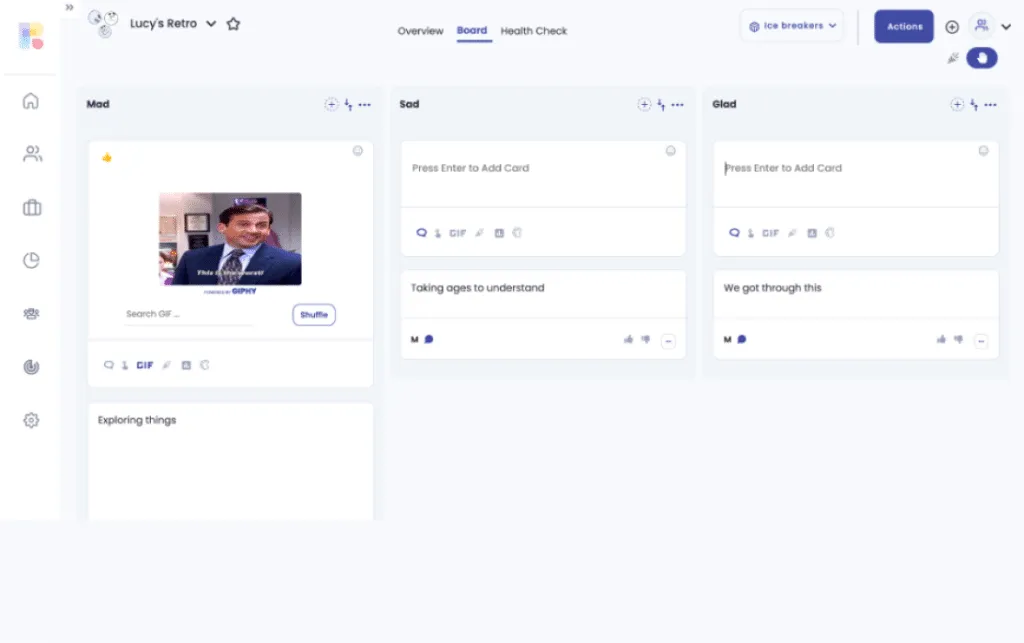
Reetro is an AI-assisted retrospective tool for agile teams. It offers AI meeting summaries, sentiment analysis and card grouping, customizable health checks and a happiness index, plus an action tracker. Retros can be run inside Slack or Microsoft Teams.
Reetro integrates with Jira, Azure DevOps, Confluence, Slack and Microsoft Teams; it’s ISO 27001 certified.
Top three features
- AI summaries, sentiment analysis and card grouping.
- Customizable health checks and happiness index.
- Action tracker with Jira and Azure DevOps export.
Trial: Yes – free version available.
Price: Free tier (3 teams, limited active boards); paid plans available. We couldn’t verify Reetro’s current pricing from its own site at the time of writing, so check the vendor.
What customers say
No reviews available at the time of writing.
Great for
Best if you want AI summaries and customizable health checks on a free tier. The catch: anonymous input and multi-voting are both paid-only, and the current pricing is hard to pin down from their own site.
Compare Reetro with TeamRetro in our side-by-side breakdown.
IdeaBoardz
Overview
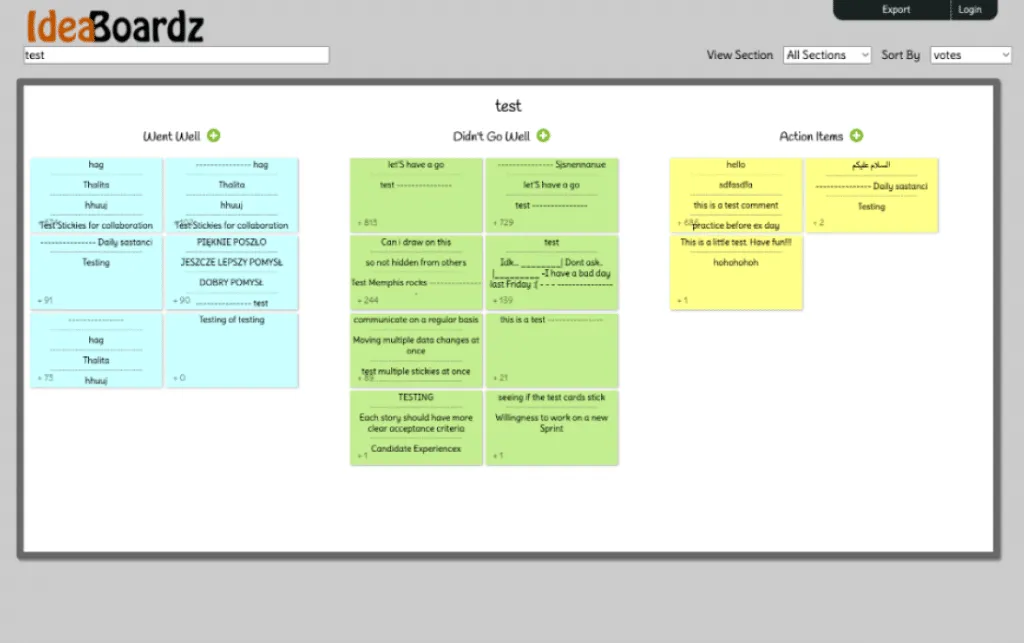
IdeaBoardz is a dead-simple, shared-URL brainstorming board for collectively gathering input, reflecting and retrospecting. It’s functional and free, but it’s a legacy tool that’s no longer actively developed, with no stated security or data guarantees.
Top three features
- Optional login.
- Export as PDF or Excel.
- Runs in any modern browser.
Trial: Free to use.
Price: Free.
What customers say
“It is one of the easiest tools to organize and manage ideas regarding anything that we want to implement in the future implementation.” – G2
Great for
Best zero-friction one-off: no account, unlimited boards, PDF and Excel export. The catch: no active development since 2020 and no stated security guarantees.
Compare IdeaBoardz with TeamRetro in our side-by-side breakdown.
Metro Retro (now Spreo)
Overview
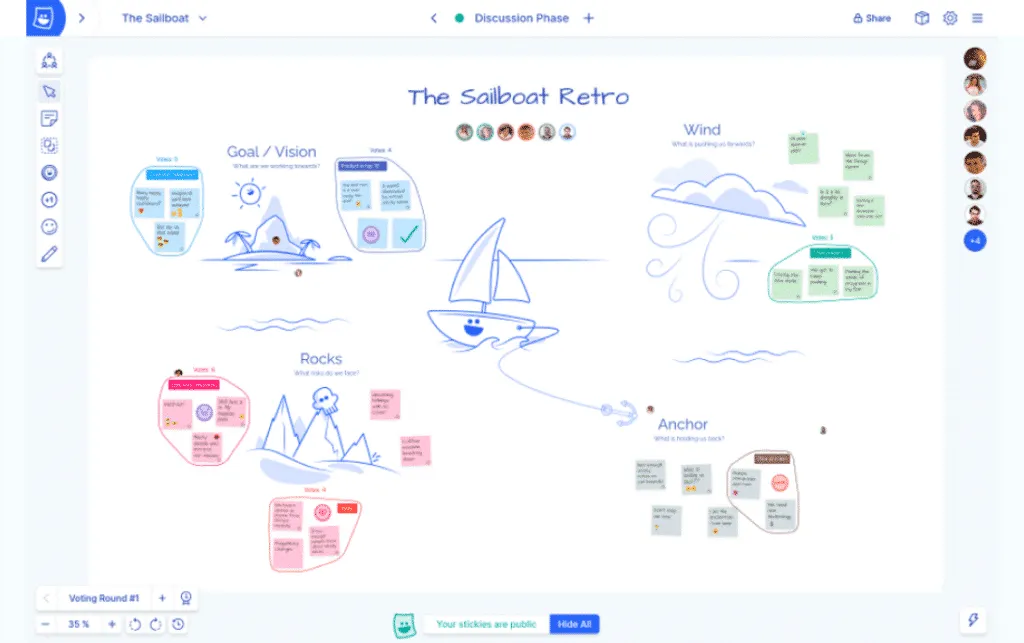
Metro Retro has been rebranded as Spreo (after an interim stint as Ludi). The old metroretro.io address now redirects on. The product itself lives on as a freeform, visual whiteboard for retros, planning and workshops, with playful templates and the illustrated stickies it was known for.
Top three features
- Infinite freeform whiteboard.
- Playful retro templates.
- Design mode and meeting mode.
Trial: Yes – 30-day trial (the free plan was retired in 2024).
Price: No free plan; paid plans are priced per member (a 10-license example works out to roughly $40/month billed annually).
What customers say
“The interface is very simple, and super easy for everyone to learn. Being able to see what others are doing/saying/commenting on in real time is priceless.” – G2
Great for
Best playful canvas for workshops, planning and the occasional retro. The catch: it is whiteboard software now, and EU-hosted only.
Compare Metro Retro with TeamRetro in our side-by-side breakdown.
RetroTime
Overview
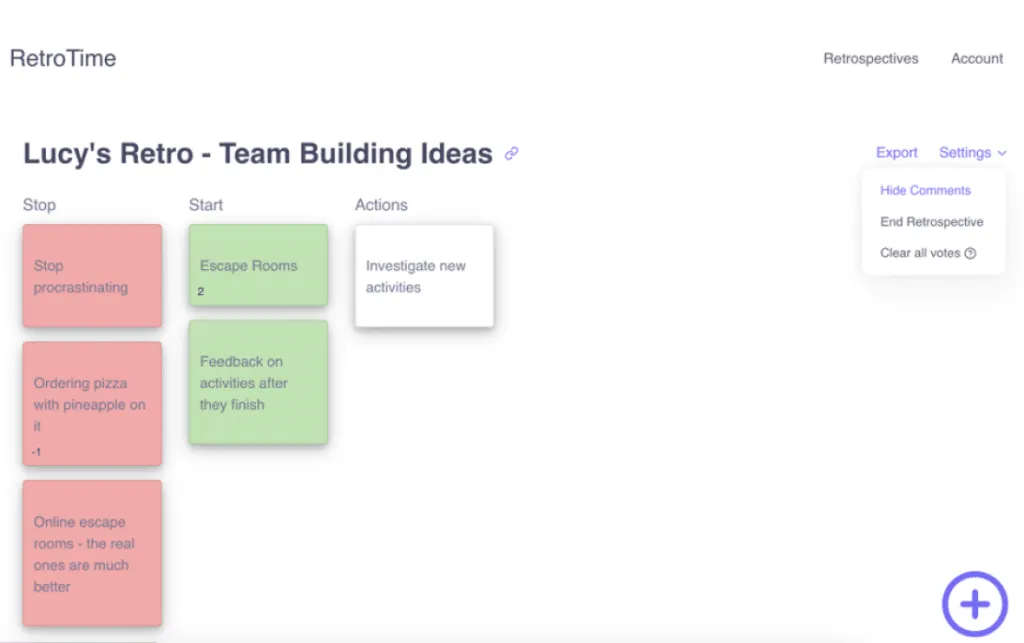
RetroTime (at retroti.me) offers a very simple, real-time way for teams to collaborate: add a sticky note, align it to a category, and vote. You can hide comments during collection, assign action items, and export the summary to your sprint tool.
Top three features
- Real-time board.
- Hide comments during collection.
- Action items and summary export.
Trial: Yes – free tier.
Price: RetroTime offers a free tier and low-cost paid plans, but we couldn’t verify its current pricing from the site at the time of writing, so check the vendor before you commit.
What customers say
No reviews available at the time of writing.
Great for
Best if you want a lightweight real-time board and nothing else. The catch: a small tool with a small surface.
Compare RetroTime with TeamRetro in our side-by-side breakdown.
Retrospected
Overview
Retrospected is open-source software (GPL-3.0) for running simple retrospectives. Boards are public on the free plan and can be encrypted or made private on paid tiers, and the whole thing can be self-hosted.
Retrospected includes integrations with Slack, GitHub, Microsoft and Okta.
Top three features
- Open source and self-hostable.
- Encrypted, private sessions (paid).
- Multilingual interface.
Trial: Yes – free Basic plan.
Price: Free Basic (40 posts); Pro $12.90/month; Unlimited $49.95/month; self-hosting is a $599 one-time license. Not SOC 2 certified.
What customers say
No reviews available at the time of writing.
Great for
Best if you want to run your own retro server under an open-source license. The catch: boards are public until you pay, self-hosting is a $599 one-time license, and security is your problem.
Compare Retrospected with TeamRetro in our side-by-side breakdown.
Frequently asked questions
What is the best retrospective tool?
There’s no single best retrospective tool. The right one depends on your team. For guided retrospectives plus team health checks, estimation and reporting in one place, TeamRetro is the strongest all-rounder; for a quick free board, EasyRetro or Parabol’s free tier work well.
What’s the best free retrospective tool?
EasyRetro, Parabol, Neatro, GoRetro and Echometer all offer free plans that suit small or co-located teams. TeamRetro doesn’t have a permanent free plan, but its 30-day trial includes every feature, health checks, estimation and reporting included.
Are retrospective tools priced per user or per team?
It varies, and it matters as you scale. Most dedicated retro tools (TeamRetro, Neatro, GoRetro, Echometer and Retrium) price per team, so cost is flat regardless of how many people join. Miro, Parabol and ScatterSpoke price per user, which is cheaper for a tiny team but grows with headcount.
Which retrospective tools work best for remote teams?
All the tools here run online. For distributed teams, look for anonymous input, independent voting and async support so people contribute honestly across time zones. TeamRetro, Retrium and Parabol are all built with remote retros in mind.
Do I need a dedicated retrospective tool, or is a whiteboard enough?
A whiteboard like Miro is flexible but unstructured. A dedicated retrospective tool adds guided steps, templates, voting, action tracking and health checks, which is what keeps retros consistent and turns them into follow-through, not a one-off discussion.
We are a team of three. Which retrospective tool should we pick?
Probably not ours, at that size. Per-team pricing is an advantage at 15 people and a disadvantage at three, so look at Parabol’s free Starter tier (unlimited users across 2 teams, 10 meetings a month) or Neatro’s free plan (10 members forever, unlimited retros and Team Radars, 30 days of history). Both give a team of three a real retro rather than a trial clock. Come back to TeamRetro when the team grows or a second team starts running retros.
Which retrospective tools can I self-host?
Parabol, and it is the clearest answer here. It is AGPL-3.0 with documented Docker and Kubernetes deployment, plus on-prem and air-gapped options on Enterprise. Retrospected is the other open-source option, licensed GPL-3.0, though self-hosting it is a $599 one-time license. TeamRetro is closed source and hosted, with a choice of US or EU hosting, so if running the software on your own infrastructure is a hard requirement, one of those two suits you better.
All pricing and features were verified against each vendor’s site in September 2026. Details change over time, so check the vendor for the latest.
Related posts
- September 23, 2026CLAUDE.md for teams: how we turned five people's AI memories into shared rules

- July 18, 2026The best team health check tools in 2026
- July 18, 2026Our AI teammates joined our retro
- July 16, 2026AI in Agile Project Management: What Teams Need to Know
- July 13, 2026Context engineering needs a feedback loop
- July 13, 2026How to gather feedback from your AI agents

- June 19, 2026The best collaboration tools for remote teams in 2026 (and the layer most stacks miss)
- June 16, 202660+ icebreaker questions for agile and scrum teams