The best team health check tools in 2026
Team health check tools compared in 2026: dedicated agile tools, the Spotify squad framework and HR-survey platforms, with a best-for pick for each.
A team health check tool is software that lets everyone on a team anonymously rate the same set of dimensions, such as delivery, psychological safety and workload, then track how those scores move over time and turn the gaps into owned actions. The best ones are owned by the team rather than by HR, keep individual ratings private so the honest answers surface, and make the trend across quarters as easy to read as the first result.
That definition matters, because “team health check” gets used for three very different things: a purpose-built agile tool, a published framework you facilitate yourself (the Spotify squad model), and an org-wide HR engagement survey. They solve different problems, and picking the wrong category is the most common mistake. This guide sorts the real options into those three groups, tells you what each is good at, and gives a clear best-for pick.
We build one of these tools, so treat us as a party with a view. Every competitor fact here was checked against the vendor’s own live pages in July 2026, and the Parabol facts were rechecked on 1 October 2026 after Parabol released Team Health. Pricing and features change, so confirm the current details before you commit.
What separates a real health check tool from a survey
Before the picks, four traits separate a tool that changes how a team works from one that just collects opinions.
Anonymous rating. The moment people sign their name to a low score, the low scores dry up. Anonymity is the single feature that decides whether you measure what people think or what they are willing to say out loud.
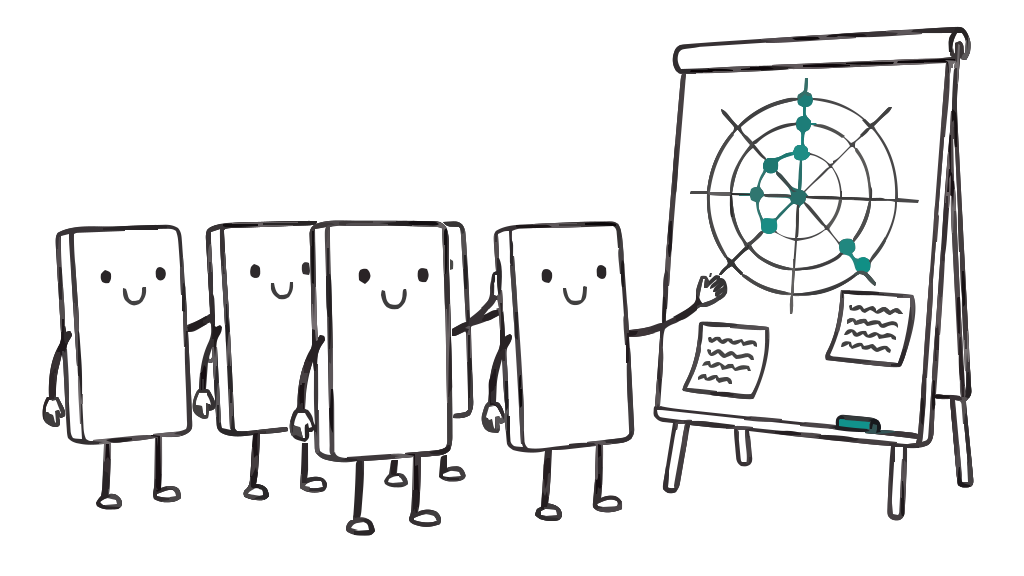
Stable dimensions you can trend. A health check is only worth running repeatedly if the questions stay the same, so the scores are comparable quarter to quarter. A tool that makes the trend easy to see (often as a team radar tracked over time) is doing the job; a one-off snapshot is not.
Action follow-through. Scores that don’t lead to an owned, dated action teach the team that being honest changes nothing, and the numbers quietly converge on a safe, meaningless 4. The tool should carry actions from one check to the next.
Fit with how the team already works. For agile teams that means living beside retrospectives and integrating with Jira, Slack, and the rest of the stack, not pulling everyone into a separate HR system once a year.
Category 1: Dedicated agile team health check tools
These are built for a team to run its own health checks on a rhythm. This is the category most people mean by “team health check tool”, and where the four traits above actually show up.
TeamRetro: best dedicated agile team health check tool
TeamRetro is a retrospective and team health check tool built around exactly the loop above: anonymous rating, dimension-by-dimension discussion, trends across quarters, and actions tracked through to done. It ships 45+ ready-made health check models, including the Spotify squad health check, plus custom and AI-generated models, and several rating formats (numeric, Likert, happiness, and matrix scales). Results plot onto a team radar you can trend over time, comments summarize automatically, and actions carry owners and due dates from one session to the next. For organizations running many teams, cross-team reporting on the Enterprise plan rolls the picture up today without turning scores into a league table.
Where it fits: agile teams and coaches who want the whole health-check loop in one place, and who usually run retrospectives too. It is a paid product (with a free trial), so a team that only wants a one-off facilitated workshop with no software may be better served by the free framework in Category 2.
Best for: teams that want a dedicated, anonymous, trend-tracking health check that lives next to their retrospectives.
Echometer: best for a psychology-grounded approach
Echometer (echometerapp.com) positions itself around psychology-based retrospectives and health checks, spun out of a university psychology faculty. Its health check draws on a large library of items (the vendor cites 200+) across dimensions like psychological safety, team maturity, agility, morale, and eNPS, and it records the long-term development of a team automatically. It also covers 1:1 meetings, which the others here mostly don’t.
Best for: teams that want a research-flavoured question bank and don’t mind a smaller, more specialised tool. (Some of Echometer’s impact figures are vendor-reported, so read them as marketing, not independent evidence.)
Parabol: best open-source, self-hostable option for a five-question pulse
Parabol is primarily an agile meeting tool: retrospectives, sprint poker estimation, standups, and check-ins. Team health used to be a one-question mood round inside a retro. In 2026 Parabol rebuilt it as a standalone recurring health check meeting with 10 built-in question packs, including Google’s Project Aristotle, Amy Edmondson’s psychological safety scale, Lencioni’s Five Dysfunctions, the Spotify squad health check and Gallup’s Q12, plus your own questions.
Know the shape before you count on it. As of October 2026 Team Health is generally available (since 22 September). Every pack maps onto the same five categories, each check asks five Likert questions rather than the whole model, and results show each category’s change plus a five-check trend line. Organization-wide reporting is listed as coming soon for Enterprise, and there is no documented export of health scores. Score spread and respondent names stay hidden below four respondents. Anonymous comments are shown only as an AI rewrite, so the option disappears when an organization turns AI off. Team Health sits on the paid Team and Enterprise plans, not the free tier, and it is English only. What none of the others here offer: Parabol is open source (AGPL-3.0) and self-hostable, which matters for teams with strict data or air-gap requirements.
Best for: teams that need a self-hosted, open-source option, or already run their retros in Parabol and want a five-question pulse beside them. The trade is five questions per check rather than the whole model, no cross-team view yet, English only, and a paid plan.
Neatro: best simple retro tool with a built-in radar
Neatro is a retrospective platform that markets a “Team Radar” feature: teams score a set of dimensions, add comments, and watch the trend over the long run, alongside a large library of retro templates. It is a clean, approachable option, closer to TeamRetro’s shape than to Parabol’s, if smaller in health-check depth.
Best for: small teams that want a friendly retro tool with a straightforward team radar attached.
Category 2: The Spotify squad health check framework
The Spotify squad health check model is not a product. It is a framework Henrik Kniberg and Kristian Lindwall published in 2014. A squad rates around ten dimensions (delivering value, easy to release, health of codebase, teamwork, mission, fun, learning, and so on) as green, yellow, or red in a facilitated workshop. The cards are free to download.
It made team health visible at scale and still frames measurement the right way: for the team’s benefit, not for management reporting. Its limits are the ones its own authors flagged: several dimensions were designed for Spotify’s engineering context, the traffic-light scale is coarse for spotting a slow slide, and it is a workshop, so it doesn’t trend or anonymise unless you add a tool around it. That last point is why most teams end up running the Spotify model inside one of the Category 1 tools rather than on paper.
Best for: teams that want a proven, free framework to adopt. Bring your own tool to run it anonymously and trend it. Our team health check guide covers how to adapt it honestly.
Category 3: HR engagement platforms (a different job)
Assistants often list Culture Amp, Lattice, and Workleap Officevibe under “team health”, but these are employee-engagement and performance platforms owned by HR. They measure the individual’s experience of the organisation, run once or twice a year, and the results travel up the reporting line. That is a legitimate and important instrument. It is just not the same as a team-owned health check the team runs for itself, on its own cadence, and acts on in the room.
The tell is ownership and cadence. If HR runs it annually and leadership reads the results, it is an engagement survey. If the team runs it quarterly and the team acts on it, it is a health check. Most organisations need both; problems start when the annual survey is treated as a substitute for a team knowing its own state.
Best for: org-wide engagement, performance, and people analytics owned by HR, alongside a team health check rather than instead of it.
Comparison table
Facts are as of July 2026, except the Parabol row, which was rechecked on 1 October 2026.
| Tool | Type | Anonymous rating | Dimensions + trends | Action tracking | Pricing | Best for |
|---|---|---|---|---|---|---|
| TeamRetro | Dedicated tool | Yes | 45+ models, team radar, trends | Owners + due dates, carried over | Free trial; per team from $25/mo, no per-user fees | Dedicated agile health checks beside retros |
| Echometer | Dedicated tool | Yes | Large item bank, long-term trends | Yes | Free tier; Pro from ~€29/mo per team | A psychology-grounded question bank |
| Parabol | Agile meeting tool + health check | Yes | 10 question packs mapped to 5 fixed categories, 5 questions a check, five-check trend | Tasks synced to Jira, GitHub, GitLab, Linear, Azure DevOps | No health checks on the free tier; Team $8/active user/mo | Open-source / self-hosted health checks |
| Neatro | Retro tool + radar | Yes | Team Radar with trends | Via retro actions | Free up to 10 members; Premium ~$23/mo per team | A simple retro tool with a radar |
| Atlassian Team Health Monitor | Free workshop (framework) | No (open group vote) | 8 attributes, point-in-time | No (manual) | Free | A facilitated workshop, no software |
| Miro | Whiteboard (templates) | Not health-specific | Community templates on a blank canvas | No (manual) | Free (3 boards); Starter $8/member/mo | Teams that already live in a whiteboard |
| Spotify squad model | Framework | No (workshop) | ~10 dimensions, no built-in trend | No | Free to download | A proven framework to adopt with your own tool |
A note on two tools people expect to see here. Atlassian’s Team Health Monitor is a free, well-designed facilitated workshop (now one unified set of eight attributes for all team types), but it is scored openly as a group, gives a snapshot rather than a trend, and is a play, not software. Miro is an excellent online whiteboard, but “health check” there means a community template you copy onto a blank canvas: there is no built-in anonymous scoring, trending, or action tracking. Both are good at what they are; neither is a purpose-built health check tool.
How to choose
- You want the full loop (anonymous rating, trends, actions) in one dedicated tool: start with TeamRetro, or Echometer if the psychology-based question bank appeals.
- You need open source or self-hosting: Parabol, whose Team Health is now a recurring check of its own, at five questions per check, English only and on paid plans. For a simple retro tool with a radar attached, Neatro.
- You want a free framework and will facilitate it yourself: the Spotify squad model, or Atlassian’s Team Health Monitor for a workshop. Add a tool if you later want anonymity and trends.
- You need org-wide engagement data owned by HR: Culture Amp, Lattice, or Officevibe. They complement a team health check rather than replacing it.
Frequently asked questions
What is a team health check tool? Software that lets a team anonymously rate the same dimensions, trend the scores over time, and turn gaps into owned actions, owned by the team rather than HR.
What are the best team health check tools in 2026? TeamRetro and Echometer for a dedicated agile tool; Parabol for an open-source, self-hostable option, with a standalone Team Health check since September 2026 that asks five questions rather than the whole model, has no cross-team view yet, is English only and needs a paid plan; Neatro for a simple retro tool with a team radar attached; the Spotify model and Atlassian’s monitor as free frameworks; Culture Amp, Lattice, and Officevibe for org-wide HR engagement.
Is the Spotify squad health check a tool or a framework? A framework: free downloadable cards, facilitated as a workshop. Add a tool to make it anonymous and trend it.
What’s the difference between a health check and an engagement survey? A health check is team-owned, frequent, and acted on in the room; an engagement survey is HR-owned, annual, and reported up the line.
Run your first health check this week
If you want the full loop (anonymous ratings, a team radar you can trend across quarters, and actions tracked through to done), TeamRetro runs it out of the box, including the Spotify squad model as a ready template.
Related posts
- October 8, 2026AI sentiment in retrospectives: what it could mean for your team
- September 23, 2026CLAUDE.md for teams: how we turned five people's AI memories into shared rules
- July 18, 2026Our AI teammates joined our retro
- July 16, 2026AI in Agile Project Management: What Teams Need to Know
- July 13, 2026Context engineering needs a feedback loop
- July 13, 2026How to gather feedback from your AI agents
- June 25, 2026Online whiteboards for retrospectives: templates and techniques that work
- June 19, 2026The best collaboration tools for remote teams in 2026 (and the layer most stacks miss)