60+ icebreaker questions for agile and scrum teams
60+ icebreaker questions for agile teams. Organized by standup, retro, and sprint planning. Tips included.
You know that awkward silence at the start of a sprint planning session? Everyone’s on the call, someone’s fiddling with their mic, and nobody quite knows how to kick things off. That’s exactly what icebreaker questions are for, and when they’re done well, they can shift the whole energy of a meeting in under two minutes.
For scrum masters and agile practitioners, a good icebreaker isn’t just a warm-up. It’s what makes the difference between a meeting where people hold back and one where they actually show up.
This guide covers icebreaker questions organized by agile ceremony (from daily standups to sprint retros), along with tips for running them well, a question of the day bank, and ideas for remote and hybrid teams. If you’d rather not pick by hand, our free icebreaker questions game serves one up for the whole team. For a broader bank sorted by goal rather than by ceremony, see our icebreaker questions for work.
⚡ Quick answer
Icebreaker questions help agile teams increase participation, build psychological safety, and improve collaboration. The best questions are short, optional, and matched to the ceremony being run. Use them at the start of standups, sprint planning, retrospectives, and team kickoffs to get people talking before the real work begins.
Icebreaker questions by ceremony: quick reference
Not sure which type of icebreaker fits your meeting? Here’s the quick version:
| Ceremony | Best icebreaker type | Time limit | Goal |
|---|---|---|---|
| Daily standup | Quick check-in | 30–60 sec | Get people talking |
| Sprint planning | Reflection or curiosity | 1–2 min | Arrive mentally present |
| Retrospective | Psychological safety | 2–3 min | Open up honest sharing |
| Team kickoff | Personal connection | 3–5 min | Build team identity |
What makes a good icebreaker question?
A bad icebreaker can make people cringe, feel put on the spot, or quietly disengage, which is why so many teams say they hate icebreakers. A good one takes about 60 seconds, gets a nod or a laugh, and opens people up before the real work starts. For a deeper look at the research behind this, check this article on what makes the best icebreakers for teams.
Here’s the difference:
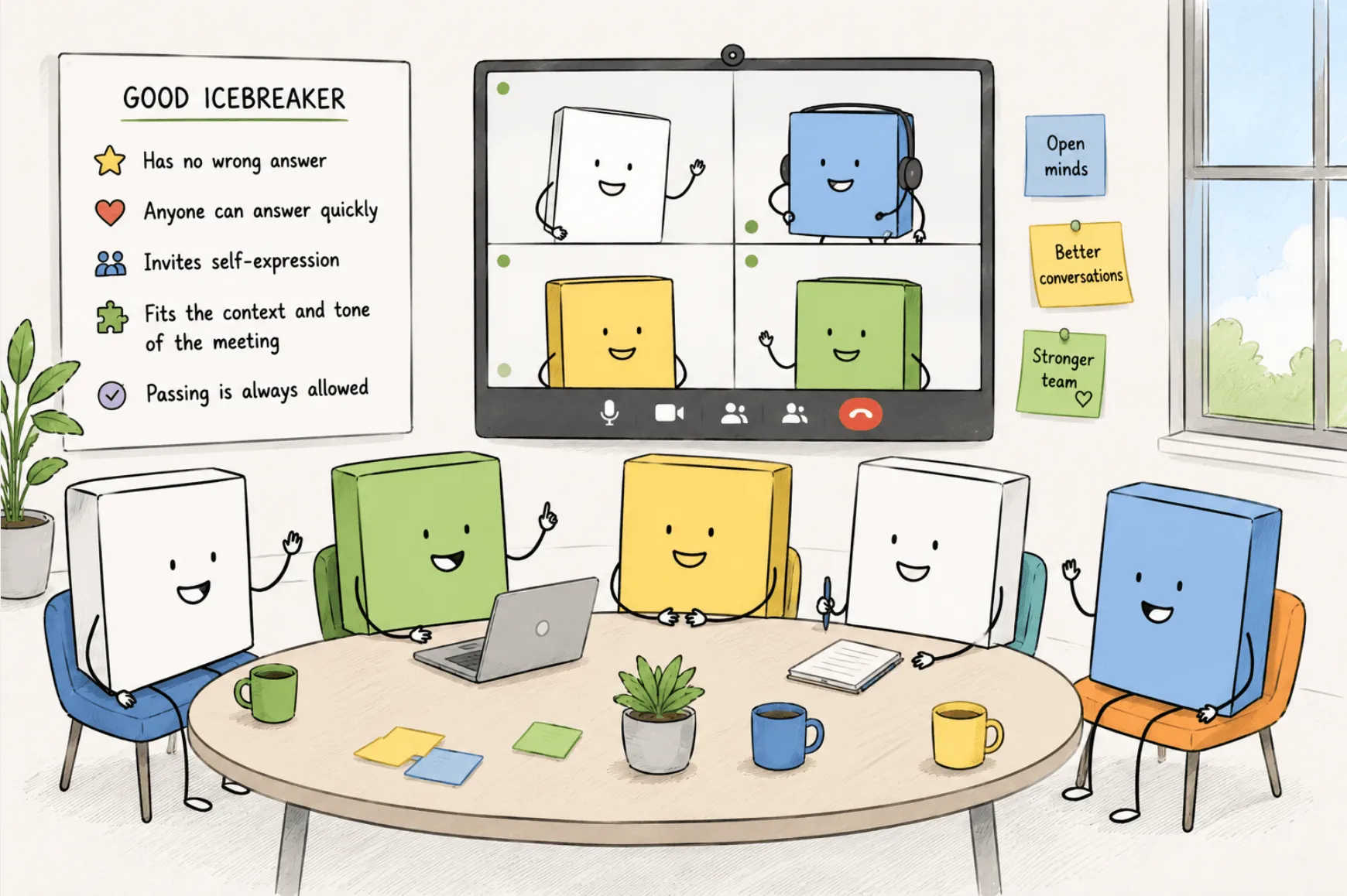
| Good icebreaker | Bad icebreaker |
|---|---|
| Has no wrong answer | Puts someone on the spot |
| Anyone can answer quickly | Requires deep thought or preparation |
| Invites self-expression | Forces disclosure or vulnerability |
| Fits the context and tone of the meeting | Same question used every week (gets stale) |
| Passing is always allowed | Mandatory participation enforced |
Five tips for running icebreakers well
Before you dive into the question banks below, it’s worth knowing what separates a good icebreaker from one that falls flat. These five things make the difference.
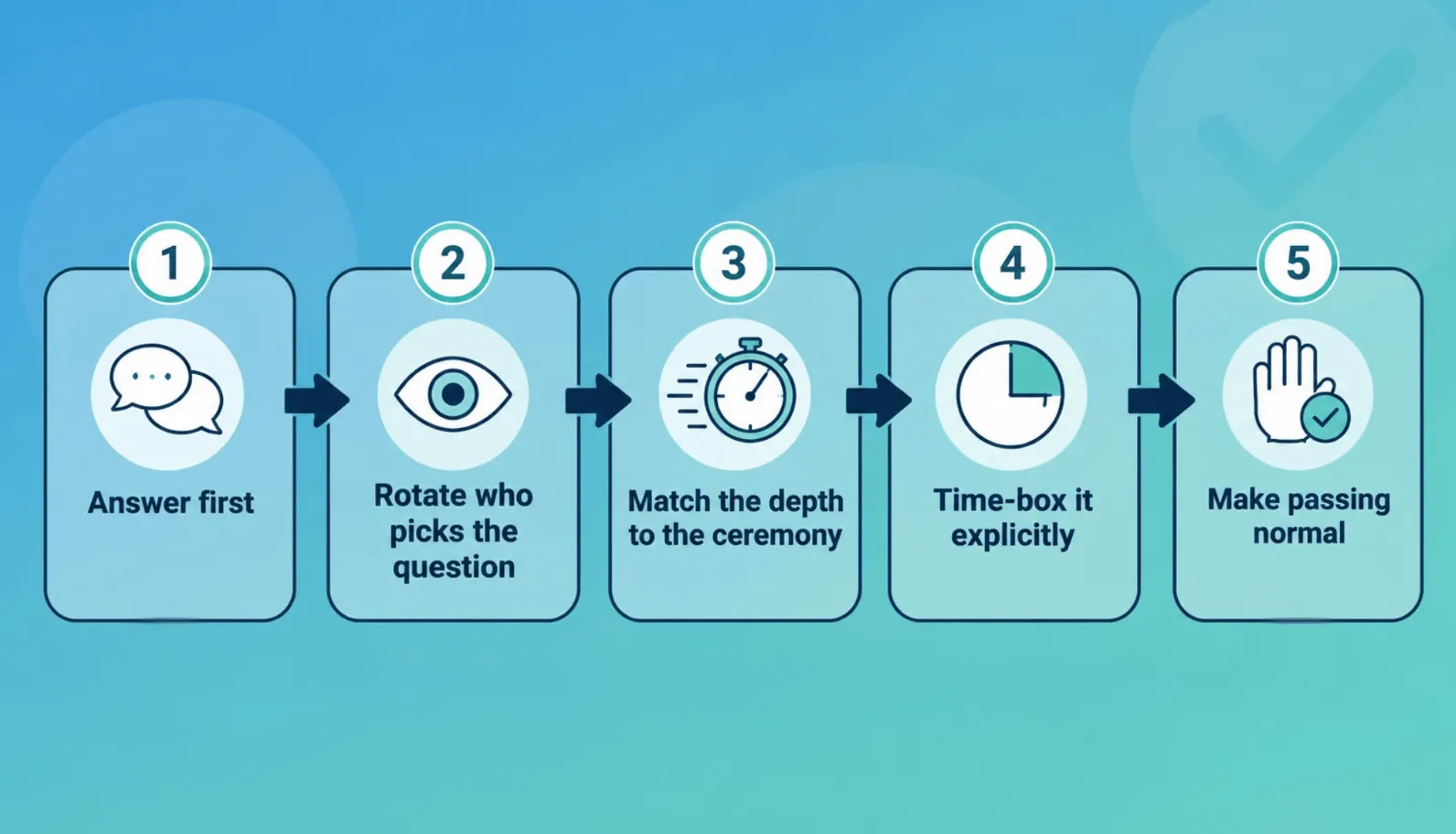
- Answer first. Before asking your team, give your own answer. It models the behavior you want and creates psychological safety. As Prof. Amy Edmondson of Harvard Business School has shown, safety starts with the person at the top of the room.
- Rotate who picks the question. Don’t let the scrum master own it every time. Rotating builds buy-in and gives people a reason to engage before the meeting even starts. A random name picker makes choosing who goes next fair and bias-free.
- Match the depth to the ceremony. A standup gets a 30-second question. A retrospective can handle something more reflective. Don’t use a deep team bonding question before a 15-minute standup.
- Time-box it explicitly. Tell the team: “We’re spending 90 seconds on this before we begin.” Naming it makes it feel intentional, not chaotic.
- Make passing normal. Some days are hard. Let people say “pass” without explanation. That’s the difference between an icebreaker and an interrogation.
For a full breakdown of each of these, see our guide on top tips for running effective icebreakers.
What are the best icebreaker questions for agile teams?
With the basics covered, here are the question banks. Each section is matched to a specific ceremony so you’re not guessing which question fits which meeting.
Standup icebreaker questions (keep it under 60 seconds)
Standups are short by design. One quick standup icebreaker question, answered in a single sentence, is all you need. If you want a ready-to-go set, TeamRetro has standup-specific icebreaker questions you can share as a link, with no account required for participants.
- What’s one word that describes how you’re feeling today?
- If your current sprint were a weather forecast, what would it be?
- What’s one small win from yesterday, inside or outside work?
- Tea, coffee, or something else, and why?
- What song would be the theme tune for your day so far?
- What’s your current browser tab count?
- On a scale of 1–5, what’s your energy like today?
- What emoji sums up your morning?
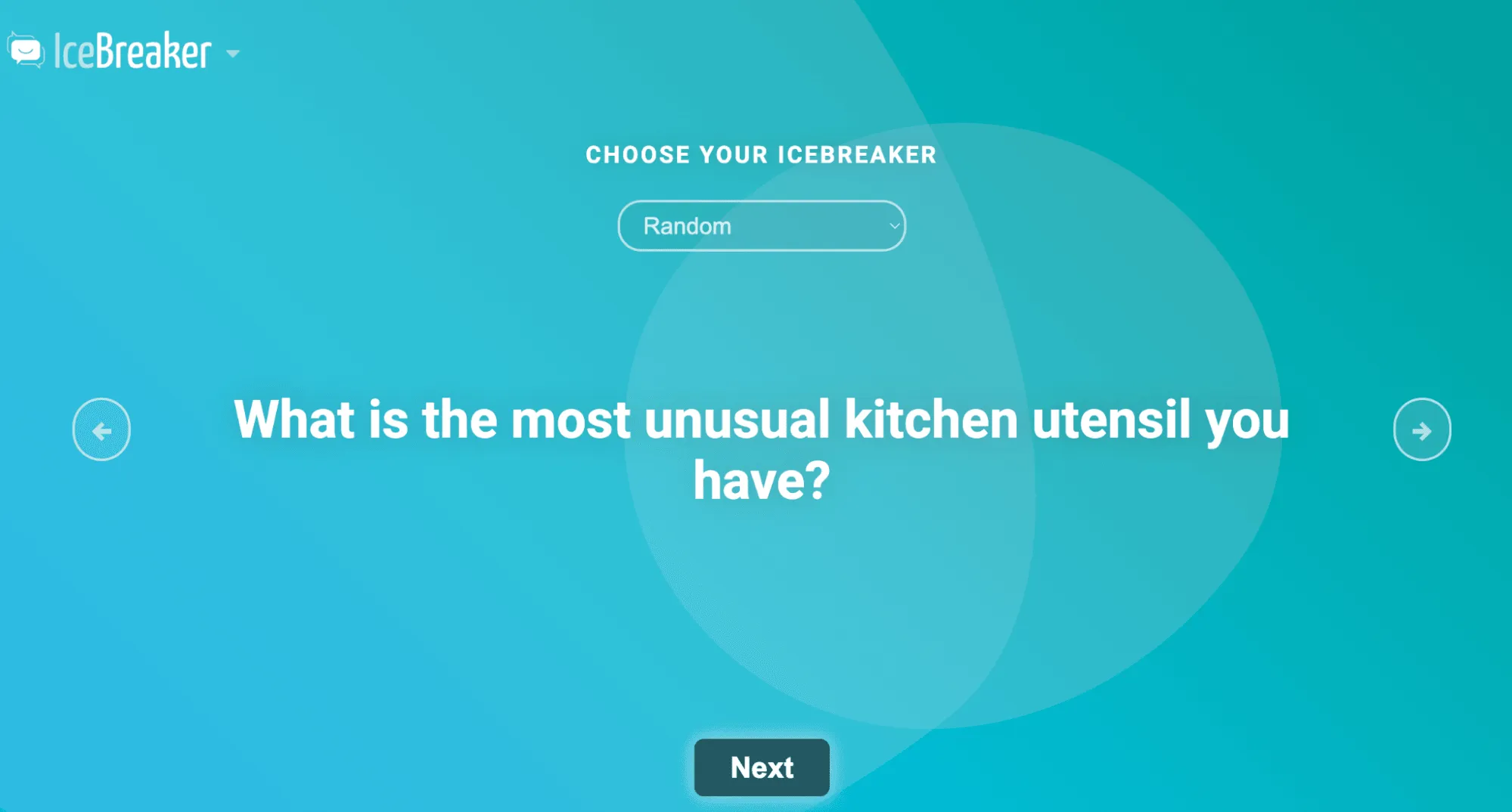
- What is the most unusual kitchen utensil you have?
- What would your out-of-office message say if you were being 100% honest?
Sprint planning and backlog refinement
These sessions require focused thinking. A slightly warmer icebreaker helps people arrive mentally before the work begins, without eating into planning time.
- What’s one thing you’re genuinely looking forward to this sprint?
- If this sprint were a film genre, what would it be?
- What’s one assumption you’re holding about this work that you’d like to test?
- What’s the most useful thing you learned last sprint?
- What’s one thing you’re hoping goes differently this sprint compared to the last?
- If you could swap one item on the backlog for something completely different, what would you add?
- What tool or process has saved you the most time recently?
Sprint retrospective icebreakers
- On a scale of 1–10, how would you rate your energy this sprint? What would have made it a 10?
- What’s one word you’d use to describe last sprint, and one word for how you want the next one to feel?
- What’s something outside work that went well for you recently?
- If last sprint were a TV show, what would this episode have been called?
- What’s one thing you learned this sprint, about the work, the team, or yourself?
- What’s one thing you wish you’d said out loud during this sprint but didn’t?
- If you could change one thing about how we work together, what would it be? (Great segue into the retro itself.)
- What’s a small, specific thing another team member did this sprint that you appreciated?
Team bonding questions for kickoffs and new members
When the team is new or someone just joined, team bonding questions need to do more heavy lifting. Give people a little more time here. These also work well as agile team building activities when you have a full team day or a new-hire onboarding session.
- What did you want to be when you grew up, and how close did you get?
- What’s a skill or hobby you have that most people here wouldn’t guess?
- Tell us your name, your role, and one thing that brought you genuine joy this week.
- What’s your remote work superpower?
- What does your ideal workday look like?
- What’s something you’ve changed your mind about in the last year?
- What’s the best piece of professional advice you’ve ever received?
Agile team building activities and icebreaker games
Sometimes a question isn’t enough, especially for kickoffs, team days, or when you want to do something a bit different before a retro. Agile team building activities that double as icebreakers give everyone a chance to interact without anyone being singled out.
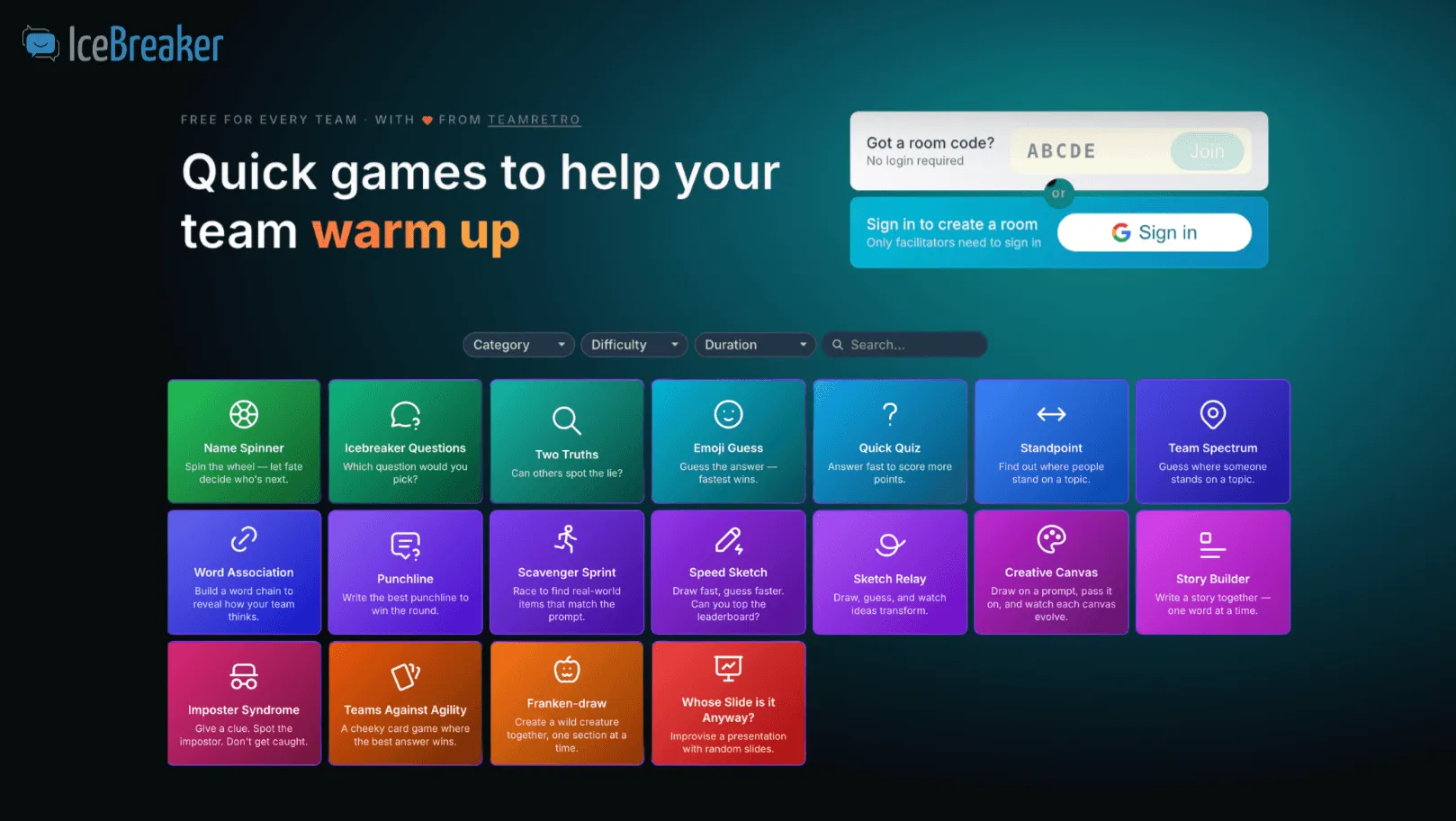
Some formats that work well:
- Icebreaker Questions: choose from a category, create your own, or let AI generate something new. Spin the wheel to see who goes next.
- Emoji Guess: emojis appear one by one to reveal a hidden answer. Race to guess it first. Fast, competitive, and works great before a standup.
- Imposter Syndrome: everyone gives a one-word clue based on a secret image, but one person saw something different. Use the clues to vote out the impostor.
- Franken-draw: each person draws a hidden section of a creature without seeing the others. Stitch them together at the end for chaotic results. Great for team days and kickoffs.
- Teams Against Agility: a cheeky card game where you submit your funniest answer to a prompt and the judge picks the winner. Perfect for end-of-sprint wind-downs.
All free, no sign-up needed for participants: just share the link and play at games.teamretro.com.
Would you rather: agile edition
- Would you rather have no sprint deadlines ever, or always have a perfectly clear backlog?
- Would you rather pair-program all day or work in complete silence?
- Would you rather have a two-hour retrospective with no action items, or a 10-minute one with three?
- Would you rather never have another blocker, or have blockers that always resolve in under an hour?
- Would you rather run every meeting as an async video, or never have another async update?
- Would you rather be the best estimator on the team or the best facilitator?
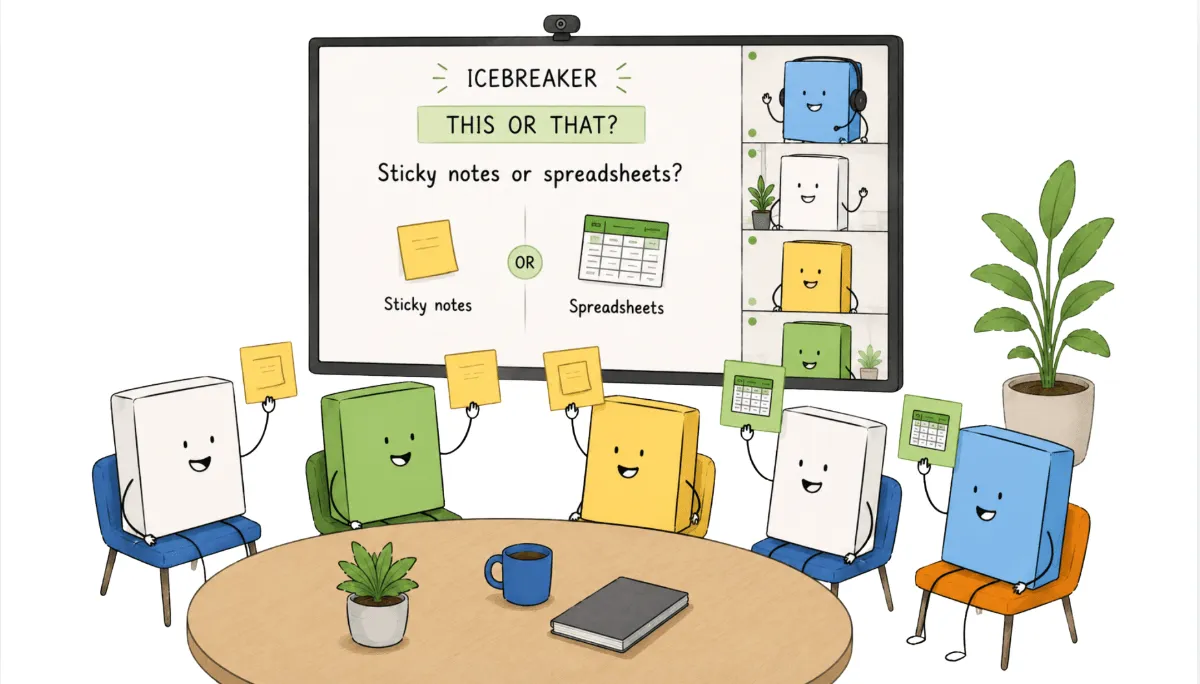
This or that: quick warm-ups
- Kanban or Scrum?
- Async standup or live standup?
- Sticky notes or spreadsheets?
- Two-week sprints or four-week sprints?
- Verbose tickets or minimal tickets?
- Story points or t-shirt sizing?
- Sprint demo to stakeholders or skip it and ship?
How to use a question of the day for work
A question of the day for work is a simple recurring ritual: one rotating icebreaker question, answered by everyone, at the start of your regular meeting. Done consistently, it builds the kind of team knowledge that pays off in planning sessions, hard conversations, and the retrospectives that actually move things forward.
The science backs this up: research from Strategy+Business shows that the sooner someone speaks at the start of a meeting, the more they contribute throughout. Getting people talking in the first few minutes isn’t a warm-up formality. It actively shapes the whole session.
The question of the day works best when it’s:
- Owned by whoever is facilitating that day, not always the scrum master
- Drawn from a shared bank the whole team contributes to
- Time-boxed: 60 to 90 seconds maximum
- Optional to answer: passing is always fine
Consider building a simple rotation: each team member picks one question per week, posted in Slack before the standup. Over a few sprints, you end up with a team artifact that reflects your culture. For async teams, this works especially well: posting the question in Slack before the meeting gives quieter members time to think before they’re asked to answer live.
How do you use icebreakers in sprint retrospectives?
A sprint retrospective icebreaker sits right at the start of the retro, before brainstorming begins. The goal isn’t entertainment. It’s to lower the emotional temperature in the room so people feel safe enough to be honest about what went wrong.
Here’s how to run one effectively:
- Pick a question that matches the tone of the retro. If the sprint was rough, go warm and personal. If the team is in a good place, something playful works well.
- Answer it yourself first. This sets the tone and models the openness you’re hoping to see.
- Use a name spinner to decide who goes next. TeamRetro’s icebreaker tool does this automatically so no one is put on the spot.
- Time-box it. Two to three minutes is usually enough. Set a visible timer and stick to it.
- Transition clearly. Once everyone has answered, acknowledge it and move into the retro. The energy carries over.
Should scrum teams use icebreakers every sprint?
Yes, but keep them short and varied. The risk isn’t overusing icebreakers, it’s using the same one every sprint until it becomes a formality people zone out through.
Here’s what a healthy rotation looks like in practice:
- Standup icebreaker questions every few days, drawn from a shared bank so it never feels repetitive
- A new sprint retrospective icebreaker each retro, matched to the format you’re running
- Deeper team bonding questions and agile team building activities at kickoffs, team days, or when someone new joins
Teams that do this consistently tend to have higher psychological safety, more honest retrospectives, and fewer people “on mute but not really there.” It’s a small habit with a compounding return.
Icebreaker for remote and hybrid agile teams
That applies to remote and hybrid teams too, arguably even more so. Without the casual hallway conversations and visible body language of an office, those two minutes at the start of a meeting often carry more weight than they would in person.
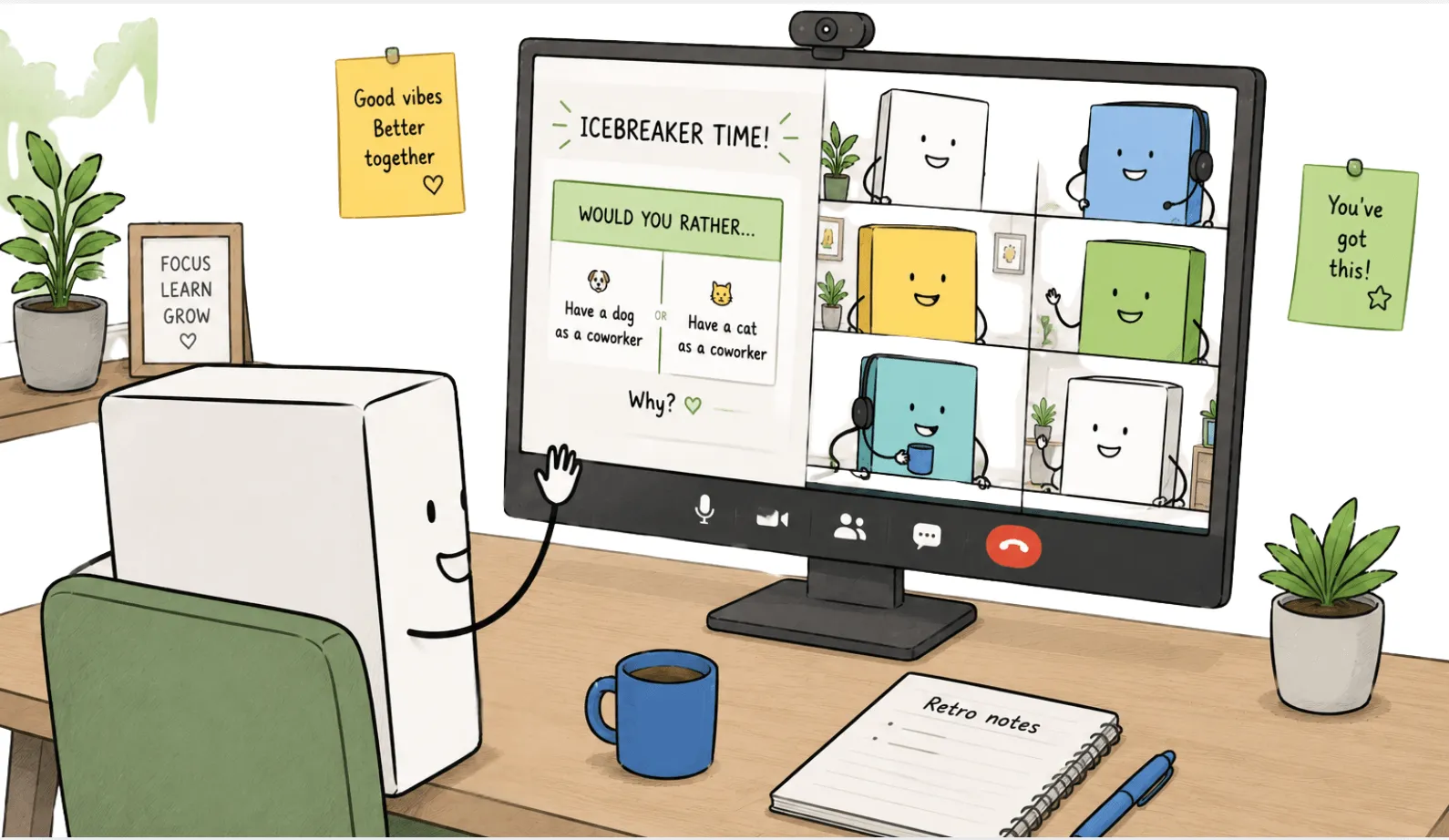
Check out our dedicated post on virtual icebreakers for remote teams for a full list of activities designed for the online space, and our broader guide on running great retrospectives with remote and distributed teams.
Ideas that work well online
- Visual prompts: “Hold up something on your desk that represents how you’re feeling” gets people off mute and on camera.
- Async questions of the day: post in Slack before the meeting so quieter team members can think and respond at their own pace.
- Polls and reactions: “Beach or mountain cabin? Drop an emoji” gets everyone interacting without putting anyone on the spot.
Remote-specific icebreaker questions
- What’s your current background noise?
- Show us something in your workspace that you actually like.
- What’s the best thing about working from where you work right now?
- If your home office had a name, what would it be?
- What’s your go-to WFH beverage, and how many have you had today?
- What’s the strangest thing that has ever appeared on screen during one of your calls?
- One skill that helps you work remotely that you didn’t expect to need:
Wrapping up: small questions, big impact
Icebreaker questions aren’t about forcing fun. They’re about creating the conditions for real collaboration. People perform at their best when they feel safe enough to take interpersonal risks, and that starts long before the hard conversations happen.
Start small. Pick one standup icebreaker question or a sprint retrospective icebreaker and rotate it. Watch what happens over a few sprints. The teams with the most honest retros and the healthiest sprint rhythms are almost always the ones that also take two minutes at the start of every meeting to actually connect as people.
Want to go further? Here are the best places to start:
- How to run an icebreaker: step-by-step facilitation guide
- Virtual icebreakers for remote teams: activities designed for the online space
- Quick icebreakers to launch your next retrospective: matched to specific retro formats
- What makes the best icebreakers for teams: the research behind why they work
- Top 5 tips for running effective icebreakers: practical tips for facilitators
- Fun retrospective ideas: agile team building activities for when you want to mix it up
- TeamRetro icebreaker tool: free tool with name spinner, timer, and AI questions built for agile teams
TeamRetro makes it easy to run collaborative retrospectives with everyone contributing honestly, whether they’re in the room or dialing in from the other side of the world. Icebreakers are built in so you never have to start from scratch.
💡 Ready to run your next icebreaker? Try it free at games.teamretro.com →
Related posts
- July 18, 2026The best team health check tools in 2026

- July 18, 2026Our AI teammates joined our retro

- July 16, 2026AI in Agile Project Management: What Teams Need to Know
- July 13, 2026Context engineering needs a feedback loop

- July 13, 2026How to gather feedback from your AI agents

- June 19, 2026The best collaboration tools for remote teams in 2026 (and the layer most stacks miss)

- June 8, 202650+ teamwork quotes to motivate and inspire your team

- May 25, 2026Agile maturity assessment: how to measure and improve your team