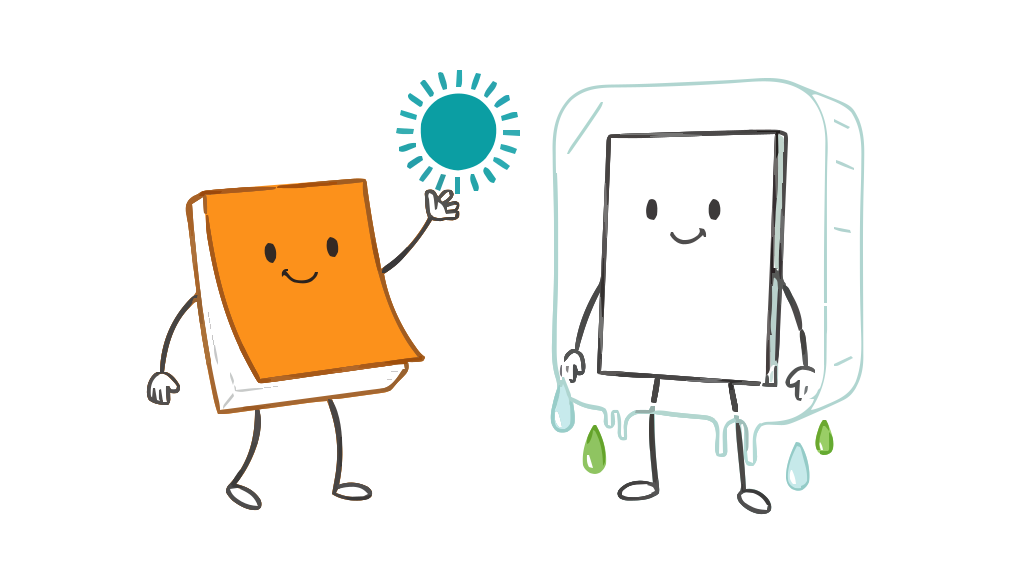
How to defrost a team (even one that hates icebreakers)
Defrosting a team means warming up a cold, new, or distributed group so it can perform. The mechanism: icebreakers thaw, check-ins sustain, charters refreeze.
Defrosting a team means deliberately warming up a cold, new, or distributed group so it can do real work together. A guarded team sits in a frozen equilibrium: people hold back and wait to see who is safe. Defrosting lowers that guard on purpose, through icebreakers, then recurring check-ins, then norms, until honest work can start.
Most advice files warming up a team under nice-to-have, a thing you bolt onto the front of a meeting when there is time. It is closer to a prerequisite. You cannot norm a team you have not thawed, and no process fixes a room where nobody trusts anyone enough to disagree out loud. This chapter is the mechanism behind that, plus an honest account of when the whole idea backfires.
A cold team is a frozen equilibrium
The thaw metaphor comes from the Lewin–Schein tradition of change. Kurt Lewin described group behavior as a balance of forces that holds a team in a steady state until something disturbs it. The tidy slogan people quote from that tradition, unfreeze then change then refreeze, was assembled by others after Lewin died in 1947, so it is fairer to credit the lineage than to call it Lewin’s model.
A new or wary team is frozen. People are polite and careful, they protect themselves by staying quiet, and the group holds an equilibrium that looks calm while producing nothing honest. To change how the team works, you have to unfreeze it first.
Edgar Schein sharpened what unfreezing takes. In his account, people let go of a safe status quo only when staying put becomes more uncomfortable than changing, and that shift needs enough psychological safety for someone to risk looking incompetent while they learn. Warming up a team is that safety, built on purpose. Amy Edmondson’s field study of 51 work teams supplies the modern evidence: teams that feel safe are associated with more learning behavior, which is what lets people speak up. We go deep on this in building trust and psychological safety; here the point is narrower. The thaw is what turns forming into norming, instead of leaving conflict to fester underground.
Icebreakers thaw, charters refreeze
That gives you a plain mechanism with three moves. Icebreakers thaw, charters refreeze, and the check-ins in between stop the team freezing solid again.
Icebreakers are the unfreeze step
An icebreaker earns its place by lowering defensiveness, so the first honest sentence costs less than it would in a cold room. Fun is a bonus, not the job. A short round of check-in questions or a quick game of Two Truths and a Lie does one useful thing: it gets everyone to speak early, so the silence breaks before the stakes are high. If people stall on inventing statements, seed the round from a bank of two truths and a lie ideas. There is a real difference between a warm-up and an icebreaker, and it pays to pick the right one for the moment.
Treated as filler at the top of a call, an icebreaker is a tax on time. Treated as the deliberate move that lets forming begin, it is five minutes that pays for itself. You will find a catalog of formats in the icebreakers library, and you can run most of them live with a remote team.
Check-ins are the recurring thaw
A team does not thaw once and stay warm. Left alone it refreezes, because people get busy and drift back to guarded. A short check-in at the top of each meeting is the recurring thaw, a low-cost ritual that keeps the group warm without a big event. The science behind a good check-in question is that it asks for a small, real answer anyone can give without performing.
Norms and charters are the refreeze
Once a team is warm and disagreeing productively, you want to lock that state in. That is the refreeze. A team charter captures the norms the team just discovered it needs: how decisions get made, how disagreement gets aired, what counts as a reasonable response time. Writing them down is how you turn agreements into culture instead of good intentions that fade by Friday. We cover the full session in team norms and working agreements.
Here is the counterintuitive part. A team refreezes every time membership changes, so the day a new person joins you are back near forming and the charter needs a re-thaw. That is not the model breaking. As we argue in the stages of team development, Tuckman describes a team, it does not predict one, and it resets to forming the day someone new joins. Re-thawing on purpose is the maintenance that keeps the reset short.
Why so many people hate icebreakers
Plenty of readers will get this far and think their team would rather eat glass than sit through an icebreaker. They are right to be wary. Acas found that team-building is the most disliked workplace social activity, with 31% of employees saying they dislike it. Forced fun has a bad name for good reasons.
The problems are specific. A mandatory round of personal questions is emotional labor dressed up as a game, and “share your greatest fear” is a bad ask at work. The format tilts toward extroverts, rewarding whoever is comfortable performing and putting quieter people on the spot in front of an audience. It often runs before any real work, so it reads as a cost rather than a way into the task. And it quietly excludes people: introverts, non-native speakers who need a beat to compose a sentence, and anyone who finds public disclosure uncomfortable all pay a higher price for the same exercise.
The skeptics also have a real alternative worth taking seriously. What builds connection, in their experience, is shared real work, like pairing on a hard problem or walking through a design review together, plus optional low-stakes social that people can skip without penalty, and short opt-in check-ins that stay close to the work instead of mining for feelings. Connection grows out of good work and real autonomy. You cannot put it on a calendar.
None of this kills the unfreeze step. It disciplines it, which is exactly what icebreakers built for teams that hate icebreakers are for.
| Forced fun that backfires | The version that works |
|---|---|
| Mandatory, performed in front of the group | Optional, easy to sit out |
| Deep personal disclosure (“your biggest fear”) | Small, work-adjacent, low-stakes |
| Bolted on before the real work | Woven into shared real work |
| Answer live, on the spot | Written first, so quieter voices land equally |
Keep the icebreaker short and opt-in, stay close to the work, and never force vulnerability. A check-in a burned-out engineer will not roll their eyes at is one that asks for a work signal rather than a confession. This or That, where everyone marks where they stand between two options and the answers reveal at once, is the kind of low-stakes format that clears this bar, because nobody has to disclose anything they would rather keep private.
Remote teams start colder and refreeze faster
Distributed teams begin colder than co-located ones. There is no hallway and no coffee queue, so there is no ambient sense of who a colleague is. New remote teams get moving on swift trust: members extend trust up front on the assumption of competence, then verify it through the work. It is enough to start with.
But swift trust is on loan. Jarvenpaa and Leidner’s study of global virtual teams found that trust at a distance is “very fragile and temporal”, forming fast and decaying fast without steady communication. Swift trust gets you moving; it does not keep you warm.
That is the whole argument for cadence. A co-located team gets its recurring thaw from the building for free. A distributed team has to schedule it, which is why warmth at distance has to be a weekly rhythm. One good ritual you run every week beats one great offsite you run every quarter. Reach for virtual icebreakers built for a screen, and treat the check-in as non-negotiable rather than the thing that gets cut when the agenda is full. We go deeper on the distributed case in remote and distributed team dynamics.
It also helps to measure the thaw rather than assume it. A quick team health check tells you whether the team feels warm, not just whether you ran the ritual, and it will flag a group that is quietly refreezing while everyone nods along on the call.
Defrosting is not a project you tick off. It is maintenance. The teams that stay warm are the ones that made the thaw boring and regular, then wrote down what good behavior looks like so it survives the next reorg. Icebreakers thaw, charters refreeze, and the check-ins in between are what keep a team from having to start cold twice.
Frequently asked questions
What does it mean to defrost a team?
Defrosting a team means deliberately warming up a cold, new, or distributed group so it can do honest work together. A guarded team sits in a frozen equilibrium where people hold back and wait to see who is safe. Defrosting lowers that guard on purpose, through icebreakers, recurring check-ins, and written norms.
Do icebreakers work, or are they a waste of time?
They work when they are used as an unfreeze step rather than as entertainment. A short, low-stakes icebreaker gets everyone to speak early, which lowers defensiveness before the stakes rise. They fail when they are mandatory, force personal disclosure, or eat time before real work. Keep them short and optional, and stay close to the work.
What works better than icebreakers if your team hates them?
Skeptics are usually right that shared real work builds more connection than forced fun. Pair people on a hard problem, run a design review together, and keep any social optional and low-stakes so people can skip it without penalty. Short, opt-in check-ins that stay close to the work beat deep personal disclosure. Connection grows out of good work rather than a scheduled event.
How do you warm up a remote or distributed team?
Remote teams start colder and lose warmth faster, because swift trust forms and fades quickly without steady contact. So make warmth a cadence rather than an event: a short check-in at the top of every meeting, virtual icebreakers built for a screen, and a written charter everyone can see. Measure it with a periodic team health check.