100+ Two Truths and a Lie ideas & examples (work-safe)
A free bank of 100+ Two Truths and a Lie ideas and examples: work-appropriate, funny, travel, food, and remote-team statements, plus how to play, believable lies, and facilitator tips.
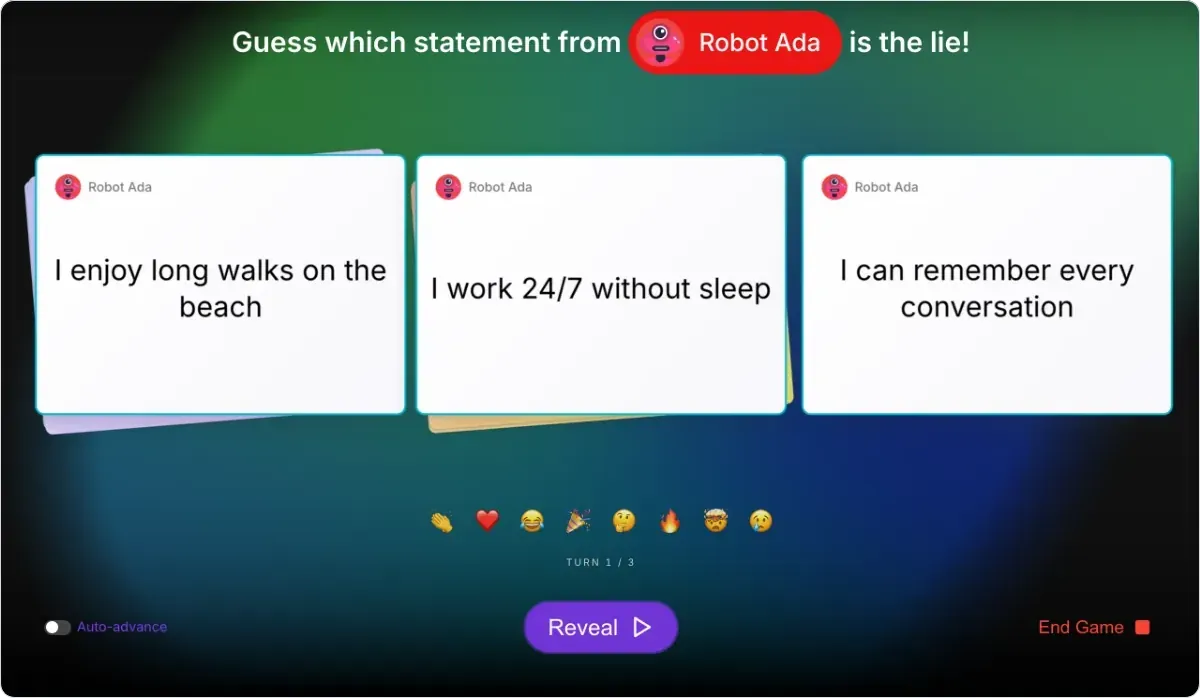
Free, with robot players and no sign-in. When you're ready, start a real game and your team joins from a link.
Running a retro or standup? TeamRetro has icebreakers built in. See it inside TeamRetro
Two Truths and a Lie is the icebreaker where each person shares three statements about themselves (two true, one false) and the group guesses which one is the lie. It needs no materials, works with three people or thirty, and the guessing does the real work: people ask follow-up questions, learn surprising things about each other, and laugh at how convincingly a colleague can fib. The hardest part is thinking of good statements on the spot, so don't. Pick from the 100+ ideas below, grouped by theme, all safe for a work setting. TeamRetro is an online retrospective, team health check, estimation, and standup tool built for Scrum Masters, agile coaches, and team leads running remote, hybrid, or in-person agile teams.
How to play Two Truths and a Lie
The rules take thirty seconds to explain. A full round runs about two to three minutes per person, so a team of eight is done in twenty minutes, or split a bigger group so nobody waits.
- Write your three statements: each player thinks of two true things about themselves and one believable lie. Jot them down so the wording stays steady when it is your turn.
- Take turns sharing: one player reads out all three statements in any order, keeping an even tone so nothing gives the lie away.
- Let the group interrogate: allow a minute of follow-up questions. Liars have to improvise details on the spot, and that is where both the fun and the clues are.
- Vote on the lie: everyone guesses which statement is false, out loud, on fingers, or in the chat on a video call.
- Reveal and score: the player reveals the lie. A point to each correct guesser, and a point to the storyteller if most of the room got it wrong.
- Rotate until everyone has played: with more than ten people, split into breakout groups of four to six so a full round stays under fifteen minutes.
Work-appropriate ideas
Statements about jobs, careers, and office life: specific enough to be interesting, safe enough for any meeting. Use them as written if they happen to be true for you, or as a template for your own.
- My first job was washing dishes in a restaurant kitchen.
- I once sent a company-wide email that was meant for one person.
- I applied for this job twice before I got it.
- I have never had a job interview over the phone.
- I once fell asleep in a meeting, and nobody noticed.
- I have worked in four completely different industries.
- I taught myself the main skill I now use in my job.
- I once worked night shifts for a full year.
- My commute used to take two hours each way.
- I was once interviewed on local TV about my job.
- I have eaten the same lunch almost every workday for a year.
- I still have the first payslip I ever earned.
Funny ideas
Small embarrassments and odd claims that get a laugh whether they turn out to be the truth or the lie.
- I once got stuck in an elevator with my boss for an hour.
- I have been mistaken for a celebrity more than once.
- I once won a karaoke contest without knowing the song.
- I locked myself out of my house twice in the same day.
- I once wore two different shoes to work and didn't notice until lunch.
- I have never learned to ride a bike.
- I once called my teacher 'Mum' in front of the whole class.
- I can quote an entire film from memory.
- I once waved back at someone who was waving at the person behind me.
- My ringtone has not changed in ten years.
- I once entered a competition and won because I was the only entrant.
- I have appeared in the background of a TV news report.
- I cried at an animated film in the last year.
- I still can't snap my fingers.
Travel ideas
Trips, mishaps, and places: a rich seam because travel stories are hard to verify and fun to interrogate.
- I have been to more than ten countries.
- I once missed a flight because I was asleep at the gate.
- I have never seen snow in real life.
- I got food poisoning on the first day of a dream holiday.
- I once drove across the country with no working radio.
- I hiked to the top of a mountain in sandals.
- I lost my passport the day before an international trip.
- I have ridden a camel.
- I once spent the night sleeping in an airport.
- I am nervous about flying but have flown more than fifty times.
- I accidentally joined a walking tour in a language I don't speak.
- I have swum in three different oceans.
Food ideas
Everyone eats, so everyone has an opinion, which makes food statements easy to challenge and fun to defend.
- I have never tried sushi.
- I once ate the same dinner every day for a month.
- I am a genuinely good baker.
- I can't stand chocolate.
- I once entered a chili-eating contest.
- I grow my own vegetables.
- I have eaten insects (on purpose).
- I drink at least five cups of coffee a day.
- I once set off a smoke alarm making toast.
- I discovered a food allergy as an adult, in a restaurant.
Want one at the start of every retro? TeamRetro can open it with one. See how
Hobbies, skills, and hidden talents
The statements that make a team go 'wait, really?' Hidden talents are the reason this game is worth playing.
- I can play three musical instruments.
- I have a black belt in a martial art.
- I can solve a Rubik's cube in under two minutes.
- I used to be in a band.
- I can say the alphabet backwards.
- I once knitted an entire blanket.
- I can juggle.
- I have written a novel that nobody has read.
- I can wiggle my ears.
- I collect something most people would find odd.
Childhood and growing up
School days and family stories: distant enough that even close colleagues can't fact-check them.
- I was born in a different country from both of my parents.
- I won a spelling bee in primary school.
- I had an imaginary friend until I was eight.
- I broke my arm falling out of a tree.
- I was the tallest kid in my class every single year of school.
- I once ran away from home, and made it to the end of the street.
- I grew up in a town with fewer than a thousand people.
- I have never broken a bone.
- I was the mascot for my school's sports team.
- My family still calls me by my childhood nickname.
Sports and adventure ideas
Feats, near-misses, and the occasional confession: modest claims are more believable than heroic ones.
- I have run a marathon.
- I once scored an own goal in a cup final.
- I have been skydiving.
- I can't swim.
- I once beat a professional athlete at their own sport, briefly.
- I have climbed a mountain higher than 4,000 meters.
- I own a real (if obscure) sporting trophy.
- I completed a fun run in fancy dress.
Found one you like? Try the game with robot players, no sign-in. Try it now
Ideas for remote teams
Statements about home offices and video-call life, made for a distributed team playing over a call, where the lie can be sitting just out of frame.
- There is a hidden mess just outside my webcam frame right now.
- I once took a video call from a supermarket without anyone noticing.
- I have never worked from a café.
- My desk chair is the most expensive thing in my home office.
- I keep a snack drawer within arm's reach of my desk.
- I once delivered an entire update before realizing I was on mute.
- I own a work shirt that has never been ironed below the shoulders.
- My laptop wallpaper has not changed in five years.
Believable lies
The best lie is boring. Grand claims get challenged; small, plausible, hard-to-verify statements slip through. Any of these makes a solid lie, or a truth nobody believes.
- I once met a famous person in an airport.
- I'm allergic to cats.
- I have never had a cavity.
- I was on my school's debate team.
- I have read every book on my bookshelf.
- I don't like coffee.
- I was an extra in a film.
- I can drive a manual car.
- I once won money in a raffle.
- I speak a second language (badly, but proudly).
- I have run a 10k race.
- I have never lost my phone.
Want one at the start of every retro? TeamRetro can open it with one. See how
Complete example rounds
Eight worked examples: each is a full set of three statements with the lie revealed, so you can see what makes a round hard to crack.
- I have never eaten a McDonald's burger · I ran a half-marathon last year · I have three older brothers. The lie is the half-marathon. Two oddly specific truths make an ordinary lie hard to spot.
- I can solve a Rubik's cube · I once shook hands with a head of state · I am scared of butterflies. The lie is the Rubik's cube. Burying a plain lie between two strange truths is the classic move.
- I was born on a leap day · I have never watched Titanic · I used to teach swimming. The lie is the leap day. A calendar fact sounds too specific to invent, which is exactly why it works.
- My first car cost three hundred dollars · I have been scuba diving · I am banned from a friend's board-game night for winning too much. The lie is the scuba diving. The joke statement is true, and that is the fun of it.
- I speak conversational Japanese · I have never been stung by a bee · I once camped alone for a week. The lie is the bee sting. 'Never' statements are hard to disprove, which makes them good lie material.
- I appeared in my university's prospectus · I hate ice cream · I have run out of fuel on a motorway twice. The lie is hating ice cream. Strong opinions are easy to fake but easy to interrogate. One follow-up question usually cracks them.
- I have broken the same arm twice · I met my best friend in a lost-luggage queue · I have read The Lord of the Rings five times. The lie is the book count. Numbers are the easiest detail to inflate.
- I keep a plant alive that is older than my career · I have never used a selfie stick · I won a regional quiz championship. The lie is the quiz. Modest achievements are more believable than grand ones.
Tips for facilitators
Small adjustments that keep a round quick, inclusive, and safe for a work setting.
- Give thinking time up front: announce the game a few minutes early, or share this page, so nobody is inventing statements under pressure while others wait.
- Go first yourself: a facilitator round sets the register. If your statements are playful and work-safe, everyone else's will be too.
- Coach toward small lies: the giveaway lie is the impressive one. Nudge players toward plausible, minor claims (see the believable-lies list above).
- Vote in the chat on video calls: simultaneous chat votes stop early guesses anchoring the room, and quieter people vote as loudly as anyone.
- Time-box each turn: two to three minutes per person, questions included. The game gets funnier at pace, not slower.
- Split groups larger than ten: breakouts of four to six keep everyone guessing instead of waiting.
- Keep the themes safe: steer statements toward hobbies, travel, food, and childhood, and away from health, relationships, or anything about people in the room.
- Follow the surprises: the best truths ('you were in a band?') are conversation starters. Leave a minute at the end to chase one or two.
Two Truths and a Lie earns its place as the default get-to-know-you icebreaker because the guessing does the work: people have to ask questions, listen closely, and defend a hunch, which is a conversation, not a formality. The ideas above are grouped by theme so you can hand a team something better than “think of three facts about yourself” and watch the round stall. Start with the work-appropriate and funny groups for a meeting opener, or the remote-team group for a video call.
To run it live with your group, play Two Truths and a Lie free in the browser; it collects everyone’s statements and handles the voting, with no signup for players. For more ways to open a meeting, browse our icebreaker questions for work, grab a quick round from funny icebreaker questions, or see the full library of icebreaker questions and games by use case.
Frequently asked questions
How do you play Two Truths and a Lie?
What are good Two Truths and a Lie ideas?
How do you come up with a good lie?
Is Two Truths and a Lie appropriate for work?
How do you play Two Truths and a Lie on Zoom or with a remote team?
How many people do you need, and how long does it take?
Pick the right icebreaker for your next meeting
A free list of 100+ agree-or-disagree questions and statements: workplace, funny, food, tech, remote-work, and deeper debate prompts for team warm-ups, with facilitator tips and how to run one.

A free list of question-of-the-day ideas for work: fun, daily check-in, and get-to-know-you questions to open a standup, meeting, or remote team chat in seconds.

A free list of 100+ would-you-rather, this-or-that, and either/or questions: quick binary-choice icebreakers for work, adults, and remote teams. Funny, deep, and work-safe.

Free Christmas icebreakers for work, including would-you-rather, this-or-that, trivia and games for meetings, virtual parties and end-of-year retros.

Over 200 icebreaker questions for work, grouped by what you want to happen next: a new team, a remote call, a quick opener, or a real conversation.

A free collection of icebreaker games for team meetings, work, and remote video calls: quick, no-prep, and large-group activities you can run in minutes.

Virtual icebreakers and remote team-building games that work on video calls and in chat: quick questions, Zoom-friendly games, and async prompts you can run free in seconds.
A free list of 90+ check-in questions for meetings and teams: quick opening, closing, mood, fun, remote, and end-of-sprint prompts to read the room, build psychological safety, and get every voice heard.
A free list of funny, silly, and weird icebreaker questions for work and team meetings: work-safe prompts that get people laughing and talking in seconds.
Icebreaker questions and quick exercises for every meeting type: team meetings, staff meetings, standups, one-on-ones, kickoffs, and tense-topic meetings.

25 team building games for work, grouped by what you want out of them: bonding, learning, or energy. Each one has a time, a group size, and how to run it.