
From awkward to awesome: the science to good check-in questions
Read how well-crafted check-in and check-out questions can turn awkward meetings to awesome ones and boost engagement and safety.
Ever started a retrospective with “How’s everyone doing today?” and been met with silence or a shrug?
You’re not alone. While check-in questions and check-out questions might seem like small talk, they’re actually powerful tools for creating engagement, psychological safety, and continuous improvement in Scrum teams.
That’s why TeamRetro has built-in features to help Scrum Masters bring intention to how they open and close every meeting.
In this post, we’ll explore:
- The psychology behind check-in and check-out questions.
- TeamRetro’s built-in options and how to use them.
- How to turn one-off responses into long-term insights.
- Tips for getting more value from your retros.
The science behind good check-in questions
What makes check-in questions so powerful in Agile retrospectives? It comes down to the science of human behavior and team dynamics.
1. Priming for participation
A small early contribution makes people more likely to speak up later. This is known as the foot-in-the-door effect, a well-documented psychological phenomenon. Freedman & Fraser, 1966.
2. Cognitive framing
The way a conversation starts frames how people think, speak, and respond throughout. A focused check-in sets the tone for constructive dialogue, feedback, and idea generation.
3. Belonging and trust
Simple questions that invite open, honest input create space for team members to feel seen, heard, and valued.
Agile thought leaders like Esther Derby, Lyssa Adkins, and Johanna Rothman all emphasize the role of team connection and psychological safety in effective retrospectives.
Check out questions: the counterpart
At the same time, a check-out question also offers its own benefits.
1. Closure and cognitive framing
Check-out questions create a clear endpoint, allowing participants to mentally “package” what they’ve learned. According to Gestalt psychology, humans naturally seek closure. Offering a moment to reflect enhances information retention.
2. Shared experience and group cohesion
Asking everyone to share a final thought reinforces a sense of belonging and psychological safety. Social identity theory (Tajfel & Turner, 1979) shows that shared rituals like closing rounds can strengthen group identity.
3. Reflection and meta-cognition
Check-out questions prompt people to think about their own thinking. This encourages deeper learning and helps participants retain what was discussed. This deepens learning and self-awareness, key principles in Agile coaching as highlighted by Lyssa Adkins and Jurgen Appelo.
4. Priming for action
A well-crafted check-out can subtly prepare the brain for future behavior. Asking what people will apply or do next builds a sense of accountability and encourages follow-through.
In either case, the key aspects of a good question are that they are:
- Short and to the point – this is not to open up or facilitate deep discussions.
- Fast and quick – we are just collecting some quick data points in order to get a team pulse check, not an ideation.
- Designed to give feedback – not to solve a problem.
Together, these questions can transform your retrospective from a checklist item to a meaningful team ritual.
“The most powerful tool we have as leaders is the question.” – Brene Brown
TeamRetro’s built-in check-in questions, and what they reveal
TeamRetro offers five built-in check-in questions to help you set the tone at the start of your meeting. Each one taps into a different aspect of team health and collaboration.
| Check-In Question | What It Captures | Why It Matters |
|---|---|---|
| Energy level | Team’s physical or mental energy coming into the meeting | Helps gauge readiness and informs pacing or tone of the session |
| Weather Report | Team’s mood or sentiment about the last sprint | Highlights morale and signals potential issues needing attention |
| Safety Check | Comfort in sharing thoughts and concerns openly | Promotes psychological safety – key to open, honest communication |
| Team Collaboration | How well the team worked together last sprint | Reflects teamwork dynamics and surfaces process or role gaps |
| Sprint Happiness | General satisfaction with the last sprint or iteration | Reveals engagement and flags deeper issues behind delivery work |
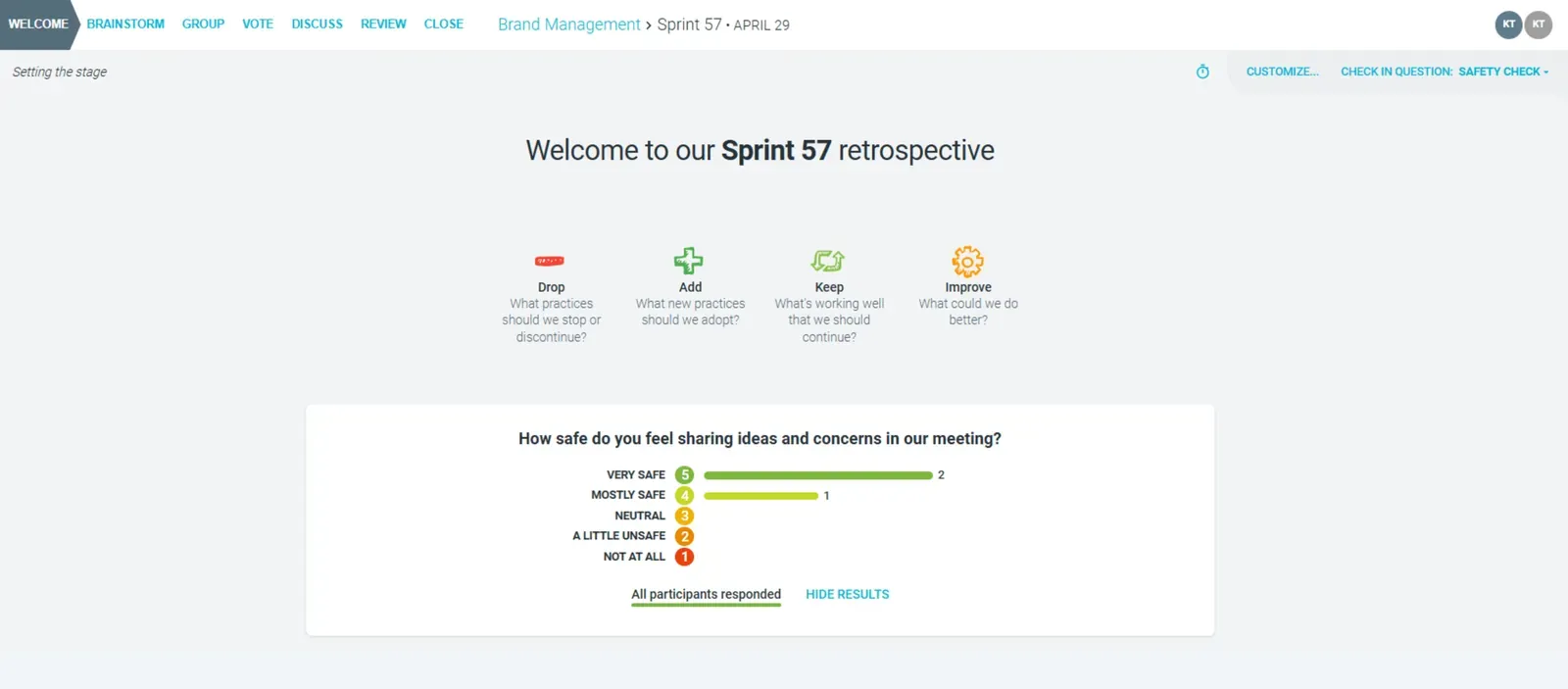
Close the loop: TeamRetro’s built-in check-out questions
At the other end of the meeting TeamRetro includes four built-in check-out questions:
| Check-Out Question | What It Captures | Why It Matters |
|---|---|---|
| Return on Time Invested | Whether the meeting was valuable and worthwhile | Tracks meeting effectiveness and ROI (shown in TeamRetro’s Insights) |
| Pulse Check | Emotional or mental state at the end of the meeting | Indicates psychological engagement and overall team sentiment |
| Delivery Confidence | Confidence in achieving sprint goals | Surfaces blockers or misalignments in team readiness |
| Retrospective Process | Satisfaction with how the retro was facilitated | Direct feedback on facilitation style and structure that supports continuous improvement |
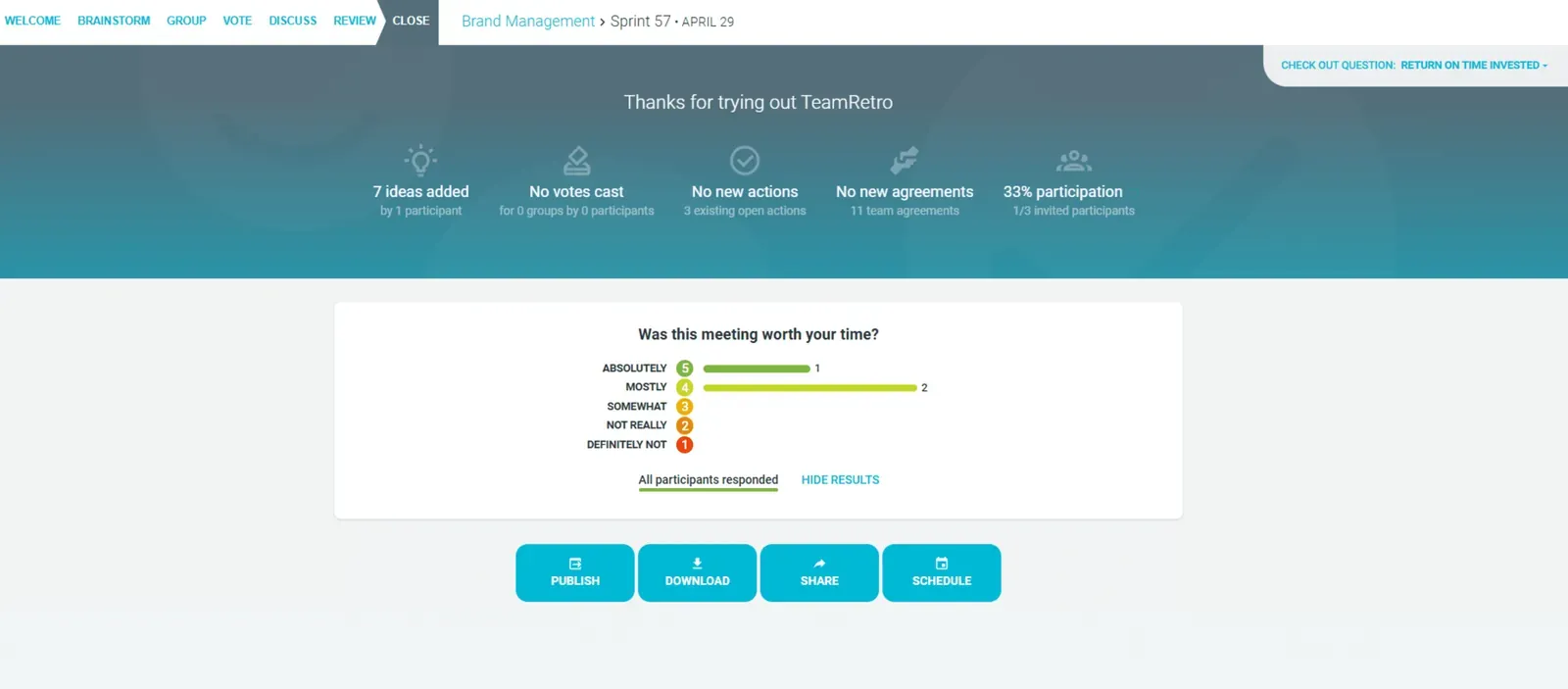
Adding these questions to your retrospective is as easy as toggling them on as a step in your retrospective and then choosing the question you would like to ask the team. See how.
Turn once-off responses into insights
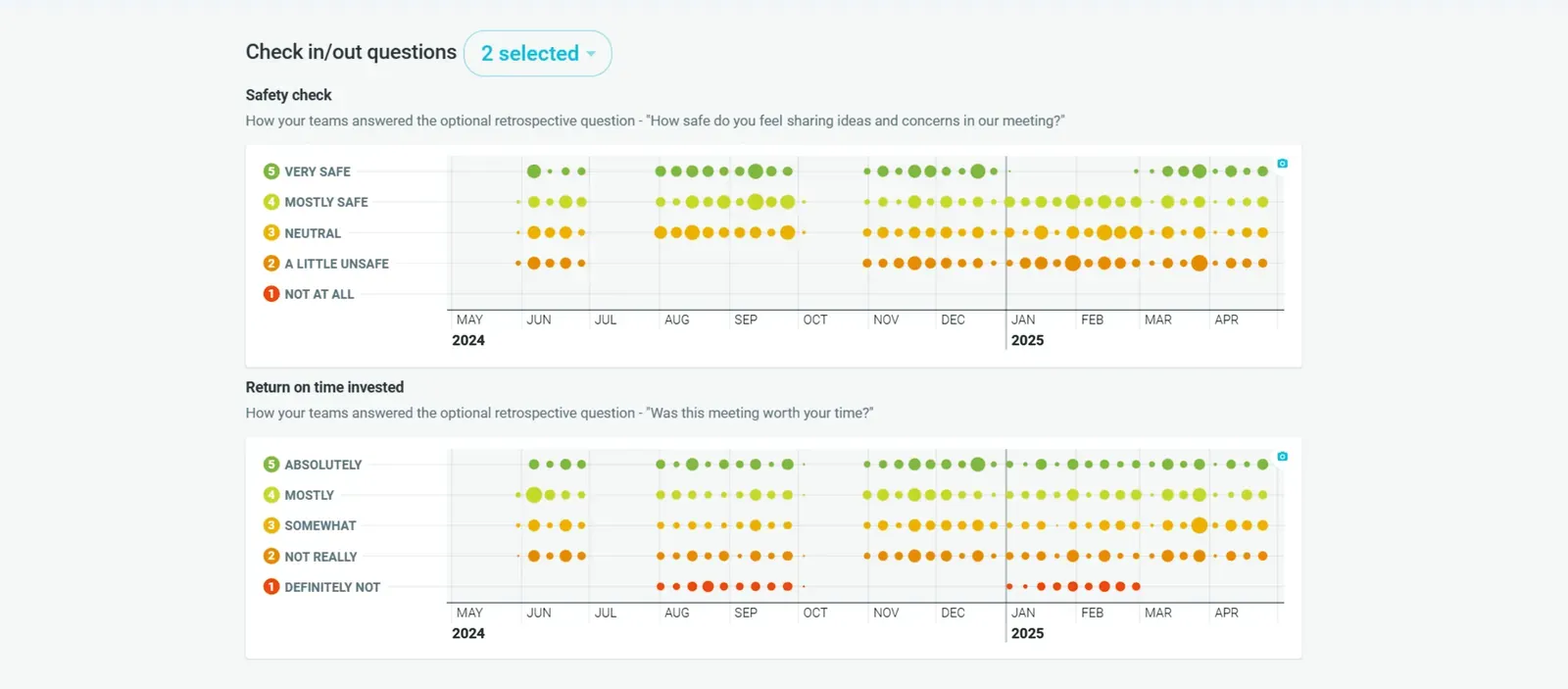
By using check-in and check-out questions regularly, you can track the emotional and cognitive pulse of your team over time. For example:
- Monitor energy levels at the start of each meeting to detect burnout early.
- Use the weather report to correlate mood with delivery confidence.
- Track retrospective process feedback to improve your facilitation style.
All this data is automatically captured in TeamRetro’s Insights tab, giving Scrum Masters and Agile coaches a clear view into team engagement trends.
Turn insight into action
Use what you learn from your insights to:
- Adjust your facilitation style.
- Acknowledge and refine what works.
- Follow up 1:1 with quiet or outlier voices.
- Change the format or timing of meetings.
- Celebrate wins or address dips in morale.
- Spot recurring blockers impacting team engagement.
Tips for Scrum Masters
Want to get the most from check-in and check-out questions? Try this:
- Rotate questions weekly to keep them fresh or if you sense a need to change the question.
- Alternatively, use the same question set if your goal is to track one metric over a period of time.
- Create a team health check to dive deeper into a specific area.
- Use the trends or results as a data point for future retrospectives.
Have a new team member? Throw in an icebreaker question into your retrospective to help open up doors for communication.
Final thoughts
Check-in and check-out questions aren’t just nice-to-haves. They’re simple but powerful tools that help teams connect, reflect, and grow. Whether measuring energy, morale, or meeting value, TeamRetro gives you the structure and insights to do it with ease.
So next time you launch a retro, don’t skip the opening question. Start strong, finish thoughtful, and watch your team open up.
👉 Try adding a check-in to your next retrospective in TeamRetro. It takes seconds and can spark conversations that matter.
Related posts
- September 23, 2026CLAUDE.md for teams: how we turned five people's AI memories into shared rules

- July 18, 2026The best team health check tools in 2026

- July 18, 2026Our AI teammates joined our retro

- July 16, 2026AI in Agile Project Management: What Teams Need to Know

- July 13, 2026Context engineering needs a feedback loop
- July 13, 2026How to gather feedback from your AI agents

- June 19, 2026The best collaboration tools for remote teams in 2026 (and the layer most stacks miss)

- June 16, 202660+ icebreaker questions for agile and scrum teams