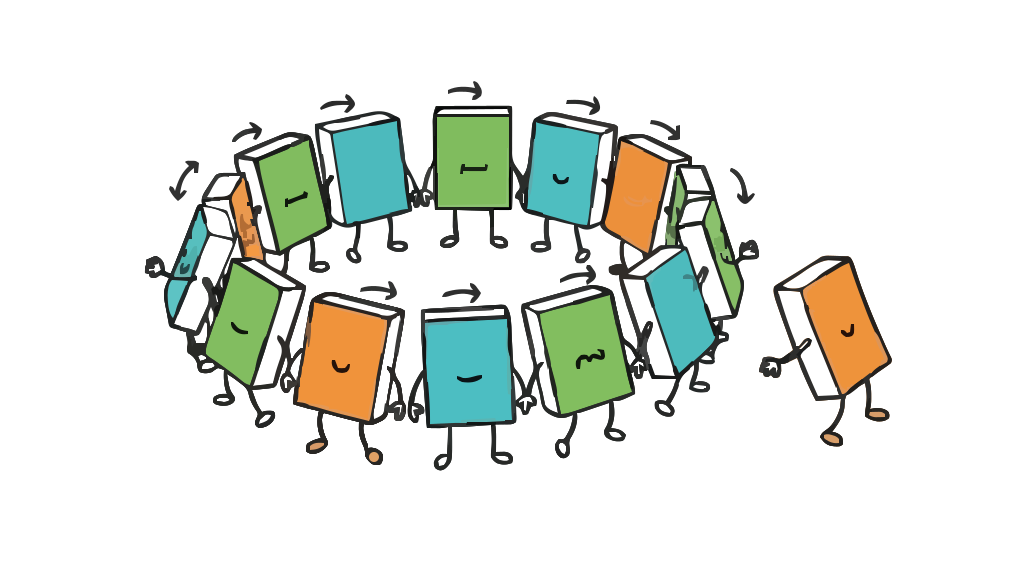
Group dynamics at work: the forces and the failure modes
Group dynamics is the study of the forces inside any group: roles, norms, cohesion, and conformity. How they shape teams at work, and how to spot groupthink.
Group dynamics is the study of the forces at work within and between groups of people, and how members influence one another’s attitudes and behavior. The psychologist Kurt Lewin coined the term in the 1940s and founded a research center for it at MIT in 1945. It is the parent field that team dynamics draws from.
The definition is where most articles stop. It is also where they stop being useful. The forces Lewin described are the same ones that let a weak decision sail through a meeting unchallenged, or a quiet expert keep their doubts to themselves while the loudest voice sets the direction. This chapter stays with those forces and what a manager does when they turn against the work.
Group dynamics vs team dynamics
Group dynamics and team dynamics get used as if they were interchangeable. They are not, and the gap matters for what you can borrow from the research.
Group dynamics is the wide field. It covers any set of people who influence each other, from a jury to a committee to a crowd. Kurt Lewin treated the group as a system with its own forces rather than a sum of the individuals in it, so changing one part of that system makes the rest shift to compensate.
Team dynamics is the workplace subset: the same forces narrowed to a small group of interdependent people who share a goal and hold each other accountable for it. For the full definition and the five things that shape a working team, start with what team dynamics are. This chapter stays at the parent level, because the classic failure modes were named here first, in the group-dynamics research, long before anyone wrote a management post about them.
The forces inside every group
Lewin’s point was that these forces operate whether or not anyone names them. Four of them do most of the work.
- Roles. Who does what, and who the group expects to do what. Roles form quickly and often without discussion, then harden. Meredith Belbin gave us a useful vocabulary for the informal roles people drift into, such as the plant who generates ideas or the finisher who chases loose ends, though his self-perception inventory has mixed psychometric support, so treat it as language rather than a test.
- Norms. The unwritten rules for how the group behaves, from expected reply times to whether it is safe to disagree in front of the boss. Norms are the most portable of the four, which is why writing them down as team norms and working agreements pays off.
- Cohesion. How tightly members bond and want to stay in the group. Cohesion builds as a team moves through its early stages, and it is mostly an asset, up to the point where the wish to stay agreeable starts to outrank the work.
- Conformity. The pull to match the group’s apparent position. Some conformity is sensible, since other people often know things you do not. The trouble starts when people conform against their own judgment because dissent feels expensive.
The first three are usually assets. The catch is that the same forces that make a group cohere can quietly degrade its judgment. That is the part the definitions leave out.
The dark side: groupthink and social loafing
Groupthink
Irving Janis studied a run of American foreign-policy disasters and asked how capable groups talked themselves into obviously bad decisions. His 1972 term was groupthink, which he defined as “a mode of thinking … when members’ strivings for unanimity override their motivation to realistically appraise alternative courses of action.”
Janis named several warning signs. Three are worth memorizing:
- an illusion of invulnerability, where the group feels too capable to fail;
- self-censorship, where members swallow their doubts to keep the consensus intact;
- mindguards, self-appointed members who shield the group from information that would disturb the emerging agreement.
Notice that cohesion is the soil groupthink grows in. A tight, agreeable team is not automatically a safe one. It can be a team where disagreement has become socially expensive.
A cheap countermeasure is to make people’s real positions visible before the group converges. You can run Team Spectrum live with your team to surface where everyone stands on a question, instead of reading a show of hands that has already tilted toward whoever spoke first.
Social loafing (the Ringelmann effect)
Around 1913, the French engineer Max Ringelmann had people pull on a rope, alone and in groups, and measured the force. Individuals pulled less hard as the group grew. The effect is now called social loafing: as a group gets bigger, the effort any one person contributes tends to drop.
At work this is the eight-person meeting where nobody owns the outcome, or the shared task everyone assumes someone else is carrying. The standard antidote is uncomfortable but effective: keep the accountable unit small, and put a named owner on every commitment. A shared task with no name against it is the one most likely to slip, so a named owner turns a group intention into one person’s job.
Conformity
Conformity is the quieter force under both of the above. People match the group for two reasons: they assume the group knows something they do not, and they would rather not pay the social cost of standing out. Both are reasonable in the moment and corrosive over time. A team that rewards agreement teaches its members to keep inconvenient information to themselves, which is the exact input groupthink needs.
How group dynamics show up at work, and what to do
You cannot order a group to have good dynamics. The forces settle on their own. What a manager changes is the conditions, and then the forces resettle around them. Four moves cover most situations.
Make dissent cheap. Groupthink and conformity both feed on the sense that disagreeing is risky. Lower that cost on purpose: ask the most senior person to speak last, collect views in writing before the discussion, or assign someone to argue the opposing case so the objection is in the room by design. A regular retrospective gives dissent a scheduled, low-stakes channel instead of leaving it to erupt or fester.
Keep the accountable unit small. Social loafing scales with group size, so resist the urge to invite everyone. Fewer people in the room, and one named owner per action, does more for follow-through than any motivational speech.
Name the roles and norms out loud. Roles and norms form whether you manage them or not. Writing them into a team charter or a set of working agreements turns invisible defaults into choices the team can inspect and change.
Build the kind of cohesion that tolerates disagreement. The goal is a team safe enough to have the hard conversation, not one where nobody ever disagrees. Google’s Project Aristotle found psychological safety to be the strongest predictor of team effectiveness in its re:Work research, building on Amy Edmondson’s original work. Healthy cohesion comes from knowing each other as people, so a short shared activity like This or That, run live, connects a group without forcing anyone to fake agreement.
You can take the temperature of these forces with a regular health check rather than guessing at them.
The honest limit
Group dynamics is a diagnostic lens, not a control panel. Naming a force does not disarm it, and every team drifts back toward its defaults the moment attention moves elsewhere. The work is ongoing: change the conditions, watch what the forces do, adjust again. That is slower than a slogan about teamwork, and it is the version that holds up. If you want the workplace application in full, read what team dynamics are; if you are ready to act, a team charter and a recurring health check are the two most useful places to start.
Frequently asked questions
What is the difference between group dynamics and team dynamics?
Group dynamics is the broad field, founded by Kurt Lewin, that studies the forces inside any group of people who influence each other. Team dynamics is the workplace subset: those same forces in a small group of interdependent people who share a goal and hold each other accountable. Team dynamics is group dynamics applied to work.
Who coined the term group dynamics?
The psychologist Kurt Lewin coined “group dynamics” in the 1940s and founded the Research Center for Group Dynamics at MIT in 1945. His central idea was that a group behaves as a system of interacting forces, not a simple sum of its members, so changing one part of a group shifts the whole.
What is groupthink and what are its symptoms?
Groupthink, named by Irving Janis in 1972, is when a group’s striving for unanimity overrides its members’ motivation to appraise alternatives realistically. Warning signs include an illusion of invulnerability, self-censorship of private doubts, and “mindguards” who shield the group from inconvenient information. The result is a confident decision that no one has stress-tested.
What is social loafing, or the Ringelmann effect?
Social loafing is the tendency for individual effort to fall as a group grows. Max Ringelmann measured it around 1913 when people pulled less hard on a rope in a team than they did alone. At work it shows up as diffused responsibility in large meetings. The fix is smaller groups and a named owner on every action.
What are examples of group dynamics in the workplace?
Common examples are the informal roles people fall into, the unwritten norms about how meetings run, the cohesion that keeps a team together, and the conformity that can silence a dissenting view. The same forces help or harm depending on the conditions, which is why managers watch for groupthink and social loafing and invest in psychological safety.