100+ agree or disagree questions & statements for teams
A free list of 100+ agree-or-disagree questions and statements: workplace, funny, food, tech, remote-work, and deeper debate prompts for team warm-ups, with facilitator tips and how to run one.
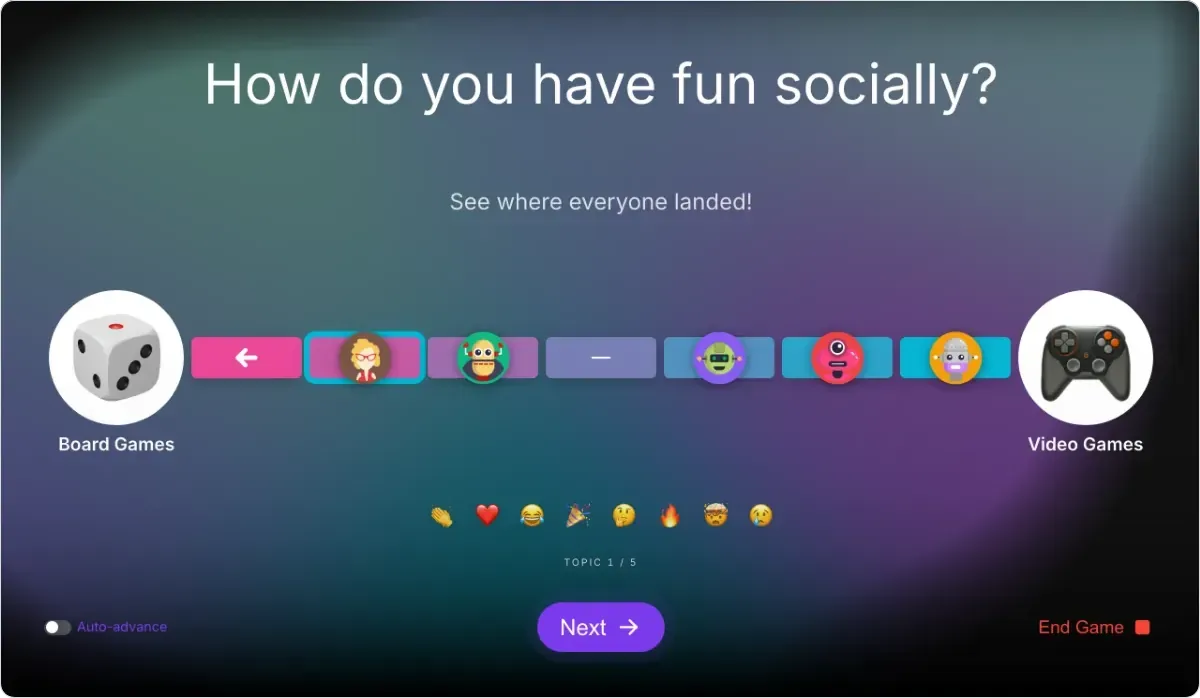
Everyone picks a spot between two answers, then you reveal where the team stands. Free. You sign in with Google, and your team joins from a link with no account.
Running a retro or standup? TeamRetro has icebreakers built in. Start a free 30-day trial
Agree-or-disagree questions are statements, not questions: you read one out ('pineapple belongs on pizza', 'most meetings could be an email') and everyone takes a side. As a team warm-up it does two useful things at once. It gets every person to commit to a position in the first minute of a meeting, which makes speaking up again later easier, and it sparks small, low-stakes debates that show how colleagues actually think. Pick a handful of statements below (light, workplace, or deeper) and you have a warm-up that runs itself. TeamRetro is an online retrospective, team health check, estimation, and standup tool built for Scrum Masters, agile coaches, and team leads running remote, hybrid, or in-person agile teams.
How to run an agree-or-disagree warm-up
No materials, no preparation: just statements and a way to vote. Five statements take about five minutes.
- Pick five to ten statements. Mix a couple of easy laughs with one or two that invite a real opinion. Skim the groups below and grab what fits your team.
- Read one statement at a time. Say it once, plainly, and resist explaining it. Ambiguity is part of the fun.
- Everyone takes a side at once. Thumbs up or down, move to opposite sides of the room, or type A or D in the chat. Simultaneous votes stop the first answer swaying the rest.
- Hear one voice from each side. Invite a sentence from one agree-er and one disagree-er. Two sentences of friendly defense is where the warm-up earns its keep.
- Keep it moving. Thirty to sixty seconds per statement, then on to the next. End on a funny one so the meeting starts on a laugh.
Agree or disagree questions for work
Statements about office life that everyone has an opinion on, safe to debate because they are about work, not about anyone in the room.
- Most meetings could be an email.
- Every meeting should have an agenda, or be canceled.
- Meetings should never be scheduled before 9am.
- It's better to be five minutes early than exactly on time.
- You should never eat lunch at your desk.
- It's fine to leave a meeting that isn't relevant to you.
- Everyone should work in customer service at least once in their career.
- A messy desk is a sign of a creative mind.
- Job titles matter more than people admit.
- The best ideas rarely arrive at your desk.
- Casual dress codes make people more productive.
- An open-plan office helps collaboration more than it hurts focus.
Fun and light statements
The classics: zero stakes, strong opinions guaranteed. Open with one of these.
- Pineapple belongs on pizza.
- Cereal is a soup.
- A hot dog is a sandwich.
- Winter is better than summer.
- Cats are better company than dogs.
- The book is always better than the film.
- Board games are better than video games.
- Breakfast food should be available all day.
- Every film is better in the cinema.
- Socks with sandals can be a look.
- Karaoke is only fun for the person holding the microphone.
- Milk goes in before the tea.
Food and everyday life
Low-stakes lifestyle takes: easy for anyone to vote on, fun for everyone to defend.
- Leftover pizza is better cold.
- A burger without cheese is incomplete.
- Coffee after 3pm is a mistake.
- Cooking at home beats eating out.
- Brunch is the best meal of the week.
- You should always order the strangest thing on the menu once.
- Spicy food is worth the pain.
- Fruit has no place on a barbecue.
- A sandwich cut diagonally tastes better.
- Dessert is worth ordering even when you are full.
Tech and internet statements
Digital-life opinions every modern team can argue about, including one or two that get surprisingly serious.
- Voice notes are better than typed messages.
- Dark mode is objectively superior.
- Autocorrect causes more problems than it solves.
- It's rude to leave someone on read.
- Physical books beat e-readers.
- Phone calls without warning are an intrusion.
- Video calls should have a cameras-on rule.
- Everyone should take one full day offline each week.
- Social media does more harm than good.
- AI will make work more human, not less.
Work habits and productivity
Statements about how work actually gets done; expect the votes to split along interesting lines.
- Multitasking is a myth.
- The best work happens in the morning.
- Deadlines make work better.
- To-do lists create more stress than they resolve.
- Notifications should be off by default.
- A four-day week would make most teams more productive.
- Busy and productive are opposites more often than not.
- Perfectionism is procrastination in disguise.
- You should never check email before breakfast.
- Working from home takes more discipline than working in an office.
Remote and hybrid work statements
For distributed teams: these double as a gentle temperature check on how your own team likes to work.
- Remote teams communicate better in writing than in meetings.
- Hybrid work is the worst of both worlds.
- Small talk matters more on a remote team, not less.
- The commute had one real benefit: a boundary between work and home.
- Async updates beat a daily standup meeting.
- An emoji reaction counts as a reply.
- Every remote meeting should start with a check-in question.
- Virtual backgrounds hide more than messy rooms.
- Working in pajama bottoms is a professional right.
- Remote onboarding can be as good as in-person onboarding.
Teamwork and meeting statements
Slightly sharper statements about how teams behave. These make excellent retrospective openers: the debate they start is usually the one the team needed to have.
- Disagreement in a meeting is a sign of a healthy team.
- Silence in a meeting means disagreement, not consensus.
- The loudest voice is usually not the best idea.
- Brainstorming works better alone first, together second.
- Feedback should always be given in private.
- Consensus is overrated: disagree, commit, and move on.
- A team that laughs together works better together.
- Conflict avoided is conflict postponed.
- Every team needs a devil's advocate.
- Retrospectives are the most important meeting a team has.
Deeper statements
For a team with a few extra minutes: these invite real positions without straying anywhere personal.
- Talent is overrated; consistency wins.
- Failure teaches more than success.
- Luck plays a bigger role in success than most people admit.
- It's better to be a big fish in a small pond.
- You can be too honest.
- Comfort zones are underrated.
- Money can buy happiness.
- It's never too late to change careers.
- Regret is a better teacher than fear.
- Everyone should live in another country at least once.
Movies, music, and entertainment
Culture takes that work with any group; nobody needs special knowledge to have a strong opinion.
- Sequels are almost never better than the original.
- Subtitles on is the superior way to watch anything.
- Spoilers don't actually ruin a good story.
- Live music is always worth the ticket price.
- Binge-watching beats waiting a week between episodes.
- A great soundtrack can save a bad film.
- Reality TV is smarter than people give it credit for.
- Award shows reward the wrong things.
Rapid-fire statements
Snap votes only: read them fast, count thumbs, no debate allowed. Perfect for the last two minutes of a warm-up.
- Toilet paper should hang over, not under.
- Double-dipping is a crime.
- Both armrests in the middle seat belong to the middle-seat passenger.
- Ketchup belongs in the fridge.
- It's fine to talk during a film at home.
- GIFs are a legitimate form of communication.
- You should make your bed every morning.
- Shoes off indoors, always.
- Clapping when the plane lands is acceptable.
- A group chat should never exceed ten people.
- Birthday cake counts as breakfast.
- Monday is the best day of the week.
Tips for facilitators
How to keep an agree-or-disagree round quick, honest, and safe for a work setting.
- Start light. Open with pineapple-on-pizza territory before anything about work. Early laughs buy honesty later.
- Make the vote visible and simultaneous. Thumbs, corners of the room, or everyone typing into the chat at once. If people vote one by one, the first answer drags the rest.
- Ask 'why' sparingly. One sentence from each side per statement. The energy lives in the voting, not in long justifications.
- Skip the third rail. No politics, no religion, and nothing about specific people, salaries, or decisions in the room. There are plenty of strong opinions left.
- Read the room and cut your losses. If a statement lands flat, move on. A warm-up statement owes you nothing.
- Add a spectrum for nuance. Swap yes/no for a strongly-agree-to-strongly-disagree line. This or That runs exactly this in the browser, with everyone's positions revealed at once.
- End on a laugh. Close with a rapid-fire statement, then start the meeting while the room is still warm.
Agree-or-disagree statements are the fastest route from “meeting started” to “everyone has spoken”. Because the first response is just a vote, the barrier to participating is as low as it gets. Once someone has defended cold pizza in front of the team, raising a real concern in the same meeting feels a lot smaller. The groups above run from throwaway fun to statements about teamwork that make genuinely good retrospective openers.
To run a round live, play This or That free in the browser: everyone places themselves along the line and the spread is revealed at once, no signup for players. For the pick-one-of-two cousin of this format, see our this or that questions; for openers that read the room rather than start a debate, try our check-in questions; or browse all our icebreaker questions by use case.
Frequently asked questions
What are agree or disagree questions?
How do you play agree or disagree with a team?
What are good agree or disagree questions for work?
What are funny agree or disagree statements?
How is agree-or-disagree different from this-or-that?
How do you run agree or disagree with a remote team?
Pick the right icebreaker for your next meeting

A free list of question-of-the-day ideas for work: fun, daily check-in, and get-to-know-you questions to open a standup, meeting, or remote team chat in seconds.
A free bank of 100+ Two Truths and a Lie ideas and examples: work-appropriate, funny, travel, food, and remote-team statements, plus how to play, believable lies, and facilitator tips.
A free list of 100+ would-you-rather, this-or-that, and either/or questions: quick binary-choice icebreakers for work, adults, and remote teams. Funny, deep, and work-safe.

Free Christmas icebreakers for work, including would-you-rather, this-or-that, trivia and games for meetings, virtual parties and end-of-year retros.

Over 200 icebreaker questions for work, grouped by what you want to happen next: a new team, a remote call, a quick opener, or a real conversation.

A free collection of icebreaker games for team meetings, work, and remote video calls: quick, no-prep, and large-group activities you can run in minutes.

Virtual icebreakers and remote team-building games that work on video calls and in chat: quick questions, Zoom-friendly games, and async prompts you can run free in seconds.
A free list of 90+ check-in questions for meetings and teams: quick opening, closing, mood, fun, remote, and end-of-sprint prompts to read the room, build psychological safety, and get every voice heard.
A free list of funny, silly, and weird icebreaker questions for work and team meetings: work-safe prompts that get people laughing and talking in seconds.
Icebreaker questions and quick exercises for every meeting type: team meetings, staff meetings, standups, one-on-ones, kickoffs, and tense-topic meetings.

25 team building games for work, grouped by what you want out of them: bonding, learning, or energy. Each one has a time, a group size, and how to run it.