100+ icebreakers for meetings, sorted by meeting type
Icebreaker questions and quick exercises for every meeting type: team meetings, staff meetings, standups, one-on-ones, kickoffs, and tense-topic meetings.
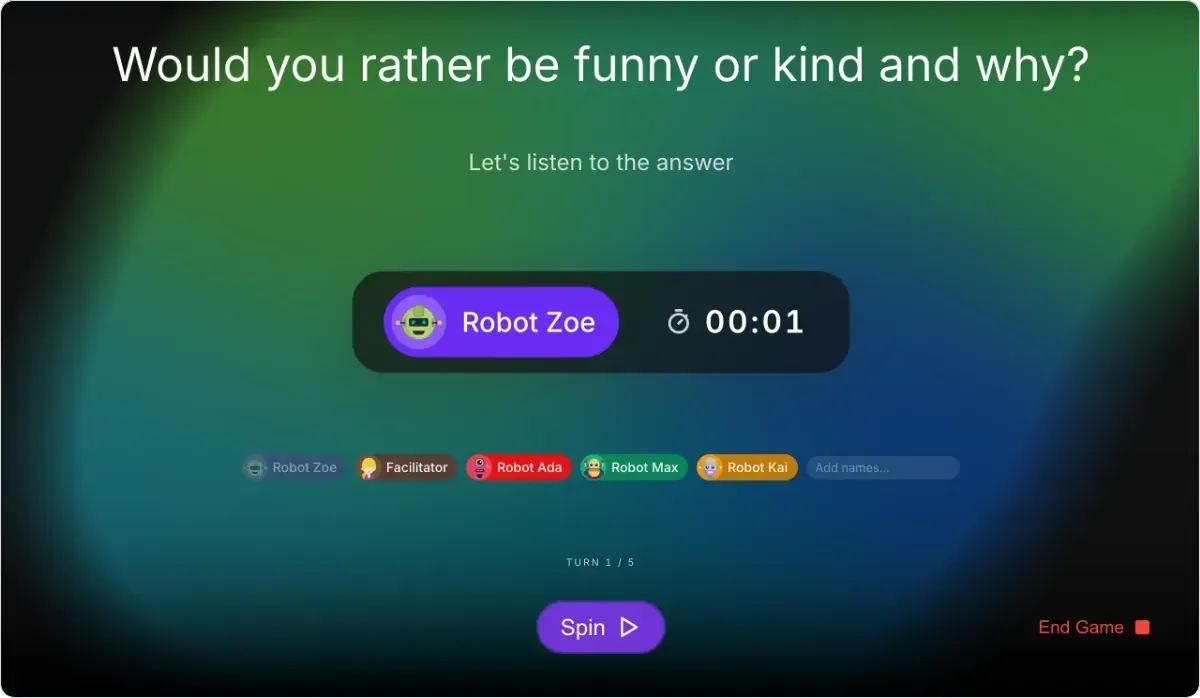
Puts a question on screen and spins a wheel to pick who answers. Free. You sign in with Google, and your team joins from a link with no account.
Running a retro or standup? TeamRetro has icebreakers built in. Start a free 30-day trial
The right icebreaker depends on the meeting, not the group. A daily standup needs a fifteen-second one-worder; an all-staff meeting needs something that works with forty people on mute; a tense budget review needs an opener that lowers the temperature instead of forcing fun. The groups below sort openers by the meeting you are actually running, so you can pick one, read it out, and get on with the agenda. TeamRetro is an online retrospective, team health check, estimation, and standup tool built for Scrum Masters, agile coaches, and team leads running remote, hybrid, or in-person agile teams.
Team meeting icebreaker questions
For the recurring team meeting: one question, one answer each, two minutes total. Rotate through these week by week rather than reusing a favorite until it wears out. If the meeting is short on time, ask for one-word answers and move on.
- What is one thing that went better than expected since we last met?
- What is the most useful thing you learned this month, work or not?
- If this week had a headline, what would yours say?
- What is one small win nobody here knows about yet?
- Which task on your plate are you most looking forward to?
- What did you almost not figure out this week, and then did?
- If you could hand one task to a robot this week, which one goes first?
- What is something a teammate did recently that made your work easier?
- What is your current desk drink, and is it working?
- What is one thing you changed your mind about recently?
- Two-week forecast: sunny, cloudy, or chance of storms, and why?
- What is the best shortcut, tip, or tool you used this week?
- What would make next week feel like a good week?
- What is one question you wish someone would ask you in this meeting?
- On a scale of parked car to rocket launch, how is your momentum today?
- What is one thing blocking you that someone here could unblock in five minutes?
- Which task on your list are you least looking forward to, and why?
- What are you giving your best hours to this week?
- What is one decision you are waiting on, and who is it with?
- What is the most useful thing you did last week, as opposed to the busiest?
- What is one thing we agreed last time that has actually changed?
Staff meeting icebreakers
Staff meetings mix people who do not work together every day, so lead with questions anyone can answer without context: no project references, no inside jokes. With a bigger room, take answers as a show of hands or from a few volunteers instead of going around everyone.
- Raise a hand: who has already had a meeting today that could have been an email?
- What is one word for how this month is going in your corner of the org?
- What is something another team shipped recently that impressed you?
- Coffee order poll: as it comes, milk and sugar, or elaborate ritual?
- What is the best meeting you have ever been in, and what made it work?
- Which season is your team in right now: planting, growing, or harvest?
- What is one thing your team does that the rest of us should steal?
- Show of hands: early bird, night owl, or powered entirely by deadlines?
- What is a tool or trick from outside work you wish we used here?
- If our organization had a mascot, what should it be?
- What is one acronym used here that you secretly had to look up?
- Finish the sentence: this quarter, the thing I want us to be known for is…
Standup and daily meeting openers
A standup opener has to cost seconds, not minutes. These are one-breath answers: ask, sweep the room once, start the updates. On a video call, take answers in the chat while people join.
- One word: how is today going so far?
- One number: how many meetings are on your calendar today?
- Red, yellow, or green: how is your workload?
- What is the first thing you will do after this standup?
- Rate your focus today from 1 to 5.
- What song title describes your yesterday?
- Sun, clouds, or fog: what is your weather report?
- What is one thing that might block you today?
- Battery check: what percentage are you starting on?
- Yesterday in three words or fewer.
- What are you saying no to today so the sprint says yes?
- Pick a gear: cruising, climbing, or coasting?
First meeting of a new team
A kickoff icebreaker has two jobs: attach names to faces and surface how people like to work before the first disagreement does it for you. Give these a little more room than a standup opener. A minute per person is fine.
- What is your name, your role, and one thing the job title does not tell us?
- How do you like to receive feedback: straight away, written down, or with coffee?
- What does your best working day look like, hour by hour?
- What is one thing past teammates would say you are reliably good at?
- When you are stuck, do you want help immediately or space to wrestle first?
- What is your communication happy place: chat, email, call, or in person?
- What time of day is your brain at its best?
- What is one working habit of yours we should know about up front?
- What was the best team you have ever been on, and what made it click?
- What are you hoping this project teaches you?
- What is a strong opinion you hold about how meetings should run?
- What should we do when we disagree with you: push back hard or ask questions?
One-on-one meeting openers
In a one-on-one the icebreaker is really a check-in: it tells you what register the rest of the conversation should take. Ask one of these, listen properly, and let the answer reorder your agenda.
- What is taking up the most head space for you this week?
- If we only solved one thing in the next half hour, what should it be?
- What has been the high point and the low point since we last talked?
- What is something you are proud of that nobody has acknowledged yet?
- How full is your plate honestly: comfortable, full, or overflowing?
- What is one thing I could do differently that would help you most?
- What are you learning right now, on purpose or otherwise?
- Is there a conversation you are avoiding that we should talk about?
- What part of your work feels most like a treadmill at the moment?
- What would you like to be doing more of in three months?
All-hands and town hall warm-ups
At all-hands scale, an opener has to work with everyone answering at once: chat storms, emoji reactions, and instant polls. Ask, give the room thirty seconds to flood the chat, read out three favorites, and hand over to the first speaker.
- Drop in the chat: one word for this quarter so far.
- Emoji storm: how is everyone feeling about the launch?
- Where is everyone joining from today? City in the chat.
- Poll: office, home, or somewhere unusual right now?
- In the chat: one thing you want to hear about in today's meeting.
- Shout out one person who helped you this month. Name them in the chat.
- Two-option poll: this quarter felt more like a sprint or a marathon?
- What is one question you hope leadership answers today?
- Chat storm: the best thing you ate this week, in three words.
- First concert, worst haircut, or proudest nickname: pick one for the chat.
- Reaction check: clap emoji if you have met someone here in person, wave if not yet.
Icebreaker exercises for meetings (two to five minutes)
Sometimes a question is not enough and you want a short structured exercise, still small enough to fit before the agenda. Each of these has one rule, needs nothing prepared, and lands inside five minutes. For longer, more playful formats, the icebreaker games collection has full activities.
- The 4 C's: everyone shares their favorite color, car, character, and cake. Silly on purpose; four fast facts per person that stick to memory.
- Rose, Thorn, Bud: each person names one good thing, one challenge, and one thing they are looking forward to. The fastest honest temperature check there is.
- Object on your desk: everyone grabs the nearest object and gives its ten-second backstory. Works in a room or on camera.
- Two-minute lineup: without talking, the group orders itself by distance traveled to work, birthday month, or years at the company. Instant movement, zero prep.
- One-word whip: pick a theme (this sprint, this quarter, this project) and whip around the room, one word each, no repeats.
- Common ground in pairs: pairs get ninety seconds to find the most surprising thing they have in common, then report the best ones back.
- Would You Rather, show of hands: read three either/or questions and vote by hand. No discussion until the votes are in; the splits do the talking.
- Guess whose fact: three people privately submit one obscure fact about themselves before the meeting; the room matches facts to faces.
- Draw your week: everyone sketches their week in thirty seconds and holds it up. The worse the drawings, the better it works.
- Highlight reel: in pairs, each person gets sixty seconds to describe one recent moment they would replay. Partners introduce each other's highlight to the room.
Openers for tense or high-stakes meetings
Before a hard conversation (a slipped deadline, a budget cut, a retro after a rough sprint), forced fun backfires. These openers lower the temperature by naming the mood and giving everyone one safe sentence to say before the difficult ones.
- In one word, how are you arriving at this meeting?
- What would make this meeting feel worth it by the end?
- On a scale of 1 to 5, how ready do you feel to talk about this today?
- What is one thing you want the group to understand before we start?
- What is one thing that is going right, even this week?
- What worry would you most like to leave at the door for the next hour?
- What does a good outcome look like for you personally?
- What is one thing you appreciate about how this team handles hard weeks?
- Anything you need from the rest of us to say what you actually think?
- If this meeting goes well, what will be different tomorrow?
Virtual meeting icebreakers (quick rounds)
Openers that use what a video call already gives you: the camera, the chat, and the reactions bar. These are the quick ones; the virtual icebreakers collection has the full remote-team set.
- Backdrop tour: one sentence about one real thing behind you on camera.
- Emoji answer only: how was your morning?
- Chat waterfall: type your answer, nobody sends until we all press enter together.
- What is the most-used app on your phone this week? Honesty encouraged.
- Camera scavenger: grab something within reach that is your favorite color.
- Reaction-bar poll: thumbs up if your week is ahead of schedule.
- What tab do you have open that you are slightly embarrassed about?
- Show us your mug and rate its contents out of ten.
- One-line weather report from wherever you actually are.
- GIF check-in: answer today's mood in the chat with one GIF.
The collections above cover the openers themselves; the skill of running them well is its own small craft. Our guide on how to run an icebreaker covers the facilitation side (how to introduce a question without it feeling forced, and when to skip one entirely), and the science behind good check-in questions explains why the first thing said in a meeting changes everything after it.
If your meeting can spare five minutes rather than two, run the opener as a game instead: Icebreaker Questions spins to pick who answers next, and This or That turns a would-you-rather round into an all-answer-at-once reveal. Both are free in the browser, no signup. For remote ceremonies there is a full collection of virtual icebreakers, for a laugh-first opener try the funny icebreaker questions, and if you want a rotating opener you never have to think about again, the question of the day collection is built for exactly that.
Frequently asked questions
What is a good icebreaker for a team meeting?
How do you open a staff meeting with an icebreaker?
What are the 4 C's icebreakers for meetings?
What are quick icebreakers for meetings?
Should you use an icebreaker in every meeting?
Pick the right icebreaker for your next meeting

A free list of 100+ agree-or-disagree questions and statements: workplace, funny, food, tech, remote-work, and deeper debate prompts for team warm-ups, with facilitator tips and how to run one.

A free list of question-of-the-day ideas for work: fun, daily check-in, and get-to-know-you questions to open a standup, meeting, or remote team chat in seconds.
A free bank of 100+ Two Truths and a Lie ideas and examples: work-appropriate, funny, travel, food, and remote-team statements, plus how to play, believable lies, and facilitator tips.

A free list of 100+ would-you-rather, this-or-that, and either/or questions: quick binary-choice icebreakers for work, adults, and remote teams. Funny, deep, and work-safe.

Free Christmas icebreakers for work, including would-you-rather, this-or-that, trivia and games for meetings, virtual parties and end-of-year retros.

Over 200 icebreaker questions for work, grouped by what you want to happen next: a new team, a remote call, a quick opener, or a real conversation.

A free collection of icebreaker games for team meetings, work, and remote video calls: quick, no-prep, and large-group activities you can run in minutes.

Virtual icebreakers and remote team-building games that work on video calls and in chat: quick questions, Zoom-friendly games, and async prompts you can run free in seconds.
A free list of 90+ check-in questions for meetings and teams: quick opening, closing, mood, fun, remote, and end-of-sprint prompts to read the room, build psychological safety, and get every voice heard.

A free list of funny, silly, and weird icebreaker questions for work and team meetings: work-safe prompts that get people laughing and talking in seconds.

25 team building games for work, grouped by what you want out of them: bonding, learning, or energy. Each one has a time, a group size, and how to run it.