
Team Spectrum: a 'Would You Rather' team building game for meetings
Team Spectrum is a free 'Would You Rather'-style team-building game: your team guesses where each person lands on a spectrum, then reveals the truth.
Every team has opinions. Strong ones. Quietly held ones. Ones nobody knew existed until someone asked. If your team enjoys “Would You Rather”, Team Spectrum is the team-building game that takes the same idea and turns it into a window into how well you actually know each other.
What is Team Spectrum?
Team Spectrum is a team-building game (sometimes called a human barometer or a “where do you stand” activity) where a topic is placed on a spectrum and each team member must guess where their colleagues would place themselves before the big reveal. Think:
The twist? You’re not just sharing where you stand; you’re testing how well you actually know your teammates. Surprises are guaranteed.
It works brilliantly for remote teams, in-person retrospectives, or as a warm-up before any meeting where you want people to feel relaxed and present.
Why Team Spectrum works
Most icebreakers ask people to share something about themselves. Team Spectrum flips that: it asks people to think about others first. That small shift creates a completely different dynamic:
- It sparks genuine curiosity. Trying to predict someone else’s answer means you’re actually thinking about them as a person.
- The reveal is the fun part. When someone places themselves far from where the group expected, the conversation that follows is priceless.
- It’s low-stakes but high-engagement. There are no wrong answers, no expertise required, and no pressure, just a fun window into how your team thinks.
- It builds empathy. Discovering you misjudged a colleague’s view on something opens a door to understanding them better.
How to run Team Spectrum
What you need
- A whiteboard, virtual whiteboard (Miro, FigJam, etc.), or the ready-to-play Team Spectrum game
- A list of spectrum topics (see below for ideas)
- 5–15 minutes
Step-by-step
- Draw the spectrum. Create a horizontal line with two opposing labels at each end. For example:
-
Everyone secretly guesses. Each team member privately notes (or places a marker for) where they think each of their colleagues falls on the spectrum. Give people 60–90 seconds.
-
Teammates reveal themselves. One by one, each person places themselves on the spectrum and explains why.
-
Compare with the guesses. See who predicted correctly, and celebrate the surprises.
-
Debrief briefly. Ask: “Did anything surprise you? What does that tell us about how well we know each other?”
Repeat with a new topic, or move into your main meeting with the energy already flowing.
Prefer a ready-made version? The free Team Spectrum game does the setup for you: pick a theme, and AI will generate a whole bunch of topics for you, or you can always customize your own. Then everyone guesses where each teammate lands before the reveal. No whiteboard, no prep.
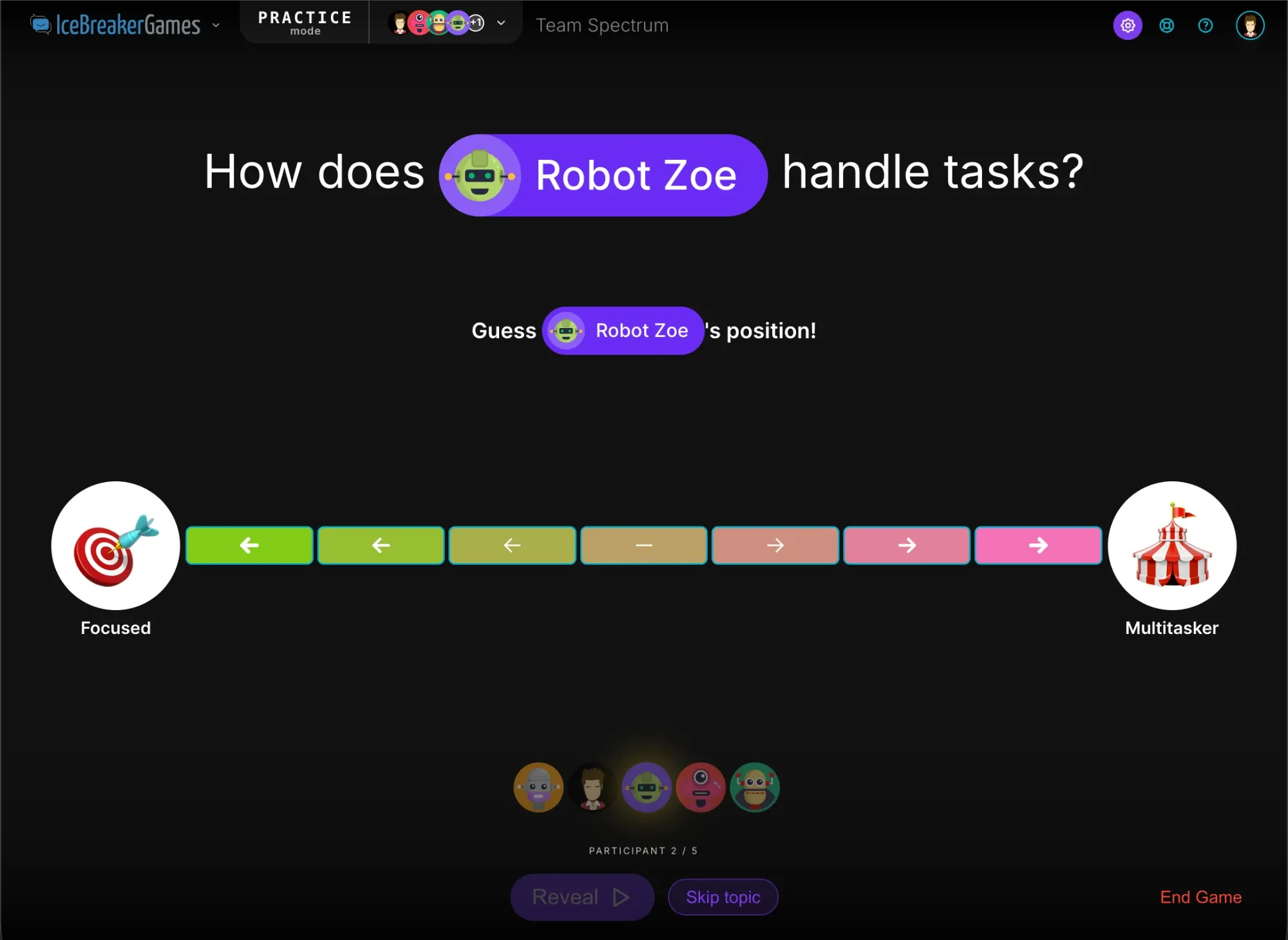
Team Spectrum topic ideas
The best topics are light-hearted, relatable, and just a little revealing. Here are some to get you started, and if you want more prompts, browse our icebreaker games and icebreaker questions for work, or run the statement version with these agree or disagree questions.
Work style
Opinions & preferences
Fun & personality
For new hires & onboarding
For retrospective warm-ups
Tips for facilitators
- Go first. Place yourself on the spectrum before anyone else reveals. It sets the tone and lowers the barrier for others.
- Encourage the “why”. The spectrum position is interesting; the reasoning behind it is where the real connection happens.
- Keep topics inclusive. Avoid anything that could feel political, personal, or divisive. The goal is warmth, not discomfort.
- Use it regularly. The game gets richer over time as teams build a shared history of surprising each other.
- Virtual teams: Use your cursor or a sticky note to place your position on a shared digital board. It works just as well remote as it does in person.
Frequently asked questions
How do you play Team Spectrum? Place a topic on a spectrum with two opposing labels at each end. Before anyone reveals their own position, each person guesses where their teammates would place themselves. Then everyone reveals their real spot and compares it with the guesses.
Is Team Spectrum good for remote teams? Yes. It works just as well remotely as in person: players place a marker on a shared digital board, or use the free online game so everyone can join from anywhere.
How is it different from Would You Rather? Would You Rather asks you to pick between two options. Team Spectrum uses a sliding scale instead of a binary choice, and adds a guessing round, so it reveals how well teammates actually know each other, not just their preferences.
Is Team Spectrum like Wavelength? They share the spectrum dial, but the goal is different. Wavelength is a party game where one person gives a clue for a hidden target and the group hunts for it. Team Spectrum has you guess where a teammate really stands, so it plays as a get-to-know-your-team round rather than a bluffing game. If you want a work-friendly version, try our Wavelength alternative built for teams.
How long does Team Spectrum take? A single round takes about five minutes. Run one topic as a quick warm-up, or several in a row for a longer session.
Try Team Spectrum in your next meeting
Team Spectrum takes five minutes and leaves people genuinely more curious about the people they work with every day. That curiosity, that small spark of “I didn’t know that about you”, is exactly what high-performing teams are built on.
It’s free to play, with no sign-up required, so you can run it at your next meeting in minutes.
Related posts
- July 10, 2026Online retrospective games vs formats: what actually works

- June 16, 202660+ icebreaker questions for agile and scrum teams
- June 8, 202650+ teamwork quotes to motivate and inspire your team

- July 14, 2025What makes the best icebreakers for teams?

- December 21, 2022Why virtual icebreakers work for remote teams
- October 26, 2022How to run an icebreaker for meetings, workshops, and training sessions

- October 17, 2022Top 5 tips for running effective icebreakers

- October 12, 2022Warm-up or icebreaker. Which one should you use?