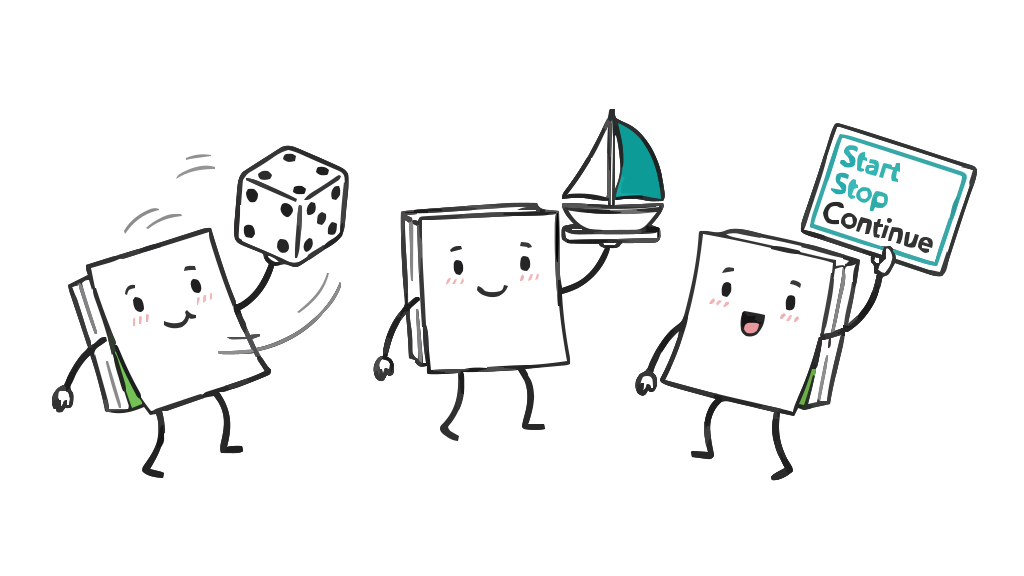
Retrospective games: 20 formats to energize your team
20 retrospective games and formats, each mapped to what it is good for: quick energizers, remote-friendly activities, and how to run every one free in TeamRetro.
Retrospective games are structured activities that give a team a frame for looking back at their work: a metaphor, a set of prompts, a few columns. The frame replaces “how did the sprint go?” with something people can answer, so the session produces honest input and one or two agreed changes instead of a general discussion.
This page lists 20 retrospective games grouped by the problem they fix rather than by how novel they are. Low energy needs a different format from a team that has stopped talking, and both need something different again from a team where the same issue keeps resurfacing. Pick the group that matches your team this week, then pick the format inside it. Every game here has a ready-made template or a board you can generate, and all of them run free in TeamRetro. Throughout, “activities” and “exercises” mean the same thing as “games”: the label matters less than choosing a structure that fits.
What retrospective games are
A retrospective game is simply a retrospective with a deliberate shape. Instead of asking “how did the sprint go?” and hoping for a reply, you give the team a frame that makes input easy to produce and easy to act on: what should we start, stop and continue?, or what is pushing our boat forward and what is anchoring it?
Reach for a game when a plain discussion would stall: after a hard sprint, when one or two people tend to dominate, or when the team has run the same format so many times it has gone stale. Keep it plain when the team is small, trusting and short on time. A five-minute Plus/Delta beats an elaborate metaphor nobody needs. If you are still learning to facilitate, the guide to running effective retrospectives covers the five phases every format below sits inside.
Pick the game for the problem, not the novelty
The most common way to choose a retrospective game is to pick the one the team has not done yet. It is also the least useful. A metaphor board will not make a team talk if the reason they are quiet is that last month’s complaint went nowhere, and no amount of novelty fixes a retro that has become a status meeting.
So start from the symptom. Four cover almost every stale retro: the team has no energy, the team is not talking, the same problems keep coming back, or the team is too new to have a shared read on anything. There is a fifth that matters more than the other four combined, which is a team that talks freely and still changes nothing.
Each group below starts with the symptom and gives four formats that address it, with what it is, when to reach for it, how long it runs, and how to run it remotely. If you recognize your team in two groups at once, take the one that is upstream: a team that is not talking will not do useful root-cause work, so fix the talking first.
When energy is low and the format has gone stale
These are the metaphor formats. They work because a picture gives people a way in that a blank column does not, and because a change of frame genuinely does wake a team up for a session or two. Treat them as a reset rather than a cure: if energy is low every fortnight, the problem is the retro’s length or its follow-through, not its theme.
1. Mario Bros Level Up. The sprint as a platform level: what powered you up, which enemies cost you a life, where the level got unfair, and what the next world looks like. Often called the Mario Kart retro, and it lands well with teams who grew up on the games. Reach for it when the team is bored rather than unhappy, and you want a session that feels like a break without stopping being useful. Allow 45 minutes. Remotely it needs nothing special beyond a shared board, though it is worth asking one person to keep the metaphor honest so it does not become a whole hour about Bowser. Run the Mario Bros Level Up template.
2. Speed Car. An engine pushing the team forward and a parachute dragging it back, with an optional pothole for the risks ahead. It is the fastest of the metaphor formats to explain, which is why it survives with teams who find the Sailboat a bit much. Reach for it when you want momentum framing and a short session. Allow 30 to 45 minutes. Remotely it works well because the two halves are unambiguous, so people know where to put a note without asking. Run the Speed Car template.
3. Hot Air Balloon. Hot air lifting the balloon, sandbags weighing it down, and storms on the horizon. The friendliest of the metaphors, and the one to pick when the sprint went badly and a car-crash frame would feel pointed. Reach for it after a hard release, or with a team that gets defensive quickly. Allow 45 minutes. Remotely, ask people to add sandbags before the call; the weighing-down notes are the ones people edit most, and they come out better written in private. Run the Hot Air Balloon template.
4. RPG retrospective. The sprint as a quest: who were the heroes, what were the monsters, what loot did you gather, and what does the party need before the next dungeon. Playful, and surprisingly good at naming hidden wins, because “loot” gives people permission to claim credit they would otherwise skip. Reach for it at the end of a long piece of work. Allow an hour, since the framing takes a few minutes to land. Remotely it benefits from one round of read-aloud before voting, so the stories land as stories. Run the RPG retrospective template.
When the team isn’t talking
A quiet retro is rarely a personality problem. It is usually a safety problem, a hierarchy problem, or the simple mechanical fact that the first person to speak sets the frame for everyone else. These four formats all lower the cost of going first, and every one of them gets better with silent writing and anonymous voting.
5. Sailboat. A boat with wind for what propels you, an anchor for what holds you back, rocks for the risks ahead, and an island for the goal. The single picture makes a rich discussion accessible to everyone, including the people who would not have known where to start in an open conversation. Reach for it when the team is quiet but not unhappy, or when you want risks on the table without anyone having to raise them as a concern. Allow 45 minutes. Remotely it is one of the best formats there is, because the image gives a distributed team the same reference point. Open the Sailboat template.
6. Mad, Sad, Glad. Three columns for what made the team angry, disappointed, or pleased. It surfaces the emotional temperature after a tough sprint, which the action-only formats miss entirely. Reach for it when something clearly went wrong and nobody has said so out loud. Allow 45 minutes to an hour, because the conversation this one starts is the point and cutting it short wastes the honesty. Remotely, run it anonymously: the moment people sign their name to “mad”, the column fills with tooling complaints instead of the real thing. Open the Mad, Sad, Glad template.
7. ESVP. A quick, anonymous poll on how people are arriving at the retro itself: Explorer, Shopper, Vacationer, or Prisoner. It is less a retrospective than a read on whether one is worth running, and it is the most honest five minutes you can spend with a team that has gone flat. Reach for it when attendance is grudging, or before you invest in a longer format you are not sure the team wants. Allow 10 minutes as an opener, then act on the result: three Prisoners in a room of six is the agenda. Remotely it only works anonymously, so use a poll rather than a round of names. There is no ESVP template in the library yet, so generate a board for it.
8. Kudo Cards. Each person writes a short, specific thank-you to a teammate. Warm, low-effort, and the fastest way to prove that saying something out loud about a colleague is safe here. Reach for it to close a session that surfaced hard material, or to open one with a team that has just been through a reorganization. Allow 10 to 15 minutes. Remotely it is better than in person, because people write more carefully than they speak and the cards stay readable afterwards. Run it with the Appreciation Round template, and see giving kudos with kudo cards for prompts that avoid the generic “thanks for all your help”.
When the same problems keep coming back
If the same issue appears in three retros running, the format is not the problem: the team keeps describing a symptom and never gets to the thing underneath it. These four are analytical rather than expressive. They are slower, they need a facilitator who can hold the thread, and they are the only ones on this page that reliably end a recurring complaint.
9. Five Whys. Take one recurring problem and ask “why” repeatedly until you reach a cause the team can actually change. A surface symptom such as flaky CI usually hides a deeper and more fixable one, and the fifth answer is often about a decision nobody remembers making. Reach for it when you have one clear problem, not five vague ones. Allow 30 minutes for a single chain, and stop when the answers stop being actionable rather than when you hit five. Remotely, type the chain where everyone can see it, so people can challenge a link instead of nodding along. Generate a Five Whys board.
10. Fishbone (Ishikawa). Work backwards from a problem to its contributing causes, grouped into categories, until the real driver is visible. Where Five Whys follows one thread, the Fishbone shows you a problem with four contributing causes and forces a choice about which one to attack. Reach for it when a problem is clearly systemic and the team disagrees about why. Allow a full hour. Remotely it needs the categories agreed up front, or the branches turn into a second brainstorm. Use the Fishbone template.
11. SWOT analysis. Strengths, Weaknesses, Opportunities, and Threats. It reads as a strategy tool because it is one, which is exactly why it suits a milestone or quarter boundary where the team is reflecting on more than one sprint. Reach for it when the recurring problem is bigger than the team’s own process. Allow an hour. Remotely, give each quadrant its own silent-writing window rather than opening all four at once, or Weaknesses eats the session. Run the SWOT analysis template.
12. Lean Coffee. The team writes the topics, votes, and then timeboxes a focused conversation through each in turn, highest votes first. It is the format to use when you suspect the recurring problem keeps getting crowded out by whatever is loudest that fortnight. Reach for it when the team has plenty to say and no agreement on what matters. Allow an hour, with eight-minute topic boxes and a thumbs vote to extend. Remotely it needs a visible timer and someone willing to close a topic mid-sentence. Run the Lean Coffee template.
When the team is new or newly reshuffled
A new team has no shared history to look back on, which makes most retrospective formats awkward for the first few weeks. What a new team does need is an agreed read on what it is trying to do and what people are worried about. Start there, then move to a normal format once the team has shipped something together. If you have not written one yet, a team charter is worth more than any of these in week one.
13. Hopes and Fears. Two columns: what people hope this team or project turns into, and what they are afraid it becomes. It is a futurespective rather than a retrospective, and it gives a brand-new team something real to talk about on day three. Reach for it at a project kickoff, after a reorganization, or when several people have joined at once. Allow 45 minutes, and finish by turning the top two fears into something the team will actually watch for. Remotely, run the fears anonymously; a new team will not name them otherwise. Open the Hopes and Fears template.
14. 4Ls. Liked, Learned, Lacked, Longed For. A rounded review that pairs feelings with what the team learned and what was missing, which makes it a good first real retrospective once a new team has finished something. Reach for it after a milestone, or as the format that follows Hopes and Fears a month later. Allow an hour. Remotely, the Learned column is the one to protect: it fills last and it is where a new team’s most useful material sits, so give it its own writing window. Use the 4Ls template.
15. Rose, Bud, Thorn. A rose for a win, a bud for an emerging opportunity, and a thorn for a problem. Gentle and balanced, and it surfaces upside and risk in the same pass without asking anyone to be blunt. Reach for it with a new team, a nervous team, or any group where a Mad, Sad, Glad column would feel like an invitation nobody wants to accept first. Allow 30 to 45 minutes. Remotely it is easy to explain in one line, which matters when half the team is new to retros as well as to each other. Try the Rose, Bud, Thorn template.
16. Letter to your future self. Everyone writes a short note to the team they will be next month: what to remember, what to watch for, what not to repeat. Then you open the letters at that retro. It is the one format on this page that builds its own history, which is why it suits a team that does not have one yet. Reach for it at the end of a first sprint or a first month. Allow 20 minutes to write, and five at a later retro to read. Remotely it needs somewhere the letters actually persist, so keep them on the board rather than in chat. Create a board for it.
When retros produce talk but nothing changes
This is the most common failure on the list and the least often diagnosed, because from the inside it looks fine. People show up, the conversation is good, everyone leaves feeling heard, and nothing is different next fortnight. The formats below are the decision-led ones. They are less interesting to read about and they are the ones we would default to, because each of them ends in a change with an owner rather than an insight.
17. Start, Stop, Continue. Each person names one thing the team should start doing, one to stop, and one to keep. The most action-oriented format there is, and the fastest route from feedback to a decision, because the columns are already phrased as commitments. Reach for it with a steady team, or any time the last retro produced discussion and no change. Allow 30 to 45 minutes, and spend the last ten assigning owners rather than adding notes. Remotely, cap each person at one note per column: it forces a choice and stops the board becoming a wish list. Use the Start, Stop, Continue template.
18. DAKI. Drop, Add, Keep, Improve. A crisp, decision-led format that pushes the team to commit to changes rather than observe them, with “Drop” doing most of the work: naming something to stop is where teams flinch, and where the time actually comes from. Reach for it when the team’s process has quietly accumulated ceremonies nobody defends. Allow 45 minutes. Remotely, vote on Drop first, before anyone has argued for their own meeting. Try the DAKI template.
19. KALM. Keep, Add, Less, More. A close cousin of Starfish that is quicker to explain and easier to vote on, and it lets a team dial something down without having to kill it outright, which is often the honest answer. Reach for it when the team’s disagreements are about degree rather than direction. Allow 45 minutes. Remotely it is one of the easiest to run cold with a group who have never met, because the four words need no explanation. Use the KALM template.
20. Starfish. Five zones running from “stop” through “less”, “keep” and “more” to “start”, so the team can dial activities up and down rather than only on or off. The extra granularity over KALM is worth it when a team is mid-way through changing how it works and needs to see the whole picture at once. Reach for it at a quarter boundary, or after a process change you want to tune rather than reverse. Allow an hour: five zones take longer to fill than four. Remotely, collapse the board to one zone at a time while writing, then show all five for voting. Run the Starfish template.
Whichever of these you run, the retro is not finished when the votes are in. Turn the top item into one specific change, with a single named owner and a date, and review it at the start of the next session rather than the end. The Follow-Through Index is our measure of whether that habit is actually holding.
Other formats worth knowing
Five formats do not belong to any one symptom, either because they are general-purpose or because they are simply short. They are the ones to reach for when the honest answer is that nothing is wrong and the team just needs 15 minutes.
- Plus/Delta: two columns, what went well and what you would change next time. The fastest way to capture signal without ceremony, and the right call after a short sprint. 15 minutes. Run it with the Plus/Delta template.
- Plus, Minus, Interesting: positives, negatives, and the merely curious. The “interesting” column catches signals that are neither good nor bad yet, which is why it suits teams working on something genuinely new. 30 minutes. Run Plus, Minus, Interesting.
- Sprint retrospective: the general-purpose agile review at the end of an iteration, for when you want something balanced and repeatable rather than a themed game. 45 minutes. Start from the agile retrospective template.
- Energy levels check-in: ask each person for a number from one to five to describe their week, before any discussion. A 60-second read of the room, and a useful trend line if you keep it. Run the energy levels template.
- Snapshot: everyone shares one photo or one word that sums up their sprint, then says a sentence about it. Quick, personal, and easy on a video call.
Browse the full retrospective template library for the rest, or generate a custom board for a format we do not template yet.
Warm-ups are not retrospective games
There is a difference worth keeping straight. A retrospective game structures the reflection itself. A warm-up gets people talking before the reflection starts, and it does not produce anything you will act on. Both are useful and they are not interchangeable: an icebreaker in place of a format gives you a cheerful meeting with no output, and a format with no warm-up starts cold and stays that way for the first ten minutes.
Run one of these for five minutes at the top, then move to a format from the groups above. For a bigger bank of ready-to-run openers, browse our icebreaker questions for work, or play them live in the browser at Icebreaker Games.
- Fun fact / Two truths and a lie: each person shares a few facts about themselves, one of which is false, and the team guesses. A light way to start that works just as well remotely. Borrow from these two truths and a lie ideas if statements don’t come easily, or play it live with Two Truths and a Lie.
- Snapshot: everyone shares one photo or one word that sums up their sprint, then says a sentence about it. Quick, personal, and easy on a video call. To keep the one-word energy going, run a round of Word Association.
- A pet for our team: the team invents a mascot animal for the sprint and explains why. A creative warm-up that doubles as a read on morale. For a hands-on version, try the collaborative Creative Canvas.
- Where do you stand?: pose a light either/or (“tabs or spaces”, “beach or mountains”) and see how the team splits. A fast read of the room before the real work. Pull statements from these agree or disagree questions, or play it as This or That.
These openers need no template. Run them as a quick round before any of the formats above. For a whole shelf of playable options, browse Icebreaker Games, or generate a custom check-in board to capture the answers.
Running retrospective games online
Every format on this page runs online, and most of them run better online than in a room, for one unglamorous reason: a shared board lets everyone write at the same time, which a whiteboard and a marker do not. Three mechanics do the work.
Anonymous voting. Hierarchy travels down a video call quickly. When notes and votes carry no name, the concern the senior person was tiptoeing around gets raised by someone else, and the top of the board reflects the team rather than the room.
Async pre-entry. Open the board a day early so the deliberate thinkers can add their notes in their own time. You start the live session with real material instead of a blank grid and a long pause.
Get those three right and almost any format above lands over video. Get them wrong and even the cleverest game turns back into an open discussion with a scoreboard on top. For the honest version of which online games actually change behavior, including five we ran on our own team, see online retrospective games versus formats.
When a game is the wrong call
A retrospective game is a means to an honest conversation, not the point of the meeting. There are three situations where reaching for one makes things worse, and all three are common enough to name.
The team is in genuine conflict. If two people are not speaking, or a decision has left someone visibly angry, a metaphor board asks them to be playful about the exact thing they are upset about. It reads as avoidance, because it is. Deal with the conflict directly, one-to-one first, and run the retro when there is something the whole team can usefully discuss.
The last three retros produced nothing. When a team has agreed changes three times and seen none of them happen, the format is not what is failing. A new game at that point is a fourth pleasant hour that also changes nothing, and it costs you the last of the team’s patience. Spend the session on the actions instead: what was agreed, what happened, and what is genuinely in the team’s control.
The team is already tired of theater. Some teams have been through enough novelty to read any new activity as management asking them to perform enthusiasm. With that group, plainer is more credible. Run Plus/Delta, keep it to 20 minutes, and let the follow-through earn back the right to try something more elaborate later.
Rotating formats is not the same as improving. Variety keeps a retro from going numb, and that is a real benefit worth having. It is not a substitute for the one or two changes a quarter that actually make the work easier, and it is worth being honest with yourself about which one you are doing.
How to run a retrospective game
The format matters less than the facilitation around it. A simple arc works for almost any game on this page:
- Set the stage. Open with a short check-in and a reminder that everyone did their best with what they knew. Keep it under five minutes. If you are running your first few, how to run a retrospective walks through the same five phases with a worked 60-minute agenda.
- Gather data. Give the team quiet time to add their own notes before anyone speaks.
- Generate insights. Group related notes, dot-vote on what matters most, then dig into the top items together.
- Decide actions. Turn insight into one or two specific changes, each with a single named owner and a date.
- Close. End on kudos, and review last retro’s actions at the start of the next one. Follow-through is what teaches a team that retros are worth the time.
For remote teams, lean on anonymous voting and silent writing even harder: they level the playing field when you cannot read the room as easily. Games that sit inside a wider team-building goal rather than a sprint review belong in a slightly different bucket. See agile games for team building.
Run any of these free in TeamRetro
Every format above runs free in TeamRetro, with silent brainstorming, anonymous voting, and tracked actions out of the box, so the three mechanics that make a remote retro work are on by default rather than something you facilitate around. Actions carry from one session to the next, which is what turns a good conversation into a change you can see.
Browse all retrospective templates to find a ready-made board, see how retrospectives work in TeamRetro, or generate a custom retrospective for a format we do not template yet and run it with your team today.
Frequently asked questions
What are retrospective games?
Retrospective games are structured activities that give a team a frame for looking back at their work: a metaphor, a set of prompts, a few columns. The frame replaces “how did the sprint go?” with something people can answer, so the session produces honest input and one or two agreed changes rather than a general discussion. Reliable starting points are Start, Stop, Continue for action, Mad, Sad, Glad for how the sprint felt, and the Sailboat when you want the whole picture in one image.
What are good retrospective games?
Good retrospective games are structured activities that help a team reflect on how they worked and decide what to change. Reliable starting points include Start, Stop, Continue; Mad, Sad, Glad; the Sailboat; the 4Ls; and the Starfish. Each gives people a clear frame for honest feedback rather than an open-ended discussion.
What are some online retrospective games?
Most retrospective games work online. What makes them work is a shared board with silent writing and anonymous dot-voting, so everyone contributes at once. Metaphor formats like the Sailboat and action formats like Start, Stop, Continue and Mad, Sad, Glad all translate well to distributed teams, and each has a ready-made template you can run free. Open with a quick online warm-up such as Two Truths and a Lie to read the room. In TeamRetro everyone adds notes at the same time and votes anonymously, so a remote session feels the same as an in-person one.
What are good retrospective games for remote teams?
The Sailboat and Start, Stop, Continue both translate well to remote teams because they give a clear shared picture and short, votable input. Add Speed Car when the team needs a change of pace and KALM when the disagreement is about degree rather than direction. Pair any of them with a quick energy check-in to read the room, and run it on a retrospective tool where everyone writes at once and votes anonymously, so the loudest voice does not anchor the discussion.
How do you make a retrospective fun without wasting time?
Use a metaphor-led format such as the Sailboat, Speed Car or Hot Air Balloon, open with a short check-in question, timebox each step, and close on kudos. The time is wasted when the activity replaces the outcome, not when it takes ten minutes: keep the activity to half the session and spend the rest deciding one or two changes with an owner and a date. Fun comes from a safe, well-paced session where people are genuinely heard, not from gimmicks bolted onto a status meeting.
Which retrospective game should I use for a new team?
Start with Hopes and Fears or ESVP. Both surface what people expect from the team and from the retro itself, which is the thing a new team has not agreed on yet, and neither requires a shared history to answer. Move to the 4Ls or Rose, Bud, Thorn once the team has finished something together. Save the anonymous-guessing games until people know each other well enough for a wrong guess to be funny rather than pointed.
How long should a retrospective game take?
A focused retrospective game runs in 30 to 60 minutes for most teams. Quick formats such as Plus/Delta fit a 15-minute slot after a short sprint; deeper problem-solving sessions like a Fishbone or root-cause analysis can take an hour. As a rule, the activity itself should take no more than half the session, so there is time left to agree what changes. Timebox each phase so you always reach agreed actions before you close.
What is the sailboat retrospective?
The Sailboat retrospective draws the team’s situation as a boat: wind for what is pushing you forward, an anchor for what is holding you back, rocks for the risks ahead, and an island for the goal you are sailing toward. Everyone adds notes to each part of the picture, then the team votes on what to act on. It takes about 45 minutes and works particularly well remotely, because the single image gives a distributed team the same reference point to argue over.
Are retrospective games worth it?
Yes, when the game is chosen for a reason. A format that matches the problem gets you honest input from everyone rather than from the two people who always speak, and that difference in input is the whole return. A format picked for novelty adds ten minutes and changes nothing. The test is what happens afterwards: if the last three retros produced no change, the format is not what is failing, and a new game will not fix it.
Can you run retrospective games with a large team?
Up to about 12 people, run it as normal. Beyond that, split into breakout groups of four to six working the same format, then bring one or two themes back from each group and vote across the whole set together. Silent written input and anonymous voting matter more at scale, not less, because a larger group amplifies whoever is most comfortable talking.