Scrum events vs ceremonies: the terminology, and whether there are four or five
"Events" and "ceremonies" are the same meetings under two names. Events is the Scrum Guide term; ceremonies is colloquial. And there are four, or five. Here's why.
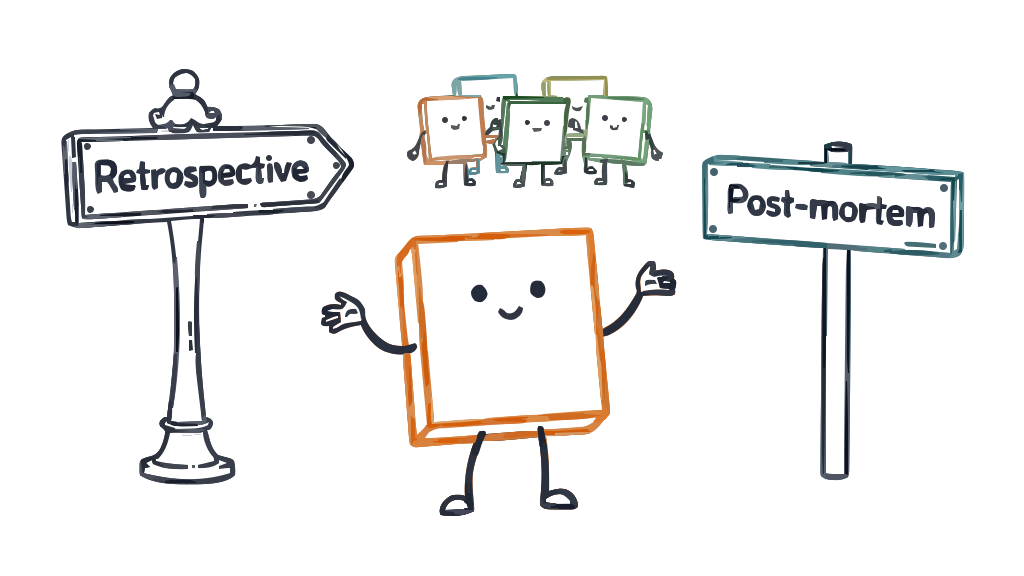
“Ceremonies” and “events” are the same meetings under two different names. Event is the word the current Scrum Guide uses; ceremony is the older, colloquial term teams still say out of habit. Neither is more correct, and the distinction only matters in one place: the count. Ask how many agile ceremonies there are and you’ll hear “four” from one person and “five” from the next. Both are right. They’re counting different things.
Events or ceremonies: does the word matter?
Not really. The 2020 Scrum Guide dropped “ceremony” in favor of “event,” partly for precision and partly because “ceremony” oversells what is, in practice, a set of working meetings. But the industry didn’t follow in lockstep: Atlassian, Asana, and most teams still say “ceremonies” day to day.
Use whichever your organization uses. If you’re writing something formal or studying for certification, “events” is the current term. In a standup, nobody will correct you for saying “ceremony.” What’s worth getting right isn’t the label; it’s understanding what each meeting is for, which is what the rest of this guide covers.
Four or five? The sprint is the fifth
Here’s the source of the disagreement.
The four meetings everyone agrees on are sprint planning, the daily scrum, the sprint review, and the sprint retrospective. When someone says “the four agile ceremonies,” they mean these.
The Scrum Guide, though, lists five events, because it counts the sprint itself as an event: the fixed-length container that holds the other four. It isn’t a meeting; it’s the timebox the meetings punctuate. So “five” adds the sprint to the four; “four” leaves it out because it isn’t something you sit down for. Once you see that, the argument evaporates: one side is counting meetings, the other is counting events, and the Scrum Guide is firmly on the side of five.
Some guides (Asana’s among them) get to a different fifth by adding backlog refinement to the four meetings. That’s defensible in spirit (refinement is real, recurring work), but it isn’t how the Scrum Guide counts, because refinement is an ongoing activity, not a formal event.
The five events, at a glance
Each links to its full treatment:
| Event | Purpose | Timebox (2-week sprint) |
|---|---|---|
| The sprint | The container: a fixed-length cycle of work | 1–4 weeks (the container) |
| Sprint planning | Agree the goal and the plan | Up to ~4 hours |
| Daily scrum | Re-plan the day toward the goal | 15 minutes |
| Sprint review | Show the product, gather feedback | Up to ~2 hours |
| Sprint retrospective | Improve how the team works | Up to ~90 minutes |
For a per-ceremony explainer of the four meetings on a single page, the retrospective guide’s four Scrum ceremonies covers them together.
The 3-5-3 rule, and where the events fit
If you’ve heard the 3-5-3 rule, it’s a mnemonic for the whole shape of Scrum, and the events are the middle number:
- 3 roles: the product owner, the scrum master, and the developers. See Scrum roles.
- 5 events: the five above.
- 3 artifacts: the product backlog, the sprint backlog, and the increment. See Scrum artifacts.
It isn’t a rule the Scrum Guide states, but it’s a fair map: roles are who, events are when, artifacts are what. Some versions extend it to 3-5-3-3 by adding the three commitments (the product goal, the sprint goal, and the definition of done). And underneath all of it sit the five Scrum values: commitment, courage, focus, openness, and respect. Those are what keep the events from becoming empty ritual.
That last point is the one worth keeping. The events are a skeleton; run them without the values and you get agile theatre, where the meetings happen on schedule and change nothing. The count is trivia. Whether the ceremonies actually inspect and adapt is the only question that matters.
Frequently asked questions
What are ceremonies in Agile?
Agile ceremonies are the recurring, timeboxed meetings a Scrum team runs to plan, coordinate, review, and improve its work: sprint planning, the daily scrum, the sprint review, and the sprint retrospective. “Ceremony” is a colloquial label (the Scrum Guide calls these meetings “events”), but the two words point at the same set of meetings.
What are the 4 core Agile ceremonies?
Sprint planning (agree what the sprint will deliver), the daily scrum or standup (re-plan the day in 15 minutes), the sprint review (show the product to stakeholders and gather feedback), and the sprint retrospective (improve how the team works). Most “four ceremonies” lists mean exactly these.
What are the five ceremonies of Agile?
The fifth is the sprint itself. The current Scrum Guide counts five events, because it treats the sprint as a container event that holds the other four. So “four” counts only the meetings; “five” adds the sprint they happen inside. Both are right. They’re just counting different things.
What is the 3-5-3 rule in Agile?
A mnemonic for the shape of Scrum: 3 roles (product owner, scrum master, developers), 5 events (the sprint plus sprint planning, the daily scrum, the sprint review, and the retrospective), and 3 artifacts (product backlog, sprint backlog, increment). It’s a memory aid, not a rule in the Scrum Guide, but it’s a fair map of the framework.
What are the 5 C’s of Agile?
There’s no canonical “5 C’s of Agile” in Scrum: different sources invent different lists (commitment, courage, communication, and so on). If you’re looking for the values that underpin Scrum, the real, defined set is the five Scrum values: commitment, courage, focus, openness, and respect.