
The five dysfunctions of a team, explained honestly
The five dysfunctions of a team pyramid explained: what each layer means, how to spot it, what to run, and where the model holds up. Plus a free check.
The five dysfunctions of a team are absence of trust, fear of conflict, lack of commitment, avoidance of accountability, and inattention to results. Patrick Lencioni stacked them as a pyramid in a 2002 business fable, and the stacking is the whole idea: each layer is caused by the one beneath it. A team that will not admit mistakes cannot argue honestly. A team that cannot argue honestly never really commits. People who have not committed do not hold each other to account, and a team that avoids accountability drifts toward personal wins instead of shared ones.
That chain is the useful part of the model, and it is the part most teams skip. When a team keeps missing what it promised, the instinct is to tighten the promises. The pyramid says look further down.
This chapter covers what each layer looks like on a real team, how to work out which one is actually yours, what to run about it, and how much weight the model can carry.
How the five dysfunctions pyramid works
The pyramid is a reading order, not a ranking of importance. Absence of trust sits at the base because every other layer rests on it, and inattention to results sits at the apex because that is where the damage finally shows. Each layer is a cause of the one above it and a symptom of the one below.
That gives you two directions to read it. Top-down is how problems surface: a team notices it is missing results long before it notices that nobody admits a mistake. Bottom-up is how you fix them: start at the lowest layer that is broken, because repairing a higher one while the base is still cracked rarely holds.
Lencioni also describes the pyramid in its healthy form, which is the more useful picture to aim for. A cohesive team trusts one another, argues openly about ideas, commits to decisions, holds each other to account for them, and puts collective results ahead of individual ones. Each dysfunction is the absence of one of those five behaviors.
Where the model comes from, and what it is not
The Five Dysfunctions of a Team is a novel. Lencioni published it in 2002 as a leadership fable: most of the book follows a fictional CEO, Kathryn Petersen, taking over a struggling executive team at an invented company. The model arrives near the end, as the lesson of the story. It came out of his consulting practice at the Table Group, his own firm, which still sells the assessments and workshops built on it. The model is theirs, and so is the official instrument. Anyone else, us included, can only adapt it.
There is no study behind it. No sample, no control group, no peer review, no published data. That is not a scandal, because the book never claimed otherwise, but it is worth knowing before you use the pyramid to make a decision about real people. Compare it with Amy Edmondson’s work on psychological safety, which came from studying 51 work teams and found that safety was associated with more learning behavior and better performance (Edmondson, 1999). Both are useful. Only one of them has evidence.
So read the five dysfunctions the way you would read a good checklist from an experienced practitioner: a well-organized way to name what you are seeing, not a finding. The Wikipedia entry is a fair summary if you want the book’s structure without the fable.
The five dysfunctions, layer by layer
Here is the working version. For each layer: what it looks like when it is happening to you, the signal most summaries leave out, and the thing worth running. The table is the map, and the detail sits underneath it.
| Dysfunction | What it looks like | What to run |
|---|---|---|
| Absence of trust | Nobody admits a mistake or asks for help | Personal histories, a check-in ritual, go first yourself |
| Fear of conflict | Meetings are polite and decisions get re-argued afterwards | Working agreements that say how you disagree |
| Lack of commitment | Everyone nods, then does something else | Decide out loud, write it down, set a review date |
| Avoidance of accountability | Slipped work goes unmentioned | Visible commitments, peer follow-up, a regular retro |
| Inattention to results | People defend their own patch | One shared measure the whole team owns |
Absence of trust
What it looks like. People manage their image. Nobody says “I got that wrong” or “I do not understand this”. Questions get asked privately after the meeting instead of in it. The team may be perfectly friendly, which is what makes this one hard to spot.
The honest signal. Lencioni means something narrower than the everyday word. He is not talking about believing your colleague will deliver on time, which is predictive trust and arrives with experience. He means vulnerability-based trust: the willingness to be seen not coping. Chapter 6 covers the distinction and how to build it in trust and psychological safety. The quick test is whether anyone on your team has said “I need help” out loud in the last month.
What to run. Someone has to go first, and it should be whoever holds the most authority, because a manager admitting a mistake changes the cost of admitting one for everybody else. Beyond that, structure helps more than sentiment: a check-in question at the top of every meeting, and a team charter that makes the expectations explicit rather than assumed.
Fear of conflict
What it looks like. Meetings are calm and slightly dull. Nobody pushes back hard. The real discussion happens afterwards in smaller groups, and decisions that seemed settled come back a week later.
The honest signal. Artificial harmony is not peace, it is deferred argument. A team with no visible disagreement is usually not aligned, it is unwilling. And the opposite failure exists too: conflict that is personal rather than about the work is not the healthy kind, and more of it will not help.
What to run. Give disagreement a shape so it does not feel like an attack. Team norms and working agreements are the practical tool here, because they let the team decide in advance how it will handle a split rather than improvising under pressure. A regular retrospective then gives friction a scheduled outlet, which is usually easier than asking people to raise things in the moment.
Lack of commitment
What it looks like. The meeting ends with apparent agreement and nothing much changes. Ask three people what was decided and you get three answers. Work restarts on questions everyone thought were closed.
The honest signal. This layer is where the causal chain earns its keep. People do not fail to commit because they are disengaged. They fail because they never got to say the thing they actually thought, so they never bought in. Lencioni’s point is that consensus is not required, but being heard is. Someone who lost the argument will still back the decision if the argument was real.
What to run. Close every discussion out loud: what we decided, who is doing it, by when. Write it down where the team can see it, and put a date on when you will look at it again. Ambiguity is the thing you are fighting, not apathy.
Avoidance of accountability
What it looks like. A commitment slips and nobody mentions it. Standards drift quietly. The manager becomes the only person who ever raises a problem, which turns every issue into an escalation.
The honest signal. This is peer-to-peer accountability, not management oversight, and it is the layer people most often try to fix first because it is the most visible. Adding a tracking tool to a team that has not committed to anything simply produces a well-maintained record of work not happening. If your accountability is weak, check the two layers below it before you buy anything.
What to run. Make commitments public inside the team so following up is normal rather than an accusation. Then keep a rhythm where noticing is expected: a retrospective that revisits the actions from last time does most of the work, because it makes “we said we would do this and we did not” a routine sentence instead of a confrontation.
Inattention to results
What it looks like. People optimize for their own function, their own metric, or their own visibility. Individual reviews go well in a quarter the team collectively missed. Status is protected more carefully than the outcome.
The honest signal. This one is usually the symptom, not the disease. It is also the layer most often caused by something outside the team: if the organization rewards individual heroics, no amount of team-building will outvote the incentives. Be honest about whether you are looking at a team problem or a company one.
What to run. Name one measure the whole team shares and can actually influence, and review it together often enough that it feels real. The point is not the number. It is that the team has something it succeeds or fails at as a unit.
Where this sits next to psychological safety
The bottom two layers of the pyramid describe much the same territory as psychological safety: whether it is safe to be wrong in front of these people. Edmondson’s version has the research behind it and a more precise definition, so where the two overlap, hers is the one to lean on.
What Lencioni adds is the chain. Psychological safety tells you whether the conditions for honest work exist. The pyramid gives you an order of operations for what to fix when they do not, and it keeps going past the point where safety stops: commitment, accountability and shared results are not safety problems, they are follow-through problems. Read together, one explains the climate and the other explains the sequence. Chapter 6 on building trust and psychological safety and our guide to psychological safety at work go deeper on the first half.
How to assess your team against the model
The official instrument is a 38-item questionnaire sold as a paper handout, with an online version of 42 questions priced per team member. It belongs to the Table Group, and teams reach for it because it looks rigorous. What actually makes an assessment useful is much simpler, and you can do it without buying anything.
Three things matter more than the instrument:
- Score the team, not the people. Every statement should be about how we behave, not how Sam behaves. The moment a survey can be read as a performance review, the answers stop being honest and you have measured politeness instead.
- Do it together, and look at the spread. The most useful part of any assessment like this is not the average, it is the disagreement. When half the team rates trust at 2 and the other half at 5, that gap is the conversation. A report that only shows you a mean has thrown away the interesting data.
- Treat a low score as a starting point. The score is not a verdict on the team, it is a prompt for the discussion that follows it. Teams that improve are the ones that pick the lowest layer and do something specific about it, not the ones that measure most often.
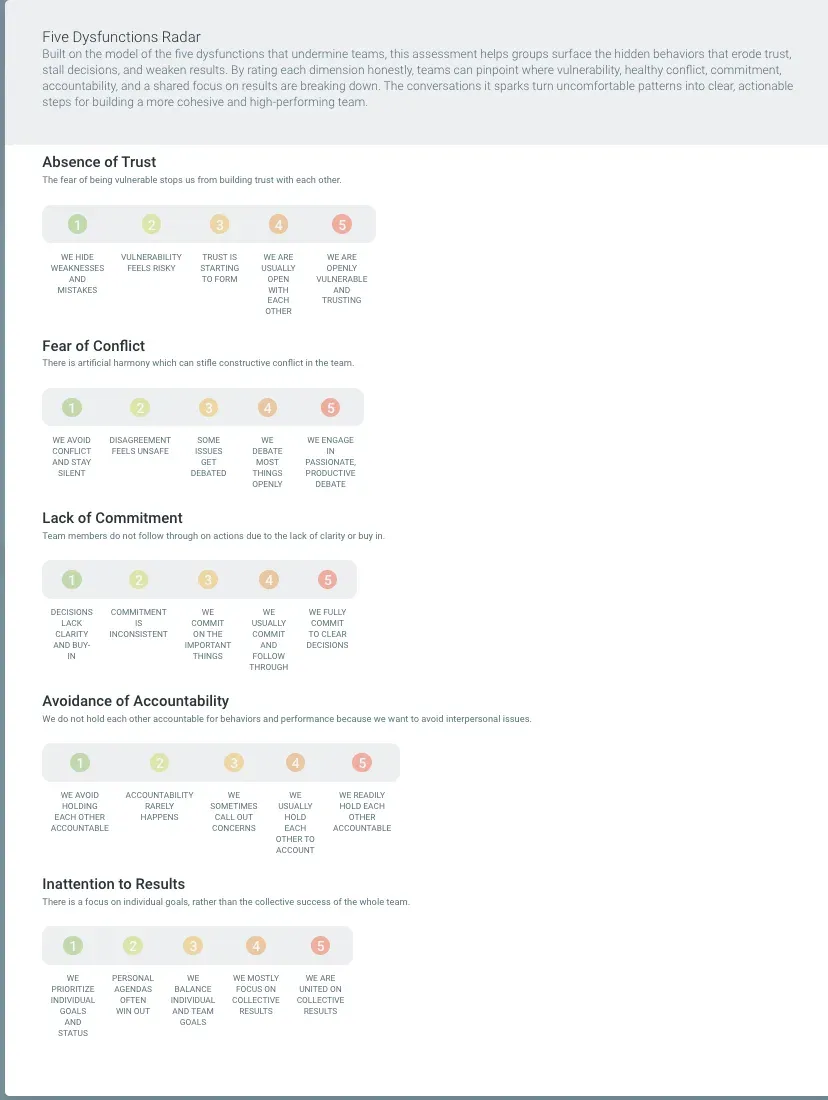
TeamRetro’s Five Dysfunctions of a Team Assessment is built to run exactly that. It is our adaptation of the five layers, not Lencioni’s official assessment and not affiliated with the Table Group. Everyone rates the same five dimensions privately on a scale of 1 to 5, the team sees the combined radar and the spread together, and the discussion starts from where people actually disagree. It is free, it takes about ten minutes, and it is built to be re-run so you can see whether anything moved.
If you want the wider context on measuring a team, the team health check guide covers how to run one well, and the Psychological Safety Check goes deeper on the bottom two layers.
Where the model breaks down
Four failures are common enough to name.
- Using it to label people. The pyramid describes team behavior. The moment it becomes vocabulary for describing a colleague, “he has a trust issue”, it has stopped helping and started doing harm. Keep it pointed at the team.
- Diagnosing from the top down. Almost every team that reads the book decides its problem is accountability, because that is the layer you can see. The model’s own logic says the break is usually lower. Resist the diagnosis that requires the least uncomfortable change.
- Treating the layers as a curriculum. The pyramid is not a five-week program to march through in order. Running a trust exercise on a team whose real problem is that nobody knows what the goal is will just annoy everyone. Find the break, then work on it.
- Assuming the answer is always trust. Sometimes the team trusts each other completely and the strategy is incoherent, or the incentives are wrong, or there are simply too many people in the room to be a team at all. A model about interpersonal behavior will find interpersonal causes, whether or not they are the real ones. Chapter 1 on what team dynamics are covers the other forces at work.
Held loosely, it remains one of the more useful things a manager can carry around, which is a fair result for a novel.
Running it with your team
If you want to do something with this rather than just know it, the sequence is short.
Run the Five Dysfunctions of a Team Assessment with the whole team and look at the spread rather than the average. Take the lowest-scoring dimension, and only that one. Run a retrospective focused on it, ending with two or three specific actions and owners. Put the same health check back in the calendar for a few months’ time so you find out whether it worked.
That loop, measure honestly, fix one layer, check again, is worth more than a complete understanding of the model. Which layer you start with matters far less than starting at all.
Frequently asked questions
What are the 5 dysfunctions of a team?
The five dysfunctions are absence of trust, fear of conflict, lack of commitment, avoidance of accountability, and inattention to results. Patrick Lencioni set them out as a pyramid in 2002, with absence of trust at the base. Each layer is caused by the one beneath it: people who cannot admit mistakes will not argue honestly, people who have not argued honestly do not commit, and so on up to a team that stops caring about shared results.
What is the most common dysfunction of a team?
Absence of trust, because it is the base of the pyramid and everything above it depends on it. It is also the one teams are least likely to name, since a team can be friendly and still have no trust in Lencioni’s sense. He means vulnerability-based trust, the willingness to say “I was wrong” or “I need help” in front of colleagues, rather than simply believing people will do their jobs.
How do you overcome the five dysfunctions of a team?
Work from the bottom up and fix one layer at a time. Build trust by having whoever holds the most authority admit a mistake first, then make it routine with check-ins and a team charter. Make conflict safe with working agreements that say how the team handles disagreement. Close discussions out loud so commitments are unambiguous. Make commitments visible so peers can follow up without it feeling like an accusation. Finally, give the team one shared measure it owns together. The common mistake is starting at the top, with accountability, when the real break is lower down.
What is the Five Dysfunctions of a Team questionnaire?
The official version, published by Lencioni’s firm the Table Group, is a 38-item questionnaire, with a longer online edition of 42 questions sold per team member. Both ask the team to rate statements about how the group behaves rather than how individuals perform, and produce a score for each of the five dysfunctions. You do not need the paid version to get the value. What matters is that everyone rates the same dimensions privately, that the results are about the team rather than any one person, and that the team looks at where its answers disagree. TeamRetro’s Five Dysfunctions of a Team Assessment is our own adaptation of the model rather than the official assessment, and it is free to run.
Is the five dysfunctions model backed by research?
No. The Five Dysfunctions of a Team is a business fable, written as a novel with the model presented as the lesson of the story, and it came out of Lencioni’s consulting practice rather than a study. There is no sample, control group or peer review behind it. That does not make it useless, but it does mean it should be treated as a well-organized practitioner’s checklist rather than a finding. Amy Edmondson’s research on psychological safety, which studied 51 work teams, covers similar ground in the bottom two layers and does have evidence behind it.
What are the 5 C’s of a team?
The 5 C’s are a separate framework, usually listed as communication, camaraderie, commitment, confidence and coachability, though the exact list varies by source. It is unrelated to Lencioni’s pyramid and there is no single authoritative version of it. The two get confused because both are memorable five-item lists about teamwork. If you want a sequence for diagnosing what is wrong with a team, the five dysfunctions is the more structured of the two, because its layers are ordered by cause.