
Build a psychologically safe retrospective
Help your team give honest feedback. Learn the signs your team lacks psychological safety and the steps a Scrum Master can take to build it in retros.
To build a psychologically safe retrospective, a Scrum Master models openness, supports team connectedness, sets team agreements, leans on the Prime Directive, and uses tools that allow anonymous input. The result is a space where people give honest feedback without fear of blame.
What is psychological safety?
The term psychological safety is attributed to Professor Amy C. Edmondson of Harvard University. It is used to describe a workplace environment free from interpersonal fear.
This means people feel safe to take risks and experiment with different solutions. According to Edmondson, this is because there is a shared, unspoken belief among the team “that one will not be punished or humiliated for speaking up with ideas, questions, concerns, or mistakes.”
Edmondson noted that when people experienced low levels of psychological safety, they feared being perceived as:
- ignorant
- incompetent
- intrusive, and
- negative
Why is psychological safety important?
Author Anthony Hood offers two reasons:
- Without psychological safety, people are afraid to speak up. The fear impacts thinking and decision making. When fear drives our behavior, our focus is self-preservation. This means they may not engage in the retrospective or not share an idea that could lead to positive changes in the team.
- A psychologically safe space supports the bottom line. It is related to a number of workplace outcomes, including innovation, knowledge sharing and divergent thinking, all of which deliver value to organizations and teams.
Google’s Project Aristotle found psychological safety to be the most important component of high-performing teams. In fact, the project noted that it was the foundation for the other four components (dependability, structure and clarity, meaning of work and impact of work).
How does psychological safety impact your team’s retrospective?
Psychological safety can increase the effectiveness and productivity of retrospectives. How? When a team feels safe and is not distracted by fear of blame or shame, this can lead to:
- Improved engagement – people are more comfortable expressing their ideas
- Improved range of ideas offered
- Less energy trying to avoid or mitigate potential blame
- Reduced group think which can impact decision making
- Better evaluation of ideas
In short, when it comes to retrospectives, psychological safety gives team members the freedom to engage, explore and innovate.
How can you tell if your team feels psychologically safe?
Observe behaviors in the team. Teams that feel psychologically safe behave very differently from those that don’t. Teams that feel safe are engaged at meetings, can provide constructive feedback and challenge ideas in a positive way, and are able to share their lessons learned to help others avoid the same mistake. On the other hand, if people aren’t attending the retrospective or engaging in the process, it’s likely they aren’t feeling comfortable enough to do so.
Run a health check on psychological safety. A team health check is an effective way of capturing how safe your team feels. The nature of psychological safety is such that the way people are questioned can affect their sense of safety and therefore, how they respond. This means, if they feel unsafe, they are unlikely to disclose it for fear of making the situation worse. Online health checks help address this in two ways. Firstly, people can respond anonymously. This removes fear of reprisal and increases the likelihood of people answering honestly. Secondly, they can be run asynchronously. This allows people to decide when they will respond and take as much time as they need to do so. There is also less time pressure and undue influence than if done face to face.
Ask each person directly. Under the right conditions, people will say whether or not they are feeling safe. This means it may be possible to simply ask a team how they feel. This could be done formally at an annual one-on-one, or more casually over a cup of coffee.
How can a Scrum Master create a psychologically safe retrospective?
Model and reinforce safe behavior. It is important for a Scrum Master to model vulnerability during retrospectives. Examples include:
- Sharing mistakes that have been made and what was learned from those mistakes
- Asking for feedback
- Being inclusive and intentional when making decisions
- Acknowledging limits to expertise
- Asking for help
- Asking questions to confirm understanding
Such modeling reinforces acceptable language and behavior for the retrospective without having to state it outright. The behaviors themselves put people at ease and foster an environment of trust and understanding. Scrum Masters can also reinforce positive behavior when it is demonstrated by others. They can thank people for openly sharing their mishaps. They can praise those who ask questions. They can celebrate those who have offered help.
Support team connectedness. Given the direct link between team connectedness and high levels of psychological safety, supporting one will help the other. When Scrum Masters create opportunities and space for team connections to form and grow, they also foster the development of safety. While team building events are an effective go-to for building connections, the retrospective itself can also be used to increase safety. Including an icebreaker at the start of the meeting can help teams learn something fun and new about their team as well as bringing people’s focus to the room. Checking out with a ROTI (return on time invested) exercise is a mechanism with which team members can provide feedback and feel heard.
Remind the team about the Retrospective Prime Directive. The Prime Directive helps to establish the culture needed for an agile retrospective. It calibrates the team to the mindset needed to ensure the meeting is both positive and result-oriented. Its purpose is to underpin the effectiveness of the meeting to ensure the team learns, finds solutions and improves. The statement uses a genuinely respectful tone. It includes reference to understanding and the true belief in the good intentions of others. It helps to align the space in which the retrospective will take place with trust and empathy. Such spaces are those in which people feel safe.
Create team agreements. Team agreements set ground rules. They are the behaviors a team promises to demonstrate when working with each other. They can cover a number of workplace contexts, from how the team will make decisions and how conflicts are to be addressed, through to how team members will support each other. They make expectations visible and articulate assumptions. They therefore deliver clarity and shared understanding to the team space, making it a psychologically safe place in which to participate.
Use online retrospective tools that build safety. Good retrospective tools include features designed to support psychological safety while delivering effective retrospectives. They help to create equitable, inclusive spaces in which a team can engage. They also help to support transparent processes that foster divergence and encourage openness. They can facilitate anonymous input, both synchronous and asynchronous meetings, and transparent decision making processes. They provide all team members opportunities for feedback. They can support accountability with the tracking of actions. They can be tailored to support diversity in teams.
Run regular safety checks and track progress. As mentioned above, running a team health check on a periodic basis allows you to do a quick check on the team’s health, as well as any trends and progress. Sometimes, it’s not just about any one point in time, but how things are changing over time. Discovering which dimensions are consistently low so that you can address them, or trending upwards so you can replicate success, is all part of having a regular cadence. A Scrum Master can use the data generated from the health check to inform actions that will support the team’s psychological safety. It can also be used to monitor those levels over time.
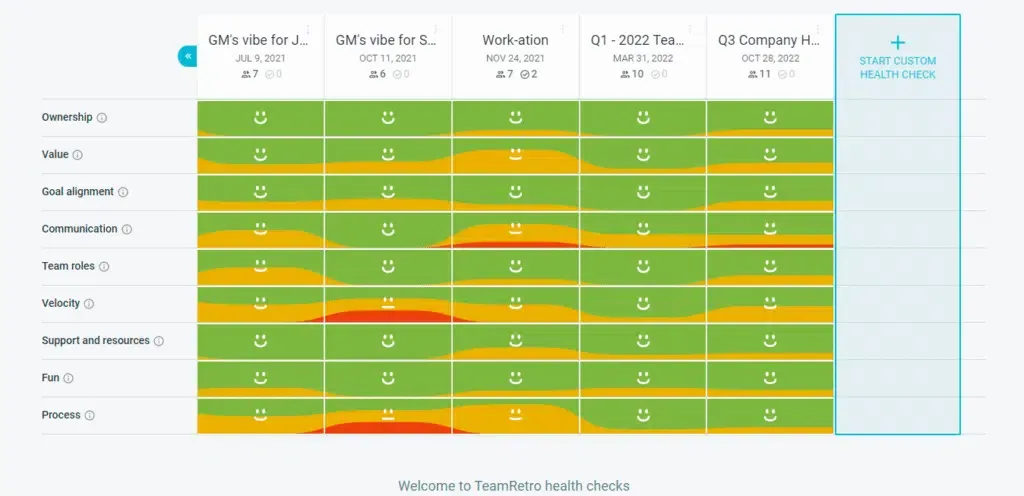
As time passes and team members come and go, it is important to revisit the health check. After all, what makes people feel safe will change over time.
Frequently asked questions
What is psychological safety in a team?
Psychological safety is a shared belief that the team is a safe place to take interpersonal risks: to ask a question, admit a mistake, or raise a concern without fear of blame or embarrassment. The term is associated with Harvard professor Amy Edmondson, and it is the foundation that lets a retrospective produce honest feedback.
Why does psychological safety matter in a retrospective?
A retrospective only works if people speak honestly, and people only speak honestly when they feel safe. Without psychological safety you get silence and “everything’s fine”; with it you get the real problems on the table and genuine improvement. It is the single biggest factor in whether a retrospective creates value or just goes through the motions.
How can a Scrum Master build psychological safety?
A Scrum Master builds safety by modeling openness (sharing their own mistakes and asking for feedback), supporting team connectedness, setting team agreements, leaning on the Retrospective Prime Directive, and using tools that allow anonymous input. Running regular team health checks helps track whether safety is improving over time.