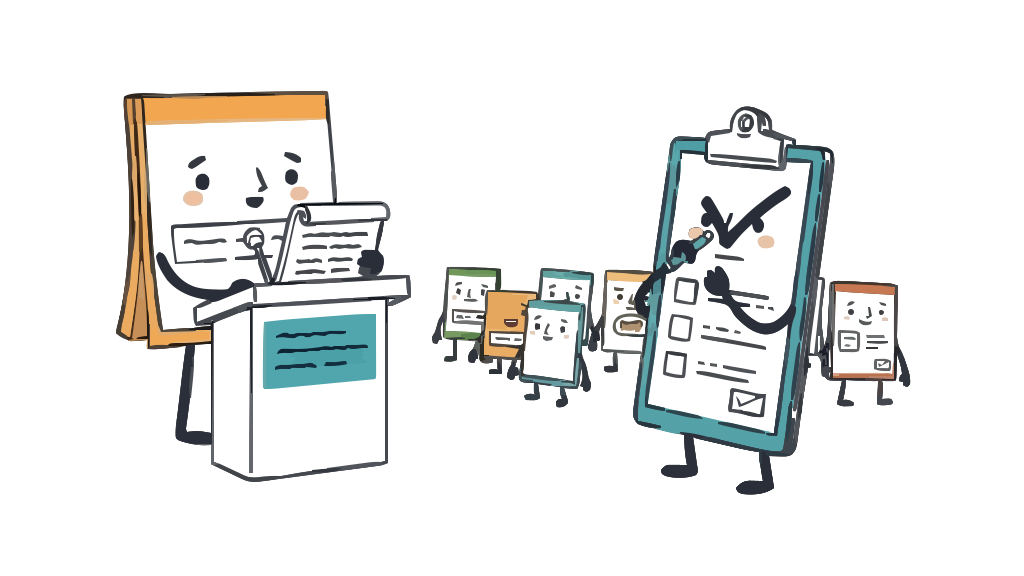
Performance: the ceremony you run for the audience
The first failure mode of agile theatre: ceremonies run for appearance, not function. Status-theatre standups, cargo-cult estimation, and the box-ticking retro, plus how to tell function from performance.
A ceremony becomes theatre the moment its real audience stops being the team.
That’s the whole test, and it cuts across every meeting on the sprint calendar. A standup performed for a manager’s eyeline. Estimates recited to look rigorous. A retrospective held because the recurring invite fired, not because anyone expects it to change anything. In each case the ritual is intact and the function is gone, and the team, who can always tell, quietly stops investing. Performance is the first failure mode of agile theatre, and it’s the substrate the other three grow out of.
The status-theatre standup
The daily standup is the most-performed ceremony in software, because it’s the easiest to hijack. Per the Scrum Guide, the Daily Scrum exists for the developers to coordinate their own plan for the day. The manager isn’t supposed to be running it, or in many teams even attending. What it becomes instead is a status report wearing a team-huddle costume: everyone recites what they did yesterday to the person who signs off on their review, and no one actually talks to anyone else.
You can spot the performance by where people are looking. In a coordination standup, developers talk to each other and to the board; someone says “I’m touching the auth module today” and someone else says “wait, so am I, let’s sync after.” In a status standup, each person reports to one face and the rest wait their turn. The tell is even sharper in the coping behavior: on a good week people hold a little work back so they’ve got something to report on a bad one, and the update becomes a small daily exercise in managing appearances rather than sharing information. When 60% of the ritual is keeping up a certain kind of face, the meeting has stopped being coordination.
The fix isn’t to add energy to the performance. It’s to change the audience. Point updates at the work, not the boss: walk the board, not the room. If the status already lives in the tracker, the pull requests and the chat, then reciting it aloud is pure ceremony; the meeting’s only real jobs are surfacing blockers and coordinating today’s overlaps. Everything else can be read asynchronously, from updates people post in a standup tool on their own schedule. Our standup anti-patterns chapter catalogs the specific tells, and the async and remote standup chapter covers how to move the status part off the clock entirely.
The cargo-cult estimate
Estimation theatre is quieter but just as common. A team runs planning poker because planning poker is what you do (cards come out, numbers get voted, a Fibonacci sequence lends an air of science), and then everyone privately converts the points back into hours anyway. The mechanics are performed flawlessly while the purpose evaporates. Practitioners have a withering shorthand for it: a group of adults arguing about what color paper a work item should be, a cargo cult that mimics the form of estimation in the hope the outcome follows.
Here’s the thing the ritual obscures: the number was never the deliverable. As Eisenhower put it, “plans are worthless, but planning is everything.” The estimate is worthless, but the estimating is the point. Planning poker isn’t a prediction machine; it’s a disagreement detector. When one engineer votes a 3 and another votes a 13 on the same story, that eight-point gap means they are picturing two different pieces of work, and the conversation that closes the gap is the entire value of the meeting. A team that votes, splits the difference, and moves on has performed the ceremony and skipped the work.
Concretely: run a silent first round so the tech lead’s card doesn’t anchor everyone; make the high estimate speak before the low one; and if nobody can explain a story well enough to size it, that’s not a number problem, it’s a refinement problem. Our how to run planning poker and planning poker mistakes chapters go deep on defeating the anchoring the ceremony is supposed to prevent, and what story points actually are explains why the points-to-hours conversion is the failure, not the fix.
The box-ticking retro
Then there’s the retrospective that runs because the calendar says so. Same format every fortnight, same stickies, same three columns, same silence. Practitioners describe it exactly: a box-ticking exercise, a shortened ritual with no useful effect, meetings that felt forced and awkward. The ceremony persists as a habit long after anyone believes in it.
The reflex is to reach for a new format: swap the columns for a sailboat, try a starfish, download a fresh template. Sometimes that helps. But be honest about what a format can and can’t fix. As one sharp practitioner argument goes, your retrospective format doesn’t matter: changing the activity is lipstick if the real problem is that nothing ever happens afterward. A stale ritual is a Performance problem you can solve with variety and better facilitation. A ritual that produces words and no change is a different failure entirely. That’s the follow-through void, the fourth mode, and no amount of format-chasing touches it.
So diagnose before you redecorate. If the room is going through the motions, freshen the format and put one concrete thing at the top of the agenda: last retro’s single improvement, and whether it happened. If the room is engaged but nothing changes downstream, the format was never the issue. Our retrospective guide covers both, and the psychological safety chapter addresses the silence that so often reads as apathy but is usually something colder.
”Real Scrum has never been tried”
Every critique of a performed ceremony draws the same rebuttal: you’re just doing it wrong, that wasn’t real agile. It’s the agile equivalent of “real communism has never been tried,” and it’s worth naming because it’s how Performance defends itself. If every failure can be waved away as “not the real thing,” the framework becomes unfalsifiable, and a practice you can’t criticize is a practice you can’t improve.
But the rebuttal isn’t always a dodge. The retrospective and the standup have published definitions: the Scrum Guide, the Agile Manifesto, the standard practitioner texts. Measuring a bad ceremony against what it’s supposed to be isn’t a no-true-Scotsman move; it’s using the actual spec. The line to hold is this: “you’re doing it wrong” is a cop-out when it’s the fifth team in a row that’s somehow doing it wrong, and it’s fair when it names the gap concretely. The Scrum Guide time-boxes the daily at fifteen minutes and yours runs forty; the retrospective belongs to the team and yours is chaired by the manager. One of those is a dodge; the other is a diff. The four modes in this guide are our attempt to name those gaps precisely enough that “do it right” means something.
Performance is where theatre starts, but it’s rarely where it ends. When appearance-management collides with a power imbalance, the performance turns coercive. That’s Power. When the ceremonies pile up past the point of use, that’s Overload. And when the meeting runs beautifully and nothing changes, that’s the Void. Start by asking the Performance question of every ceremony you run, who is this actually for?, and you’ll find the other three hiding behind it.
Frequently asked questions
How do I know if our standup is just a status meeting?
Watch where people look. In a coordination standup the team talks to each other and to the board; in a status meeting everyone reports to one person’s eyeline and nobody responds to anyone else. If the manager’s absence would change the meeting, it was theirs, not the team’s.
Is planning poker a waste of time?
Only if you skip the part that matters. Voting on tickets nobody analyzed is theatre. The value isn’t the number. It’s the disagreement it surfaces. When one person votes 3 and another votes 13, the gap is the whole point of the meeting.
Does the retrospective format matter?
Less than vendors selling formats want you to think. Swapping Mad/Sad/Glad for a sailboat is lipstick if nothing changes afterward. A fresh format fixes a stale ritual; it does nothing for a retro whose real problem is that no one acts on it.
What is agile theatre?
A ceremony run for appearance rather than function: going through the motions of a standup, planning session or retrospective so the process looks followed, while the thing the ceremony exists to produce quietly doesn’t happen. Performance is the first and most common of its four failure modes.
Related reading
- Power: when authority captures the ceremony: where performance turns coercive.
- The follow-through void: the retro that runs well and changes nothing.
- Standup anti-patterns: the specific tells of a status-theatre standup.
- The daily standup (daily scrum): what the ceremony is for, before it becomes a status performance.
- How to run planning poker: running estimation for the conversation, not the number.
- Agile Theatre glossary: the four coined failure modes, defined.