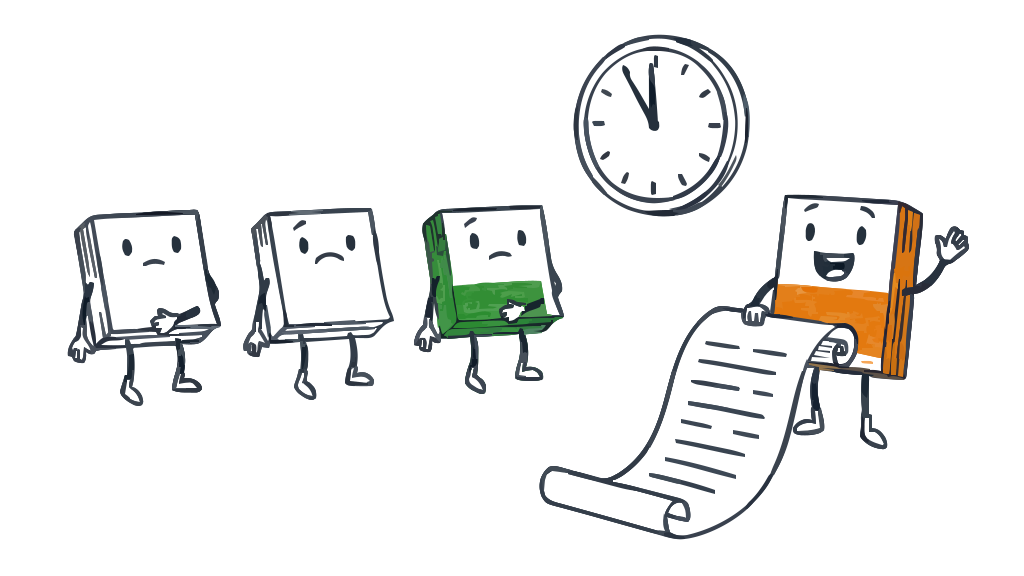
Why your standup is broken: the common anti-patterns
The daily standup anti-patterns that quietly kill the meeting: status theatre, the manager report, the forty-minute overrun, blockers nobody follows up, and how to fix each.
A daily standup doesn’t fail loudly. It decays. The meeting keeps happening, people keep showing up, and one sprint at a time it turns from a coordination checkpoint into a fifteen-minute tax that nobody defends and nobody quite cancels. The complaints you hear (“pointless,” “a waste of time,” “just list out yesterday’s tasks”) are almost always describing one of a handful of specific anti-patterns.
This chapter is a diagnostic. Find the pattern you recognize, fix that, and resist the urge to cancel the meeting. A broken standup is a symptom, and canceling it just moves the problem somewhere less visible.
Anti-pattern 1: status theatre
The most common one. Everyone takes a turn narrating what they did, the room half-listens, nothing gets acted on, and the meeting produces the appearance of coordination with none of the substance. One team put it perfectly: “we kept talking about small day-to-day tasks, the kind that fill your day but don’t move the needle.”
Status theatre is the default state the three questions decay into. It feels productive because everyone spoke, but the test is simple: did anything said change what a teammate does today? If not, you performed a meeting.
The fix: stop organizing around people and organize around work. Walk the board, lead with blockers, and cut anything that doesn’t affect someone else’s plan. See the three standup questions for why the classic format tips into theatre and how to answer the intent instead of the literal words.
Anti-pattern 2: the daily manager report
The standup where updates are aimed at the manager or Scrum Master at the front, not at the team. This is the anti-pattern that makes people ask whether standups are micromanagement, and when it’s run this way, they’re not wrong.
The fix: make it explicitly the team’s meeting. If a manager attends, their role is to listen and to clear blockers they’re uniquely placed to clear, not to question. Redirect updates that drift toward the front: “tell the team, not me.” How to run an effective standup has the facilitation moves.
Anti-pattern 3: the forty-minute standup
A fifteen-minute meeting that reliably runs to forty. There’s a well-worn field story here. A coach joins a team’s “daily scrum,” it lasts forty-two minutes of one-by-one status reports, and the team can’t work out why they’re moving slower every sprint. The two are connected. A standup that long isn’t coordinating the team; it’s consuming the time the team needs to do the work.
The cause is almost never rambling for its own sake. It’s problem-solving. Two people find a real issue and start solving it while eight others watch.
The fix: the parking lot, held ruthlessly. Problems get surfaced in the standup and solved outside it. Name the topic, name who’s needed, move on, and hold a hard end time even mid-sentence. The daily standup agenda shows where the parking lot sits in the run of show.
Anti-pattern 4: blockers that go nowhere
The subtle one. The standup surfaces blockers just fine (someone says “I’m stuck on X” every morning) but nothing ever comes of it. No owner, no follow-up, and the same blocker resurfaces the next day, and the day after.
This is worse than not raising blockers at all, because the team learns that the standup is where problems go to be acknowledged and then ignored. Once people believe that, they stop bothering to raise the real ones.
The fix: every blocker gets a name and a “we’ll sort it right after” before the meeting ends, and a standup tool that tracks blockers with a count of the days each has been open keeps the follow-up honest. A blocker without an owner isn’t a blocker that’s been raised. It’s a blocker that’s been narrated.
Anti-pattern 5: the standup a great team has outgrown
The counterintuitive one. Sometimes the meeting feels pointless because the team genuinely doesn’t need it in its current form. A mature, high-trust team already raises blockers the moment they hit them, in the channel, without waiting for a 9:30 slot. For them, a rote daily meeting is friction, not help.
A daily standup is partly a workaround for a team that can’t yet see itself clearly. That’s not an insult. Most teams need it, and a young or reforming team needs it badly. But if yours has outgrown the workaround, the answer isn’t to keep performing the ritual. It’s to go async, go lighter, or use the format catalog to find something that fits the team you’ve become.
How to actually fix it
Don’t reach for a new format first. Diagnose:
- Nothing gets acted on → status theatre. Walk the board; lead with blockers.
- Updates point at the manager → the manager report. Make it the team’s meeting.
- It runs long → problem-solving in the room. Parking lot, hard timebox.
- Blockers recur → no follow-up. Assign an owner to every blocker.
- It feels like friction to a strong team → you’ve outgrown it. Go lighter or async.
And put the meeting itself on a retrospective agenda now and then. “How we run standup” is exactly the kind of process question the retrospective exists to fix, and the two meetings are meant to improve each other.
For the constructive side of all this, how to run a standup worth the fifteen minutes, see the rest of the daily standup guide.
Frequently asked questions
Why do daily standups feel like a waste of time?
Usually because the meeting has turned into status theatre. Everyone recites what they did to an audience, nothing gets acted on, and the fifteen minutes produce no coordination. A standup that changes nobody’s day is a waste of time, and people are right to resent it. The fix isn’t to cancel it; it’s to make it about surfacing and clearing blockers, which is the only thing it was ever for.
Are daily standups micromanagement?
Not by design, but they tip into it easily. A standup becomes micromanagement when it’s aimed at a manager who scrutinizes every detail, rather than run by the team to coordinate itself. The tell is the direction the updates point: toward the front of the room, or toward each other. Fix it by making it the team’s meeting, cutting the manager’s role to listening, and focusing on blockers instead of activity.
Why does my standup run so long?
Because the team is solving problems in a meeting built only to surface them. The moment two people start debugging, everyone else is stuck watching, and a fifteen-minute sync becomes a forty-minute one. The fix is a hard parking-lot habit: name the deep topic, note who’s needed, move on, and hold that conversation right after with only the people it concerns.
What are the signs a standup is broken?
People multitask or arrive late, updates are aimed at a manager, blockers get aired but never followed up, the meeting regularly overruns, and nothing anyone says changes what a teammate does that day. If updates are just yesterday’s task list read aloud, and the sprint feels slower rather than more coordinated, the meeting has become theatre. Diagnose the specific anti-pattern before you change the format.