Daily standup agenda and format
A real fifteen-minute daily standup agenda: the minute-by-minute run of show, walking the board, the parking lot, and the facilitation that keeps it on time.
A daily standup agenda is deliberately thin: orient on the goal, work through what’s in progress, assign owners to any blockers, and stop. The whole thing fits in fifteen minutes because the meeting is a sync, not a working session. The moment it tries to be more, the timebox breaks.
Here is a standup agenda that actually holds to fifteen minutes.
The fifteen-minute run of show
Orient on the sprint goal (0:00 – 1:00). One sentence from the facilitator: what are we trying to finish this sprint, and are we on track. This is the anchor every update points back to. Skip it and the meeting drifts into disconnected status.
The main body (1:00 – 12:00). This is where most of the time goes, and you have two ways to run it:
- Walk the board (recommended for any team past its first few sprints). Move across the items in progress and talk about the work.
- The three questions, person by person: yesterday, today, blockers. Fine for a new team; prone to becoming a status recital. See the three questions and their alternatives.
Blockers and owners (12:00 – 14:00). Sweep the blockers that came up. Each one gets a name attached and a “we’ll sort it right after.” No solving, just ownership.
Parking lot (14:00 – 15:00). Confirm the deeper conversations that got parked, and who’s staying for each. Then close.
Those times are a shape, not a stopwatch. A team of five often lands the whole thing in eight minutes. The point isn’t precision. It’s that every block has a purpose, and none of them is “problem-solving.”
Walk the board, don’t walk the room
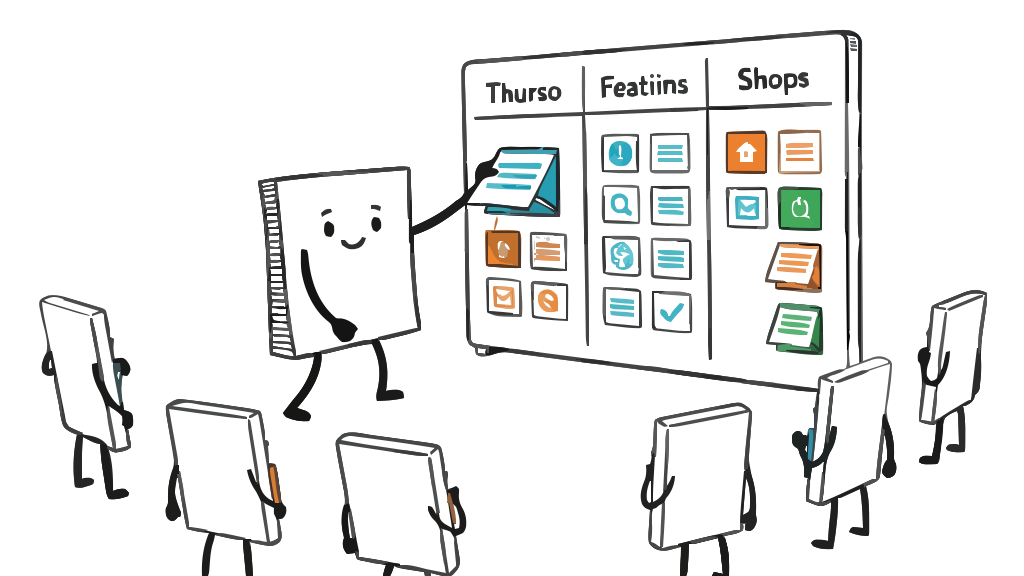
The single highest-leverage change to a standup agenda is to organize it around the board rather than the people. Start at the column closest to done and move backward toward the newest work. For each item: who’s on it, what’s it waiting on, what does it need to move.
Why right to left? Because it biases the team toward finishing over starting: you spend your attention on the work closest to shipping, not the shiny new thing someone picked up this morning. It also makes stalled work impossible to miss. A person can narrate a busy day; a card sitting in the same column for three days cannot.
The parking lot is what makes the timebox real
Every standup contains the seed of its own overrun: two people find a genuinely interesting problem and start solving it while eight others watch. The parking lot is the fix, and it’s a facilitation habit more than a place.
When a conversation goes deep, the facilitator says some version of: “Good one. Let’s park it. Priya, Sam, can you two grab five minutes right after?” Name the topic, name who’s needed, move on. The discussion still happens. It happens with the two people it concerns, immediately, instead of with the whole team, never.
Who owns the agenda
Someone has to hold the shape, or it doesn’t hold. On a Scrum team that’s often the Scrum Master, at least early on, but the goal is a team that runs its own standup without a designated timekeeper. The facilitator’s job is small and specific: open on the goal, keep the board moving, park the deep dives, end on time, which is easier in a timeboxed standup tool that shows how long is left. It is not to receive updates. For the facilitation moves in detail (handling the rambler, the dominator, the silent day), see how to run an effective standup.
Once the agenda is working, the fastest way to make it stick is to give people a consistent format to fill in. Copy-paste standup templates provide exactly that for both live and async teams. And if the daily agenda feels stale, the standup format catalog has ways to vary it without losing the fifteen-minute discipline.
For how the standup’s agenda fits alongside the other sprint meetings, see the agile ceremonies guide; for the rest of the daily-standup chapters, head back to the guide hub.
Frequently asked questions
What is the agenda for a daily standup?
A minute or two to settle and orient on the sprint goal, then the main body (either the three questions or, better, walking the board), then a quick sweep to assign owners to any blockers and hand off deeper discussions to a parking lot. Total: fifteen minutes or less. The agenda is deliberately thin because the meeting is a sync, not a working session.
How do you structure a fifteen-minute standup?
Front-load what matters. Open on the sprint goal so every update has something to point at, spend the bulk of the time on the work in progress, and reserve the last minute to confirm who owns each blocker. Keep problem-solving out of the meeting entirely. The timebox holds only because deeper conversations are pushed to a parking lot the moment they start.
What is a parking lot in a standup?
The parking lot is where any topic that needs more than a sentence goes to wait. When two people start problem-solving, the facilitator names the topic, notes who needs to be in it, and moves on. The discussion happens right after the standup with only the people it concerns. It’s the single mechanism that keeps a fifteen-minute meeting from becoming a forty-minute one.
How do you keep a daily standup to fifteen minutes?
Hold a hard timebox and end on time even mid-sentence, use the parking lot for anything that needs debate, and consider walking the board instead of going person by person so the focus stays on the work. The overrun is a signal, not a failure: a standup that regularly runs long is telling you the team is trying to solve problems in a meeting built only to surface them.