Estimating a login feature
How to estimate a login feature: the hidden scope (password reset, 2FA, federation, rate limiting, sessions) and the questions to land before anyone votes.
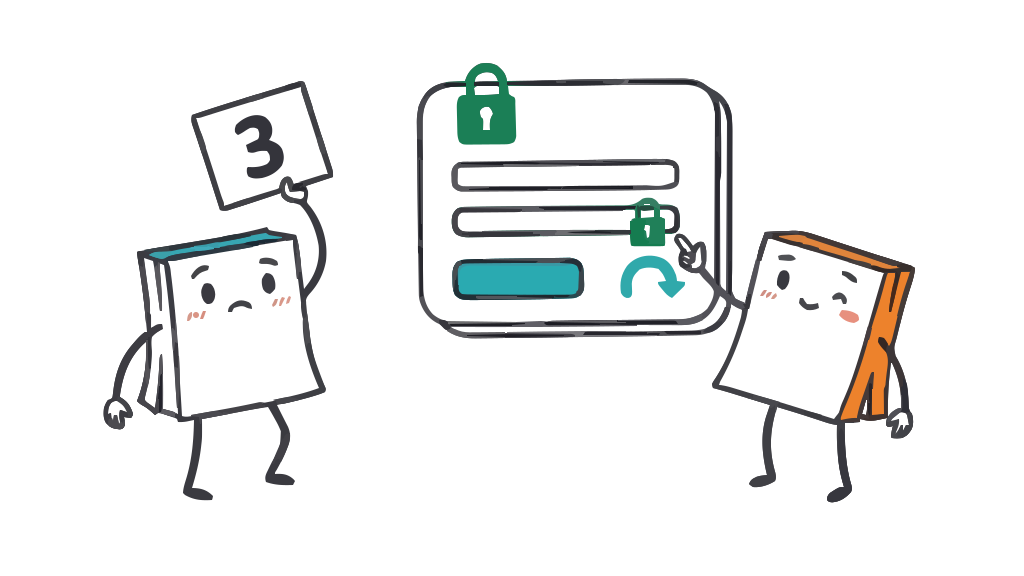
Login stories are almost never a 3, but someone always votes 3.
“Add login” reads small because everyone in the room has shipped login before, on a different product, with a different set of decisions already made. The scope you remember is the scope from last time, not the scope you’re about to take on. The story sounds like a known quantity right up until someone asks one of the questions below, and then it isn’t.
The trap isn’t that login is hard. It’s that the discussion ends before the trade-offs are visible. Backend engineers anchor on “we have a library for this.” PMs anchor on the happy-path screenshot. Whoever has actually built the thing recently is the one who breaks the false consensus, usually with a question that wasn’t on the ticket.
What gets said in the room
Backend: “It’s just JWT, we have the library.”
Security: “Password reset isn’t ‘just JWT’.”
PM: “Do we need 2FA on day one, or is that a follow-up?”
Frontend: “Are we federating to Google and Apple, or rolling our own?”
SRE: “What’s the rate limit on the login endpoint?”
Questions worth asking before voting
- Is there a password-reset flow, and who owns the email template?
- Federated identity (Google, Apple, SSO), or username and password only?
- Session storage: JWT, server session, both, refresh tokens?
- Rate limiting and account lockout on the login endpoint?
- 2FA in scope now, or a deliberate “later”?
- Audit logging for failed attempts?
Most of these answers are either “trivial” or “that’s its own ticket.” Count the second kind. Two or more, and you don’t have a story yet: you have a candidate for splitting, and the 3 you were about to vote is measuring the wrong thing.
If your team votes 3 on login, the conversation hasn’t happened yet. Send it back.
Adjacent: common planning-poker mistakes covers what goes wrong inside the session; how to run a session has the four-phase loop. See the other worked estimation examples, or open a free planning poker session and walk this story through it.