

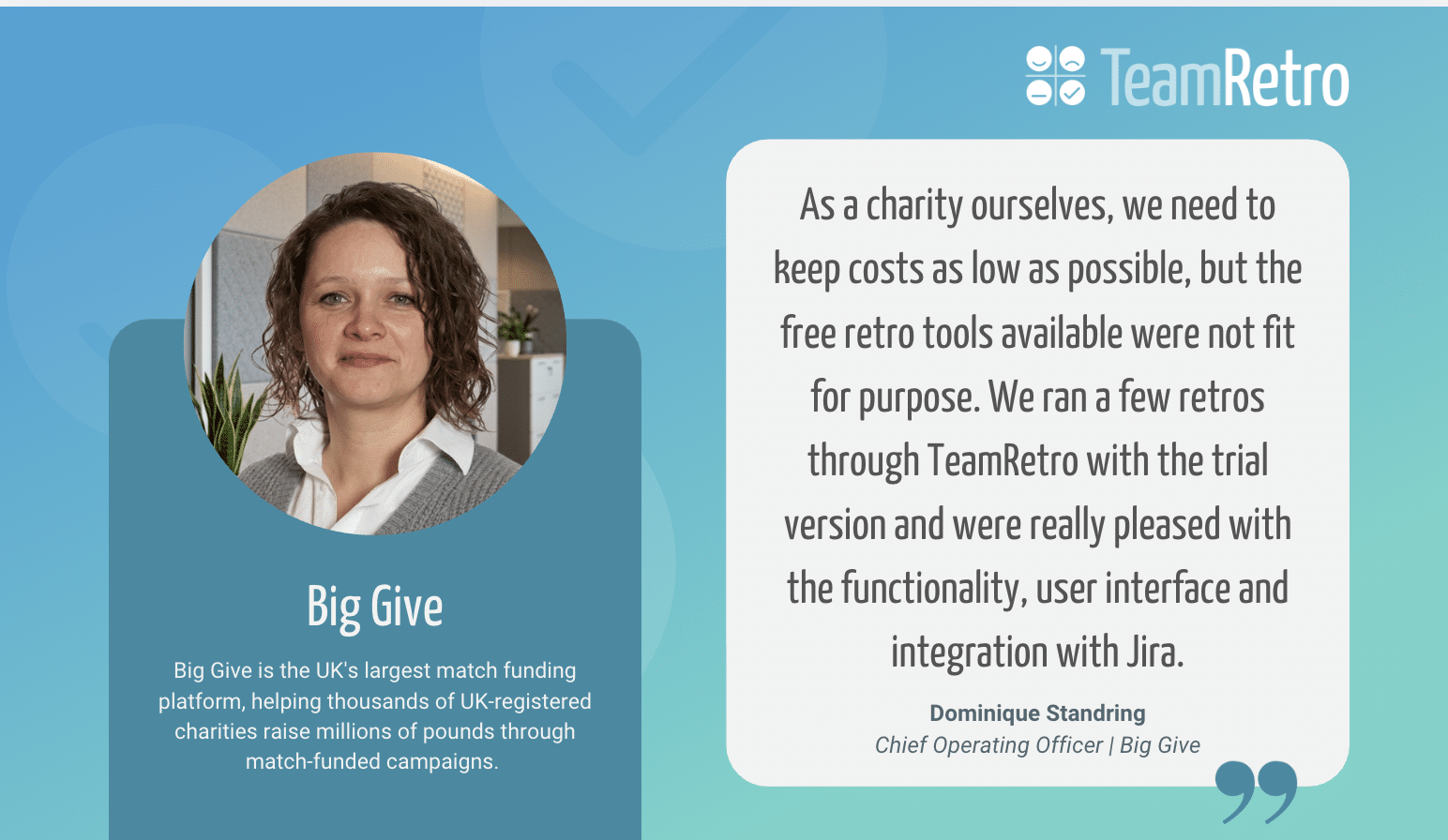
At Big Give, small means mighty. Big Give is the UK’s largest match funding platform, helping thousands of UK-registered charities raise millions of pounds through match-funded campaigns. With just 12 people driving that outsized impact, every process, every conversation, and every lesson learned counts. For a team this size, finding the right online retrospective tool wasn’t a nice-to-have, it was essential to staying sharp. We’re genuinely proud to support Big Give and the work they do, and even prouder that they’ve trusted us to share their story here.
This case study was contributed by Dominique Standring, Chief Operating Officer (COO) at Big Give, who has over 12 years of experience designing systems and processes in the charity sector. Dominique shares how TeamRetro helped transform Big Give’s retrospective practice from a fragmented, time-consuming exercise into a reliable engine for continuous improvement.
The challenge: Lost data and no central home for reflections
For a team that prizes learning and constant improvement, running effective retrospectives wasn’t optional — it was baked into the culture. Big Give uses the retrospective format not just for sprint reviews, but for structured reflection after each of their match-funded campaigns.
The problem? Their tooling wasn’t keeping up.
As a charity, keeping costs low is a real constraint — but that couldn’t come at the expense of quality. Big Give needed a solution that was both affordable and genuinely fit for purpose.
Why Big Give chose TeamRetro
A straightforward Google search led Dominique to TeamRetro. After running a few trial retrospectives, the decision was clear.
The combination of a clean user interface, strong functionality, and Jira integration made TeamRetro stand out from the alternatives. What clinched it was actually using it: the trial experience gave the team enough confidence to commit.
How Big Give uses TeamRetro
Big Give now runs two distinct retrospective rhythms with TeamRetro: every four weeks for the development team, and after each of their six annual campaigns for the whole organisation.
One of Dominique’s top tips for anyone learning how to run retrospectives remotely? Set up the board well in advance.
“The ability to set up a board and invite participants long in advance of a retro is great because it means we can capture reflections directly on the board while they are still fresh.”
That head start transforms the quality of the conversation. Instead of asking people to recall how they felt three weeks ago, reflections are captured in the moment and ready to explore when the team gathers.
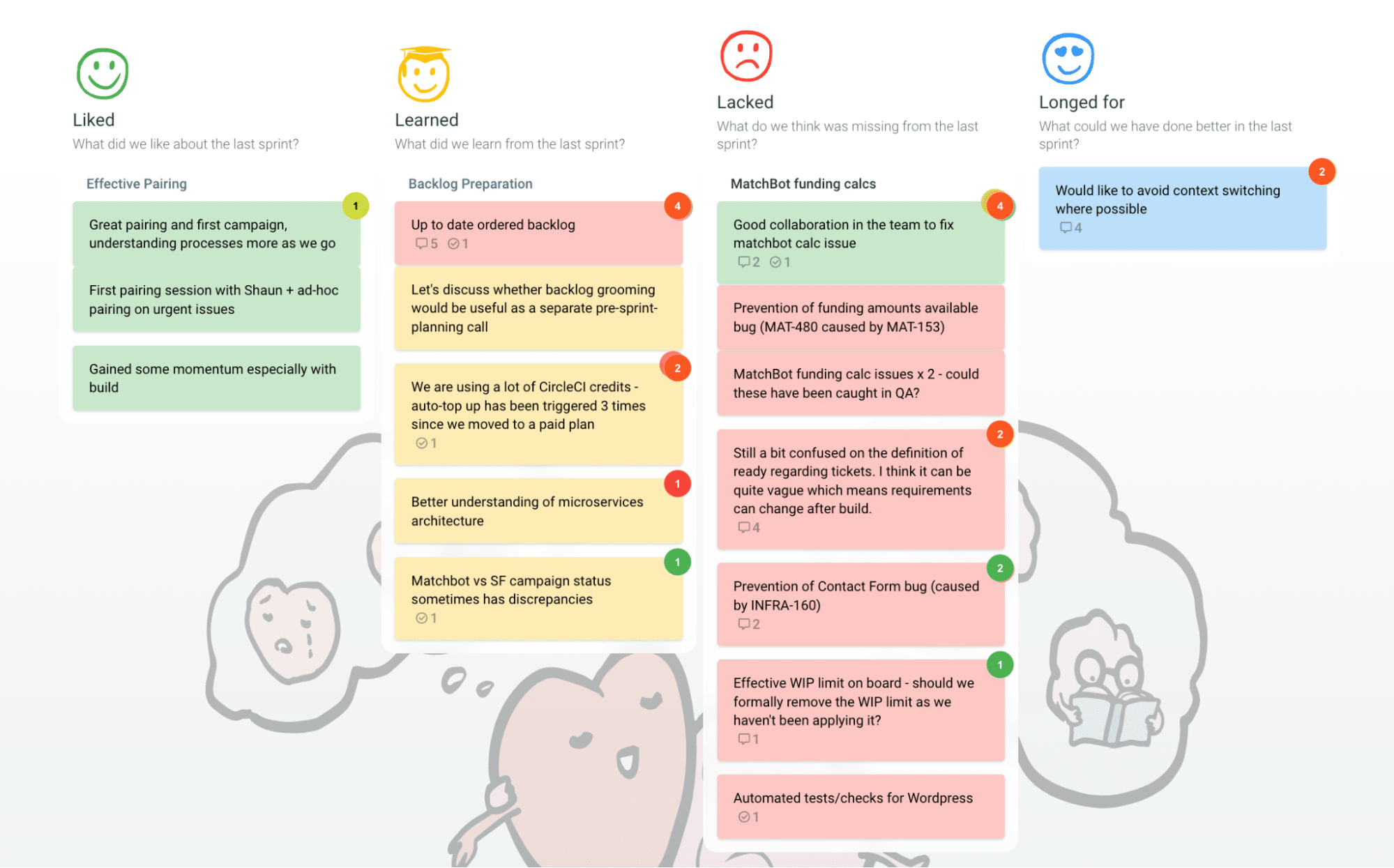
Image provided by Big Give – reproduced with permission
Benefits the team experienced
A richer, more connected conversation
Working mostly from home, Big Give relies on TeamRetro as their retrospective tool for remote team collaboration. The asynchronous features — commenting and emoji reactions — let team members engage with each other’s reflections before the live session even begins.
“This allows for a much richer conversation when we’re holding discussions about each reflection.”
One central home for every retro
One of the most tangible wins has been having all retrospectives in one place. No more lost data, no more hunting through old tools or documents. For a professional, fast-paced team running continuous improvement retrospectives across multiple campaigns and development cycles, that consistency is invaluable.
“Efficiency and central data storage have made our retros more productive and helpful.”
A Jira integration that closes the loop
The retrospective tool’s Jira integration was a key reason Big Give chose TeamRetro — and it continues to be one of its most valued features. Actions don’t get lost between tools. They flow straight into the team’s existing workflow, keeping accountability tight without adding friction.
A format the team actually enjoys
When it comes to the live discussion, the team appreciated TeamRetro’s presentation mode, which keeps the conversation focused and structured. Combined with the ability to comment on individual tickets, it makes the discussion feel purposeful rather than scattered.
“The team liked the interface, the fact that you can comment on tickets and the presentation mode for the discussion.”
Outcomes for a team with an outsized impact
For an organisation of 12 people, continuous improvement isn’t a nice-to-have — it’s how Big Give punches above its weight.
“TeamRetro is helping us become more efficient while maintaining high quality and a good work-life balance for everyone — not only in the fact that we now have all of our retros in one place but also in the ease of use and integration with other platforms.”
Dominique’s tip for running remote retrospectives
Dominique’s advice is simple, practical, and easy to implement:
“Set up the boards in advance so people can add things as they come up.”
It’s one of the most underrated techniques for anyone figuring out how to run retrospectives remotely. Reflections captured in the moment are more honest, more specific, and more useful than memories reconstructed days later. If you’re not already opening your boards early, start there.
Want more than what a free agile retrospective tool can offer? Try TeamRetro and see what a difference the right choice makes.