

Estimation plays a critical role in agile planning, but it’s not just about assigning numbers or sizes to user stories. At its core, estimation is about building shared understanding, setting expectations, and enabling teams to plan and deliver work more reliably.
It’s a surprisingly human exercise that blends structured guessing with group psychology, with just enough maths to keep everyone honest.
Choosing the right deck improves agile story point estimation, team alignment, and boosts team velocity. It can simplify complex work and add structure to abstract ideas during backlog refinement or sprint planning.
It can directly influence how easily you reach consensus, how confident people feel about their estimates, and how accurately you can forecast future sprints. And who wouldn’t want that?
So here’s the crunch.
I’ve got an estimation meeting coming up with my team. – “How do I choose the right deck?”
Here we explore the common choices for planning poker card decks, share our top tips and things you need to think about when choosing a deck, and use a case in point example to compare two common methods. In this case Fibonacci versus T-Shirt size.
Fun origin fact
Planning poker is based on Wideband Delphi, a forecasting method invented by the RAND Corporation sometime between the 1940s and 1968 (even historians can’t agree 😄). It was modernised for Agile teams in 2002 and made mainstream by Mike Cohn.
Choose your planning poker deck: Why the numbers matter?

When it comes to planning poker decks, the numbers are doing more work than you think.
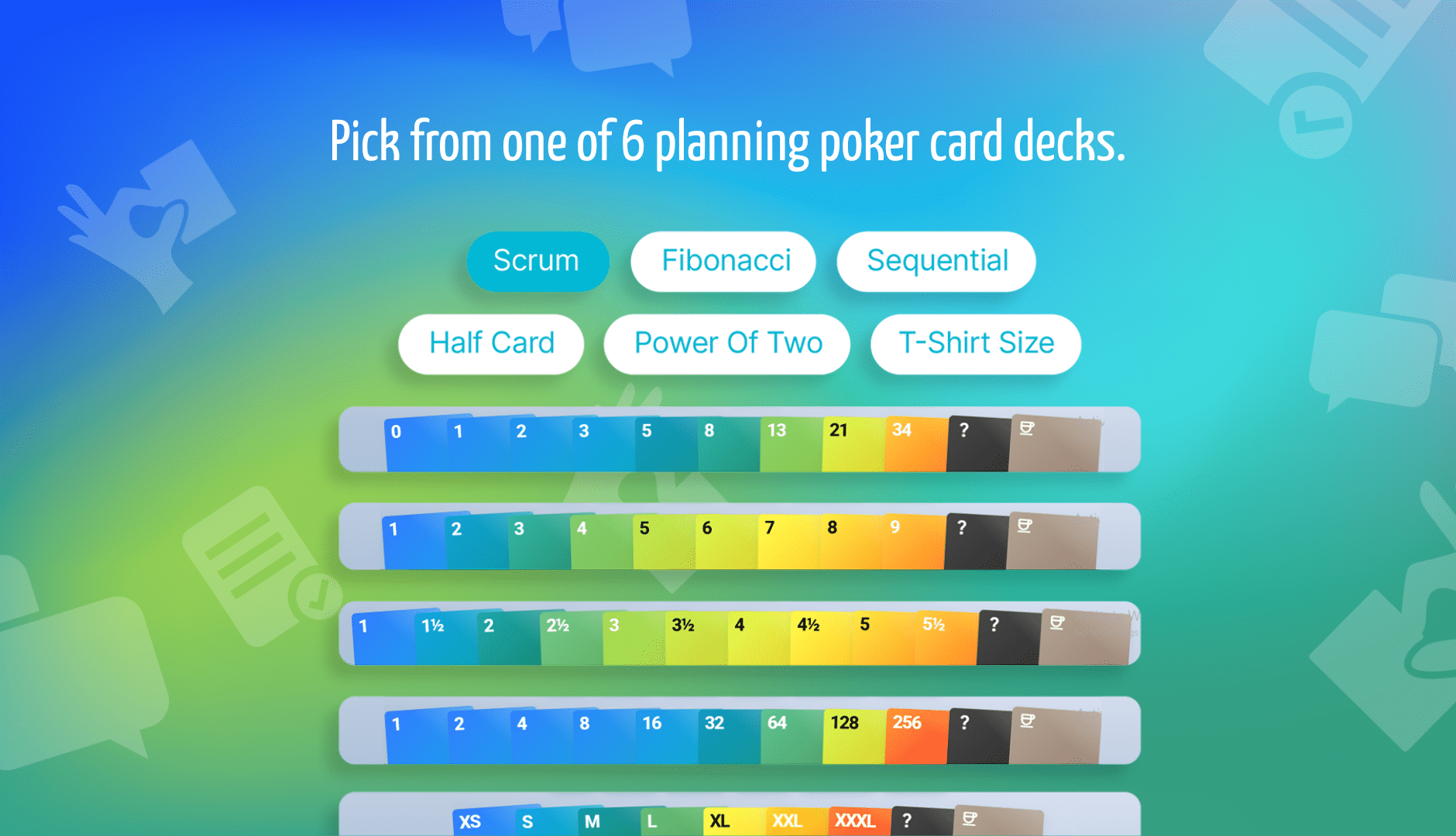
Some of the most common card decks include:
- Scrum: Based on the traditional Scrum values (0, 1,2,3,5,8) this deck helps standardize estimates across agile teams following Scrum methodologies.
- Fibonacci: A sequence (1, 2, 3, 5, 8, 13…) a sequence that intentionally gets less precise as numbers grow to represent increasing levels of effort and complexity.
- Sequential: A linear progression of numbers (e.g., 1, 2, 3, 4, 5…) for teams who want more consistent, evenly spaced estimates. A popular choice where projects have less variations. This can also be used for estimating based on Ideal days or time based.
- Half card: Allows for finer granularity between common estimates by including values like (1, 1½, 2, 2 ½, 3) – a more precise estimation sequence that further refines estimations.
- Power of two: Exponential sizing (1, 2, 4, 8, 16…) is a variation on the fibonacci sequence that emphasizes uncertainty when it comes to the larger tasks.
- T-shirt sizing: Abstract labels like XS, S, M, L, XL that work well for high-level planning, relative ranking or when collaborating with cross-functional teams. It can be a useful discussion point to get a general team definition of each t-shirt size.
There are some other variations out there including weighted averaging and weighted shortest job first, but they tend to over complicate something which cannot be so precisely calculated and leads to an over reliance that the final output must be accurate simply due to its complexity.
Factors for choosing the right planning poker card deck
When selecting a deck, the goal isn’t perfection — it’s clarity and consistency. The right deck should support productive conversations and fit naturally into how your team already works. A few factors can help guide the decision:
Workflow alignment
Choose a deck that fits naturally with the tools, ceremonies, and processes your team already uses. The best deck is one your team doesn’t have to think about.
Team experience
T-shirt sizing is often easier for newer or mixed-discipline teams, while Fibonacci estimation works well for teams comfortable discussing relative complexity and trade-offs.
Level of precision
Numeric decks support more detailed estimates, while abstract sizing keeps early planning lightweight and avoids false precision.
Planning goals
T-shirt sizing works well for discovery and roadmap conversations. Fibonacci and similar numeric decks are better suited to sprint planning and tracking team velocity over time.
Risk and uncertainty
If work items vary widely in unknowns, decks like Fibonacci or Power of Two help surface uncertainty by spreading estimates further apart as size increases.
Nature of the work
Routine or repeatable tasks may suit linear or time-based decks, while exploratory or creative work benefits from relative or abstract sizing.
Speed of decision-making
Abstract or bucket-style decks encourage faster consensus and reduce over-analysis when working through large backlogs.
Cross-team consistency
If multiple teams collaborate or compare estimates, using the same deck can reduce confusion and make shared planning more effective.
Cognitive load
Simpler decks reduce mental overhead, helping teams focus on discussion and shared understanding rather than debating numbers. The decks that are in our estimation set are chosen for a simpler approach.
Change tolerance
Switching decks mid-project can disrupt velocity tracking. Consider whether your team values continuity or is comfortable experimenting with new approaches.
Remote collaboration
For remote teams, decks with fewer options and clearer distinctions often work better, reducing friction and decision fatigue during online sessions.
Ultimately, the best planning poker card deck is the one that encourages meaningful conversations, builds shared understanding, and supports how your team works day to day.
While there are some default or go to – popular models, it’s (excuse the pun) not a one size fits all scenario.
Planning poker card deck decision matrix
Legend:
★★★ = Strong fit
★★☆ = Can work
★☆☆ = Not ideal
| Card deck → Decision factor ↓ |
Scrum | Fibonacci | Sequential | Half card | Power of two | T-shirt sizing |
|---|---|---|---|---|---|---|
| Early discovery / roadmap planning | ★☆☆ | ★★☆ | ★★☆ | ★☆☆ | ★☆☆ | ★★★ |
| Sprint planning & delivery | ★★★ | ★★★ | ★★☆ | ★★★ | ★★☆ | ★☆☆ |
| New or mixed-discipline teams | ★★☆ | ★☆☆ | ★★★ | ★☆☆ | ★☆☆ | ★★★ |
| Experienced agile teams | ★★★ | ★★★ | ★★☆ | ★★★ | ★★★ | ★★☆ |
| High uncertainty / unknowns | ★★☆ | ★★★ | ★☆☆ | ★☆☆ | ★★★ | ★★☆ |
| Predictable, repeatable work | ★★☆ | ★★☆ | ★★★ | ★★★ | ★☆☆ | ★☆☆ |
| Needs high precision | ★☆☆ | ★★☆ | ★★☆ | ★★★ | ★☆☆ | ★☆☆ |
| Avoid false precision | ★★☆ | ★★★ | ★☆☆ | ★☆☆ | ★★★ | ★★★ |
| Fast consensus needed | ★★☆ | ★★☆ | ★★☆ | ★☆☆ | ★☆☆ | ★★★ |
| Encourages discussion & alignment | ★★★ | ★★★ | ★★☆ | ★★★ | ★★☆ | ★★☆ |
| Remote-first teams | ★★☆ | ★★★ | ★★☆ | ★☆☆ | ★★☆ | ★★★ |
| Cross-team consistency required | ★★★ | ★★★ | ★★☆ | ★☆☆ | ★★☆ | ★☆☆ |
Case study: Fibonacci vs t-shirt sizing for an internal product team

An internal product division at a mid-sized organisation was responsible for building and maintaining several shared tools used across the business. They regularly collaborated with stakeholders from operations, finance, and customer support.
While the work wasn’t customer-facing, the impact was significant — small delivery delays often created ripple effects across the business.
The development team was experienced and stable, working in two-week sprints with a predictable release cadence. However, planning sessions were starting to feel strained.
As the product matured, the team needed a clearer approach to estimation that could support both longer-term planning and day-to-day delivery.
The challenge
The team faced two distinct planning contexts:
- Early-stage work, where requirements were still evolving and input from non-technical stakeholders was essential
- Sprint-level work, where stories were well-defined and the team needed reliable estimates to track velocity and forecast delivery
To address this, the team compared two commonly used estimation approaches: Fibonacci estimation and t-shirt sizing.
Option 1: Fibonacci estimation
Fibonacci estimation uses a non-linear number sequence where each value represents a meaningful increase in effort and uncertainty. This helped the team recognise that larger stories were harder to estimate precisely and encouraged deeper discussion when estimates diverged.
The team found Fibonacci particularly effective for:
- Sprint planning
- Tracking velocity across iterations
- Improving forecasting accuracy over time
Once work items were refined and ready for delivery, Fibonacci supported consistent planning and helped the team understand their capacity from sprint to sprint.
Trade-offs
- Slower during early backlog discussions
Less accessible for non-technical stakeholders during planning sessions
Option 2: T-shirt sizing in agile
T-shirt sizing takes a more abstract approach by using relative sizes instead of numbers. This made it easier for stakeholders outside the development team to contribute during planning and kept conversations focused on relative effort rather than precision.
The team found T-shirt sizing especially useful for:
- Early backlog refinement
- Roadmap planning
- Cross-functional or remote planning poker sessions
By removing numbers from the conversation, the team moved faster through early-stage ideas and avoided overcommitting too early.
Trade-offs
- Not detailed enough for sprint-level forecasting
Required translation into numeric estimates before delivery
The decision
Rather than choosing a single deck, the team aligned each approach to a specific planning goal:
- T-shirt sizing for early backlog refinement and roadmap planning
- Fibonacci estimation for sprint planning and delivery
This allowed the team to maintain clarity and consistency without forcing precision too early in the process.
How planning poker card decks influence team velocity
Team velocity isn’t about speed—it’s about consistency. Reliable velocity allows teams to plan with confidence and make better delivery commitments.
Numeric estimation decks like Fibonacci support velocity by helping teams:
- Compare completed work across sprints
- Identify delivery trends
- Improve long-term forecasting
T-shirt sizing influences velocity more indirectly. By keeping estimation lightweight, teams often:
- Plan faster
- Spend more time clarifying scope
- Align earlier before committing to detailed estimates
Both approaches can boost team velocity when used consistently and at the right stage of planning.
There’s no universally “correct” way to estimate. The most effective teams choose an approach that supports clear communication, alignment, and predictable delivery.
As teams grow, their estimation practices often evolve too. Revisiting how you estimate—and why—can be a simple but powerful way to improve planning outcomes and long-term team velocity.
Start estimating in seconds
The planning poker deck your team uses shapes how you plan, collaborate, and deliver. Some teams need numerical precision, while others benefit from fast, lightweight sizing—especially in remote or async planning poker sessions.
Choosing the right deck isn’t just a preference; it’s a strategic decision that affects how clearly your team communicates and how reliably it delivers.
Try TeamRetro’s free planning poker tool today. No sign-up needed, just open your browser and get started.
Looking for templates, tips, or a walkthrough video? We’ve got more resources coming soon.