


Agile estimation meetings are meant to create clarity, not confusion. Yet many teams still struggle to reach estimation consensus efficiently.
If you have ever watched a team debate a single story for 20 minutes, bounce between opinions, and still end with “Let’s just go with 5”, you are not alone.
The good news is that you can get estimation consensus faster without rushing, forcing agreement, or turning estimation into a battle of confidence.
In this guide, we will walk through practical ways to improve alignment, reduce friction, and run a smoother agile estimation meeting that actually helps your team plan with confidence.
Why estimation consensus takes time and why it matters
Consensus is not slow because your team is doing it wrong. It is slow because estimation involves different assumptions, different levels of context, different experiences, and different interpretations of risk. When teams do not surface those differences early, they get stuck in long, unproductive discussions.
What a designer can validate quickly in a prototype may require significant engineering effort to build and maintain, which is why teams often estimate the same story differently. Alternatively, a user experience issue that requires workflow changes can be mitigated through improved user interfaces.
Consensus matters because it is not just about choosing a number. It is about building a shared understanding of what the work involves and what it will take to deliver the outcome.
Tips for reaching estimation consensus faster
1. Start with the goal: Shared understanding, not perfect accuracy
A fast meeting is not always a good meeting, and a slow meeting is not always bad. But if your team’s goal is “pick the right number”, you will end up arguing endlessly. Instead, guide the team toward this shared goal: “We want enough alignment to move forward with confidence.”
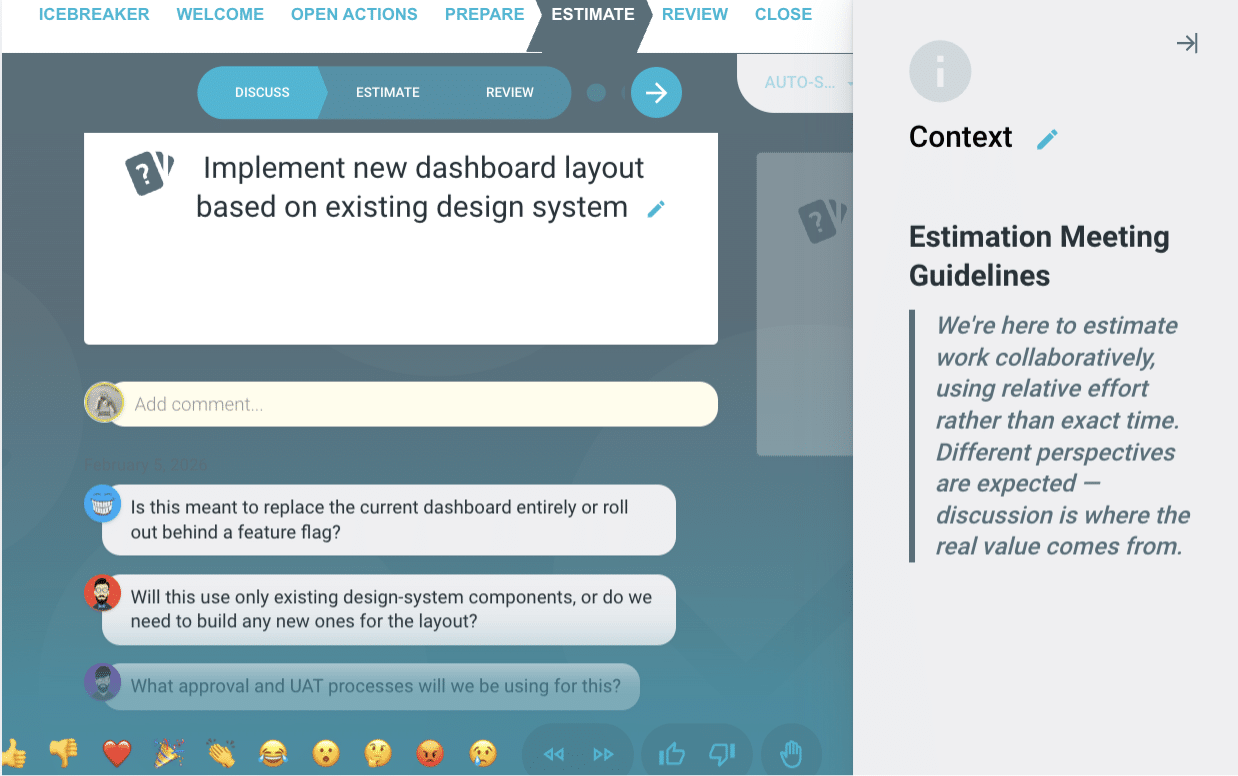
Make this explicit at the start of the meeting through team agreements or a visible reminder so everyone is aligned before estimating.
2. Agree on what “done” means before estimating
A major reason teams cannot align is that they are estimating different outcomes. Before estimating, confirm:
- What is included
- What is explicitly excluded
- What “done” means for this story
- Whether there are dependencies or testing requirements
This step improves estimation speed because it removes ambiguity early, and ambiguity is what slows everything down.
3. Use story points the way they are meant to be used
Many estimation meetings drag because teams treat points like time. But story points are not hours. They are a relative way to compare work based on complexity, effort, and uncertainty.
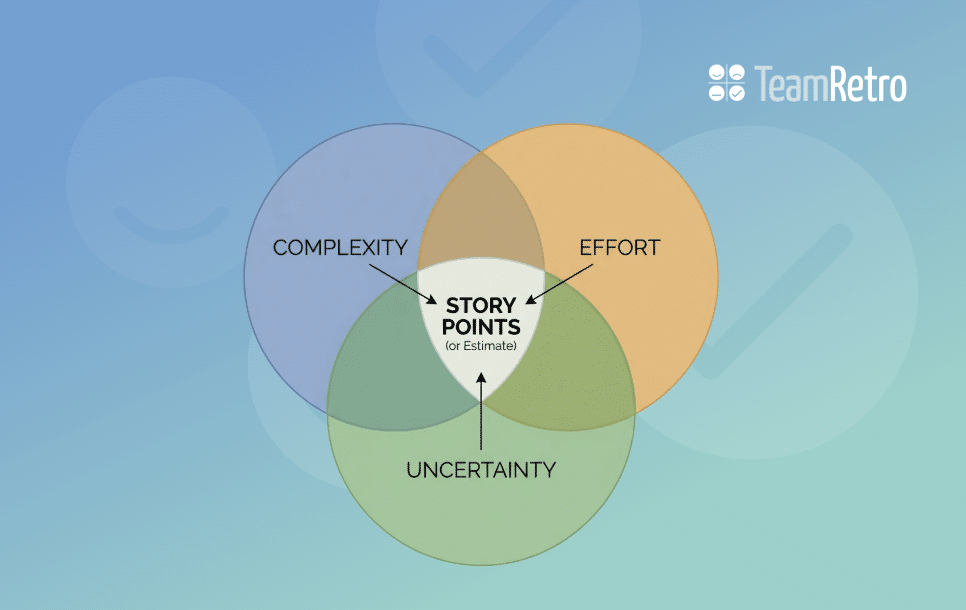
If your team keeps converting everything into “how many days”, consensus becomes harder because time estimates feel personal and risky. To speed things up, remind the team:
- Points are comparative, not exact
- You are estimating as a team, not defending a personal opinion
- Uncertainty is part of the estimate, and that is okay
When teams treat story points as shared signals rather than personal commitments, consensus forms faster. Strong estimation consensus is a foundation of effective agile estimating and planning, not a separate activity.
4. Use reference stories to speed up decisions
If every story feels like a fresh debate, your team will keep starting from zero. Reference stories from past sprints can establish a baseline. For example:
- “This is similar to the login validation story we estimated as a 3”
- “This feels like the reporting feature we rated as an 8”
- “This is smaller than the dashboard redesign, which was a 13”
Reference stories build context and speed up agreement by anchoring estimates to shared past experiences.
5. Keep user stories small enough to estimate quickly
If the story is too big, you will never get a consensus quickly. A good rule of thumb is this: If you cannot estimate it in under 5 minutes, it is probably too large or unclear. During your agile estimation meeting, look out for warning signs like:
- “We will figure that out later”
- “It depends”
- “There are a lot of unknowns”
- “This touches everything”
These are signals that the story needs to be broken down, clarified, or scoped before you estimate it. Smaller stories lead to faster discussions and more reliable user story points.
6. Timebox the discussion without shutting people down
Consensus takes time, but it should not take forever. Try this structure:
- Read the story (30 seconds)
- Clarify requirements and discuss (1-2 minutes)
- Estimate silently (15 seconds)
- Reveal estimates (10 seconds)
- Discuss only the outliers (2 to 4 minutes max)
- Re-estimate if needed (30 seconds)
Timeboxing works because it forces focus. Instead of letting every opinion turn into a debate, it keeps the team centered on the differences that matter.
7. Focus on the assumptions behind the estimates
When people disagree, the goal is not to make everyone agree on a number. Here are some prompt questions that can help:
“What assumptions are creating this gap?”
“What are you including in your estimate that others might not be?”
“What might be something you see that the others don’t see?”
For example, one person might include edge cases while another assumes a basic workflow. Exploring those assumptions quickly aligns the team and helps achieve estimation consensus faster. It is also a great way for people to learn and understand what others might need to do in terms of their part of the job. (Remember: The estimate should be for the whole team, not just their own section.)
8. Make uncertainty visible instead of arguing about it
Sometimes, the story is genuinely unclear. Instead of forcing agreement, consider:
- Estimating with a confidence check
- Adding a spike to research unknowns
- Splitting work into “known” and “unknown” tasks
This supports better effort estimation techniques for software development by separating uncertainty from effort instead of mixing the two. When the team can name the uncertainty, consensus becomes easier.
A simple structure to get estimation consensus faster
If you want a lightweight way to apply the tips above consistently, this flow brings them together into a repeatable agile estimation meeting structure.
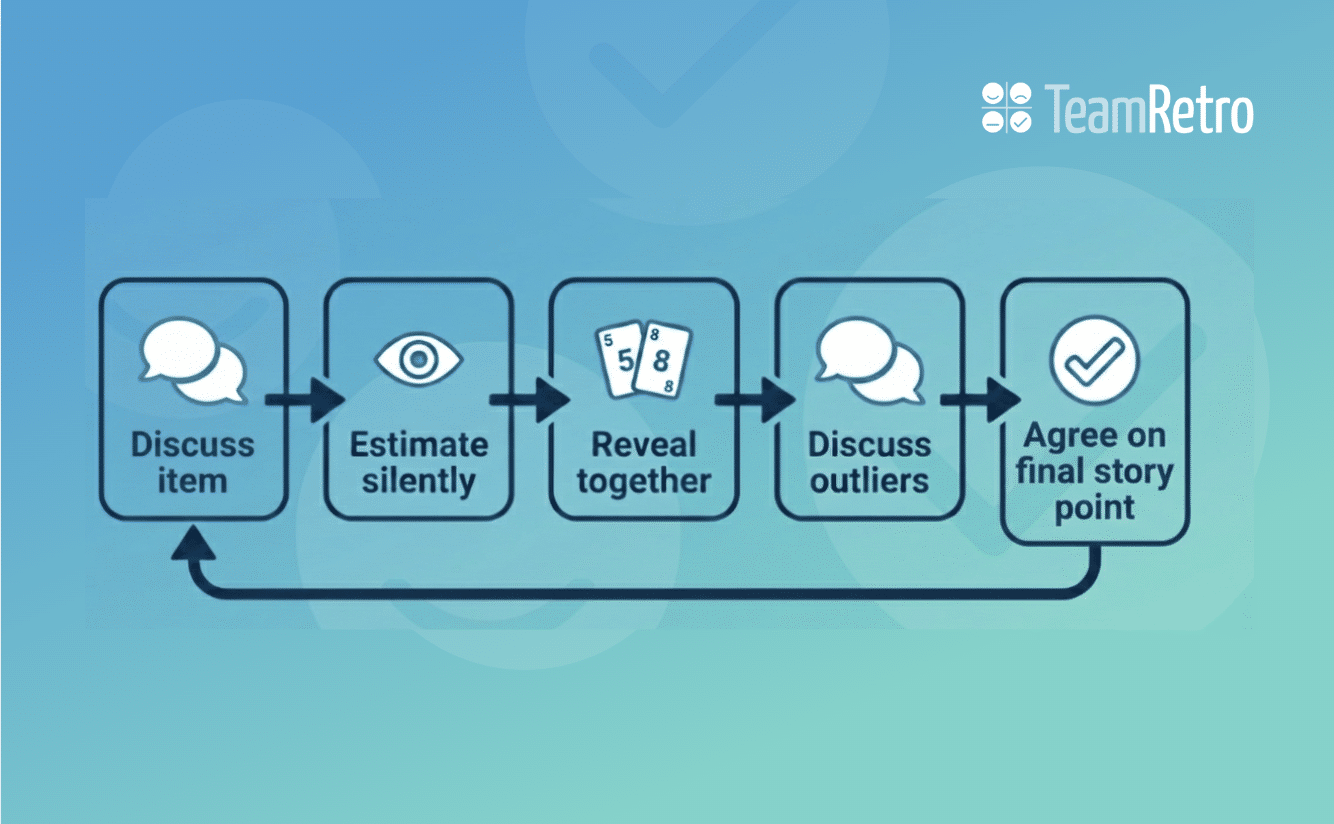
Step 1: Clarify (2 minutes)
This is where we align on what estimation means for the team, shared understanding over perfection and confirm the Definition of Done. It’s also where assumptions, constraints, and unknowns are surfaced so everyone is estimating the same thing.
Step 2: Estimate silently (30 seconds)
This is where we use story points properly, estimating relatively rather than translating to time. Reference stories help anchor thinking, while silent estimation avoids bias and premature influence.
Step 3: Reveal together (10 seconds)
This is where differences become visible without pressure. Revealing at the same time gives everyone an equal voice and turns variation into useful data rather than debate.
Step 4: Discuss outliers only (3 minutes)
This is where estimation earns its keep. The highest and lowest estimates explain what they are factoring in unknowns, edge cases, dependencies, technical risk, or prior experience with similar work. This conversation exposes assumptions the rest of the team may not have considered, so everyone leaves with the same understanding of scope and risk.
Step 5: Re-estimate (30 seconds)
This is where we test whether that shared understanding actually exists. If estimates move closer together, the work is likely clear and ready to plan. If they don’t, it’s a signal the story needs to be split, clarified, or de-risked before moving forward.
Final thoughts
If your estimation meetings feel slow, the solution is not to talk less. It is to talk about the right things: assumptions, scope, uncertainty, and shared understanding.
When your team gets better at surfacing those details early, estimation becomes faster and more useful. You spend less time debating numbers and more time aligning on what it will take to deliver.
That is what leads to stronger estimation consensus and better sprint planning.
If you want to make estimation a structured, repeatable part of how your team plans and not just a quick voting exercise, TeamRetro’s estimation meetings guide teams through story-by-story estimation with anonymous voting, simultaneous reveals, and focused outlier discussions. It keeps conversations centered on assumptions and risk, helps teams reach genuine consensus, and connects estimates directly back to the tools your team already uses.
Teams that improve estimation consensus spend less time debating numbers and more time making confident planning decisions. Try estimation meetings in the TeamRetro app and see how clearer conversations lead to faster, more confident sprint planning.