

Retrospektiven-Leitfaden für Scrum Master
Dein vollständiger Leitfaden für Scrum Master zum Durchführen unterhaltsamer, einfacher und effektiver Sprint-Retrospektiven
Wähle die beste Retrospektiven-Vorlage für dein Meeting
Die Bühne für den Erfolg bereiten: Wie du die beste Retrospektiven-Vorlage für dein Meeting auswählst?
What is retrospective template?
A retrospective template is both a guide for and a record of a retrospective meeting. It takes the form of a board that includes simple prompts designed to facilitate a team’s reflection of their last sprint. It is also where responses to those prompts can be captured. Once the retrospective template is populated, it is then used as the foundation for discussions that will shape the team’s next steps.
Retrospective templates can come in a variety of forms. They can be built using whiteboards and markers, flip charts and pens, or even windows with post-its. They can be delivered online using a range of collaborative tools from virtual whiteboards to the online retrospective templates curated by TeamRetro.
Why are retrospective templates important?
Retrospective templates are important because they help to maximize the success of the retrospective meeting. As mentioned in Chapter Two – Why are retrospectives a useful agile tool? the meeting is a chance for the team to come together to reflect on their sprint. During the meeting, they share, explore and propose ideas that will help them improve. This came with the caveat that the retrospective must be run with intention and focus, as well as be engaging and time-efficient. The retrospective template is the tool that helps to deliver that intent, focus, engagement, and efficiency.
As well as supporting all five of Derby and Larsen’s sprint retrospective process steps that we touched upon in Chapter 1 – What is a sprint retrospective?, a retrospective template delivers a lot of value. A template –
- helps set the tone of the meeting
- provides a framework for ideation and discussion
- allows all participants to contribute equally, so it encourages engagement, fosters collaboration, and supports equity
- provides focus and reinforces the purpose of the meeting
- facilitates the easy capture of ideas
When delivered online, retrospective templates are particularly beneficial. As well as delivering the above value, they can also –
- deliver a clear structure that supports a transparent meeting process
- allow participants to contribute anonymously. This helps to address group-think, ensure all voices are heard, and support psychologically safety
- automatically capture ideas and comments inputted by participants, significantly streamlining the meeting documentation process
- automatically generate reports that can be shared with all participants
- be used online with co-located, remote, and hybrid teams
Additionally, a template can be leveraged to –
- energize the team
- support team connectedness and team building
- reinforce the Scrum Values
- open the lines of communication to safely address issues
or even
- help make the meeting fun
In short, the impressive range of retrospective templates available can help a Scrum Master address an equally impressive number of anti-patterns and team issues.
Warum Retrospektiven-Vorlagen wechseln?
Es gibt zwei wichtige Gründe, warum ein Scrum Master die von ihm verwendete Retrospektiven-Vorlage regelmäßig wechseln sollte. Zunächst einmal ist der Wandel an sich wertvoll für das Team. Zweitens können verschiedene Retrospektivvorlagen zu unterschiedlichen Vorteilen führen.
Veränderung hilft uns, besser zu werden. Sie hilft uns, Fortschritte zu machen, neue Dinge zu entwickeln und zu liefern. Sie bietet uns Abwechslung und neue Perspektiven, die die Kreativität fördern. Kurz gesagt: Veränderung hilft uns zu wachsen.
Allein durch das Ändern der Vorlage, die zur Unterstützung eines Retrospektiven-Meetings verwendet wird, kann ein Scrum Master seinem Team eine neue Perspektive bieten, durch die sie ihren letzten Sprint betrachten können. Mit einer anderen Vorlage wird das Team sanft kalibriert, um verschiedene Wörter, Formulierungen und neue Perspektiven zu berücksichtigen.
Gleichzeitig hilft der Scrum Master, die potenzielle Monotonie zu umgehen, die manchmal in regelmäßigen Meetings liegt. Dies trägt auch dazu bei, das Risiko zu mindern, dass Teammitglieder ihren “Retro-Autopiloten” einschalten, wenn sie Standard- oder Klischee-Feedback geben, anstatt überlegte und kreative Antworten zu geben.
Wie wähle ich die richtige Retrospektiven-Vorlage für mein Meeting?
Die Wahl der richtigen Retrospektiven-Vorlage läuft darauf hinaus, was du mit deinem Team während deiner Sprint-Retrospektive erreichen möchtest.
Bei der Wahl der Vorlage für die Retrospektive können verschiedene Faktoren eine Rolle spielen. Ein Ansatz besteht darin, zu überlegen, worauf sich das Team konzentrieren soll.
- Menschen (dazu gehören Kommunikation und Verbundenheit)
- Prozess (wie Sie tun, was Sie tun)
- Produkt (das Vehikel zur Schaffung von Mehrwert)
Ein anderer Ansatz besteht darin, den Kontext zu berücksichtigen –
- die des Teams (Interessen, Reife, Größe, Vielfalt)
- Die des Scrum Masters (neu im Scrum, sehr erfahren)
- Das vom letzten Sprint (alles ging schief, es war ok, es war toll)
Die Wahl der Vorlage könnte auch verhaltensbasiert sein.
- Spezifische Anti-Muster, die Sie angehen möchten
- Aspekte der psychologischen Sicherheit, die Sie unterstützen möchten
- Elemente des Spiels, die Sie zu fördern hoffen
Brauchen Sie Hilfe bei der Auswahl?
Wir haben ein Tool zur Auswahl von Retrospektivvorlagen entwickelt, das Ihnen hilft, die beste Retrospektivvorlage für Ihr nächstes Meeting zu finden.
Natürlich sollten alle guten Vorlagen zu Meetings führen, die ansprechend und fokussiert, relevant und zielgerichtet sowie produktiv sind und Spaß machen. Im Folgenden finden Sie einige der von uns verwendeten Retrospektivvorlagen und die zusätzlichen Vorteile, die sie unserer Meinung nach bieten.
Die Retrospektiven-Vorlage, die du verwenden solltest, wenn du noch nie eine Retrospektive durchgeführt hast
Wenn Sie Ihre erste Retrospektive vorbereiten, kommen Sie an der Vorlage für agile Retrospektiven nicht vorbei.
Agile
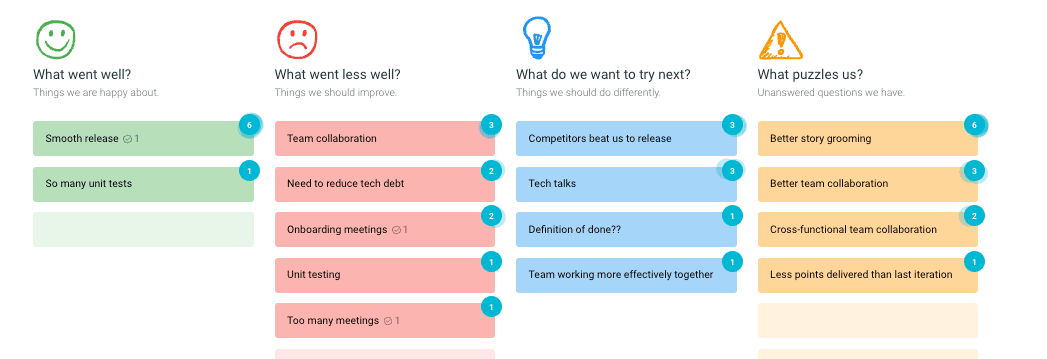
The Agile retrospective asks four basic questions that gets the team thinking about the outcomes of the last sprint, and what actions they should focus on next.
While it is straightforward, it sends a clear message that you are listening and geared for improvement.
Großartige Retrospektiven-Vorlagen, um Menschen zu unterstützen
Ein unterstütztes Team ist ein produktives Team. Im Folgenden finden Sie drei der von uns verwendeten Vorlagen, die effektive Meetings ermöglichen und die Stärkung und Unterstützung des Teams in den Vordergrund stellen.
Vier Ls
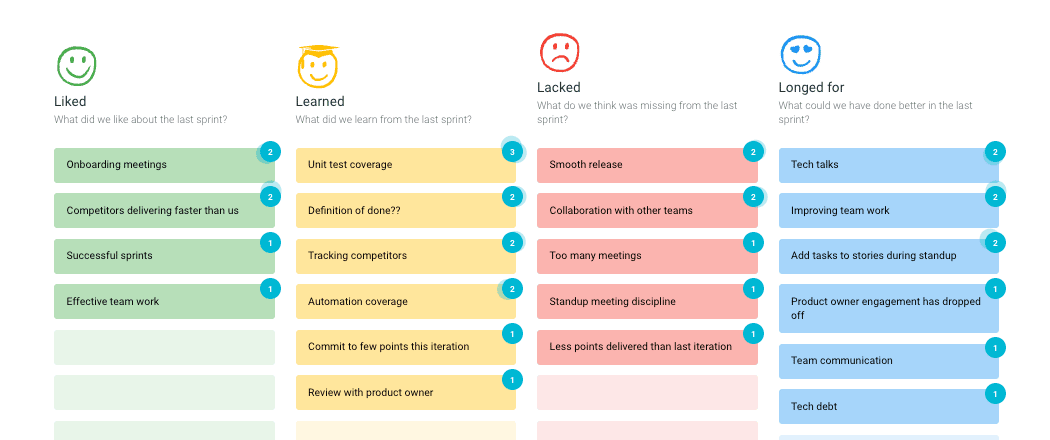
The Four L’s retrospective presents your team with the opportunity to share both thoughts and feelings about their last sprint in a safe way.
You can use it to gain insight into how they prefer to be supported and their aspirations.
Persönliches Wachstum
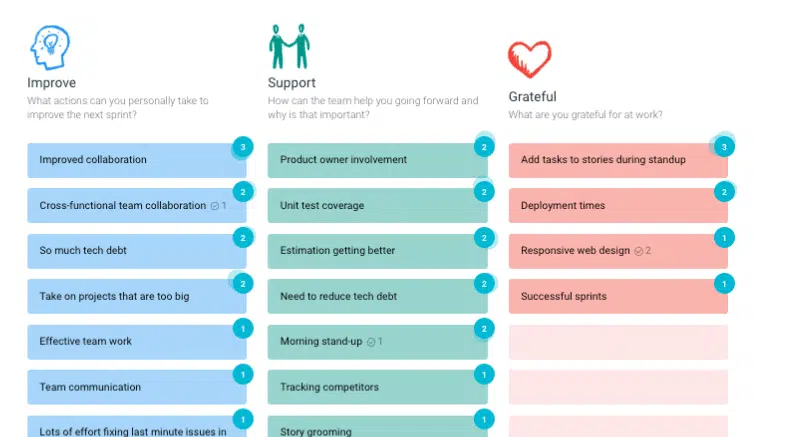
The Personal Growth retrospective has been designed to support the empowerment and well-being of your team members.
It gives each team the space to set goals and identify how others can support their efforts.
Scrum-Werte
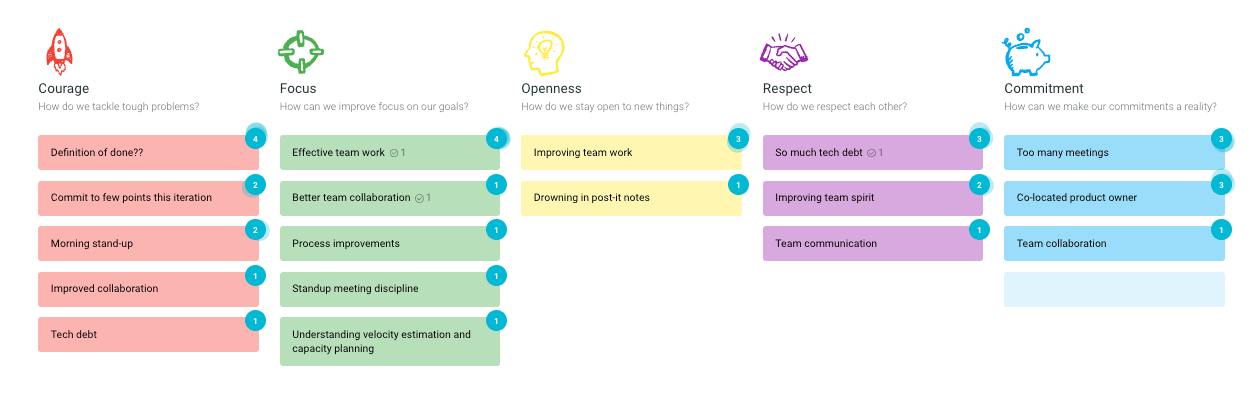
The Scrum Value retrospective is a deep dive into the behaviors and actions each person takes in their daily life and work practices that reflect the values of Scrum.
It’s an opportunity to explore the connection between the Scrum Values and those of the team.
Die besten Retrospektiven-Vorlagen, um den Prozess zu unterstützen
Wenn die Dinge nicht so gut laufen wie geplant, ist es vielleicht an der Zeit, die Prozesse zu überprüfen. Dies sind drei der Vorlagen, die wir für den Prozess verwenden. Sie helfen uns dabei, die Geschehnisse zu ergründen und Maßnahmen zu entwickeln, um die Dinge wieder auf den richtigen Weg zu bringen.
Stopp Start Weiter
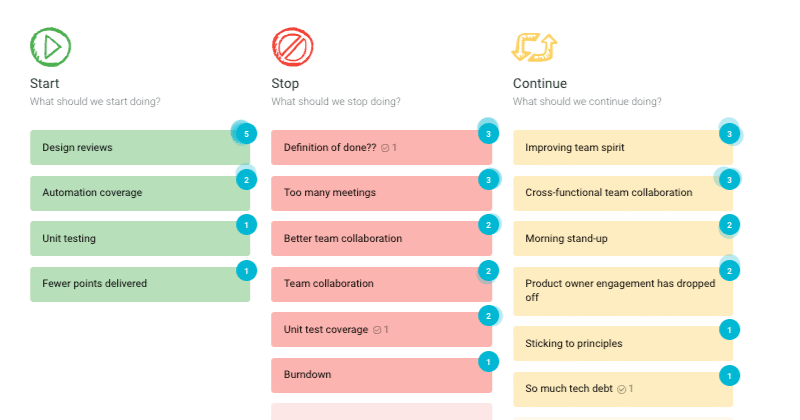
The Start Stop Continue retrospective throws processes into sharp focus.
It’s a great tool to hone in on actions and quickly identify those that deliver value and those that don’t.
KALM
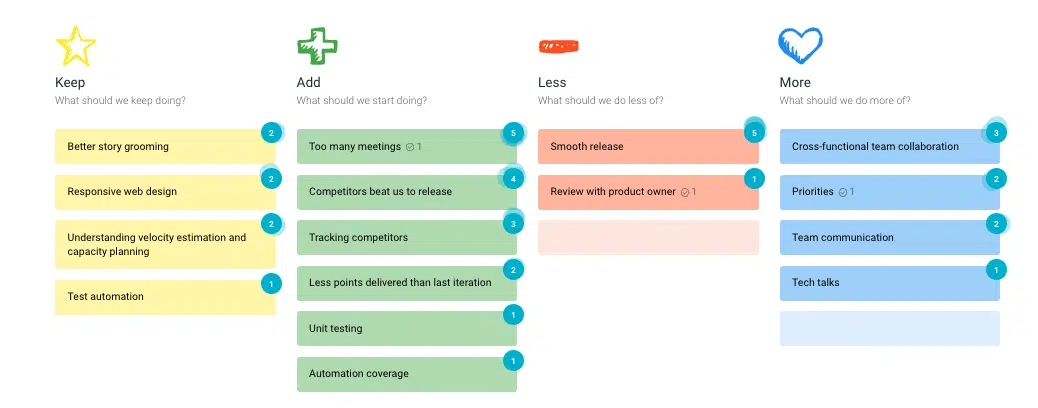
The KALM retrospective creates a safe space in which a team can fine-tune its processes.
It promotes a sense of agency and utility allowing the team to come up with ideas to help them move forward.
Seestern
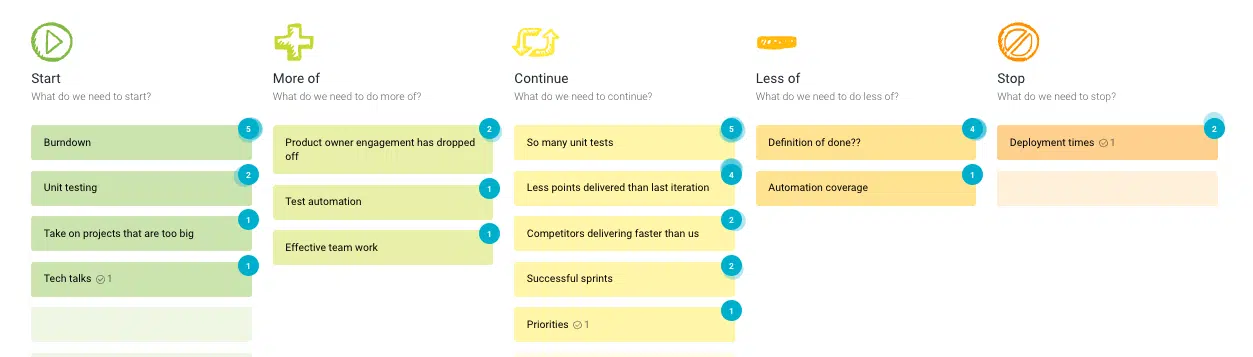
The Starfish retrospective supports an examination of the varying degrees of value delivered by actions and activities.
It helps the team look at current practices and which ones should have more or less energy directed towards them.
Die besten Retrospektiven-Vorlagen, um das Produktmanagement zu unterstützen
Der Zweck eines Scrum-Teams ist es, Ergebnisse zu liefern, die die Anforderungen der Stakeholder erfüllen. Das Produktmanagement ist daher für ihren Erfolg von zentraler Bedeutung.
Müssen Sollte Könnte Könnte nicht
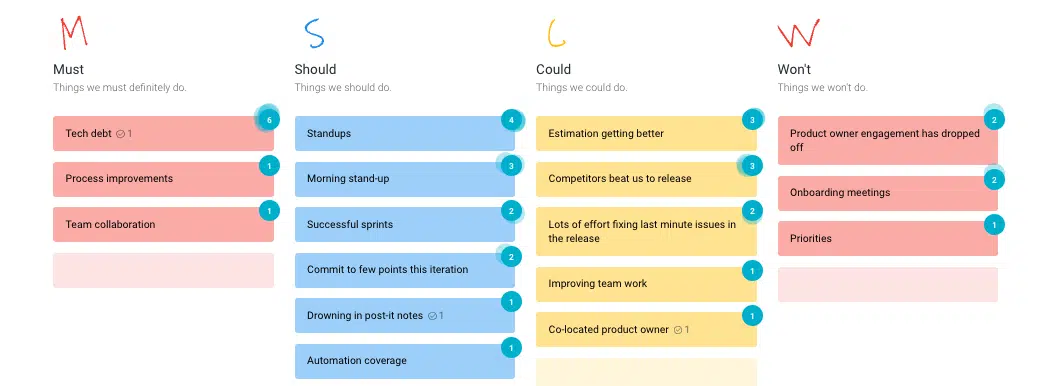
The Must Should Could Won’t retrospective is a great tool that offers the team a mechanism to step into the shoes of a customer and view the product from their perspective.
It is a particularly useful tool to maintain focus on priorities for projects with a large number of feature requests and competing stakeholders.
Drei kleine Schweinchen
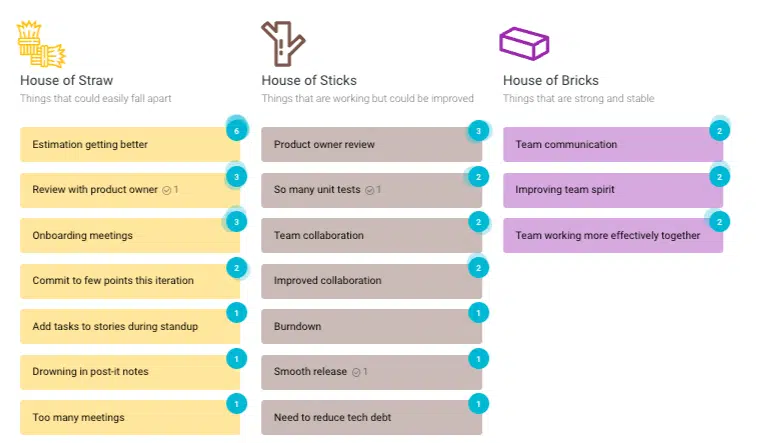
The Three Little Pigs retrospective offers your team a creative sprint retrospective idea to help identify short, medium, and long-term actions that will bring stability and value-added features to your product.
It helps analyze the current product or technology stack and which elements can be easily broken, need fixing up, or are part of the foundational core to deliver your service.
Rosenknospendorn
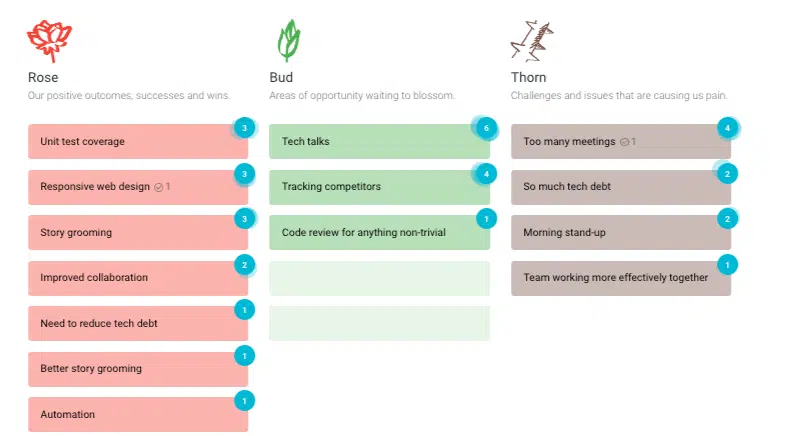
The Rose, Bud, Thorn retrospective is an effective technique designed to help identify the positive outcomes, the opportunities, and the challenges from your last sprint.
This is a great retrospective to use if you wish to help remind your team to view challenges as manageable accompaniments to the delivery of value.
Großartige Retrospektiven, die du verwenden kannst, wenn du einen schlechten Sprint hattest
Wir sind Menschen. Wir werden gute und schlechte Tage haben. Unser Team wird gute und schlechte Sprints haben. Das Wichtigste ist, dass wir aus den schlechten Erfahrungen lernen.
Wie? Na und? Was nun?
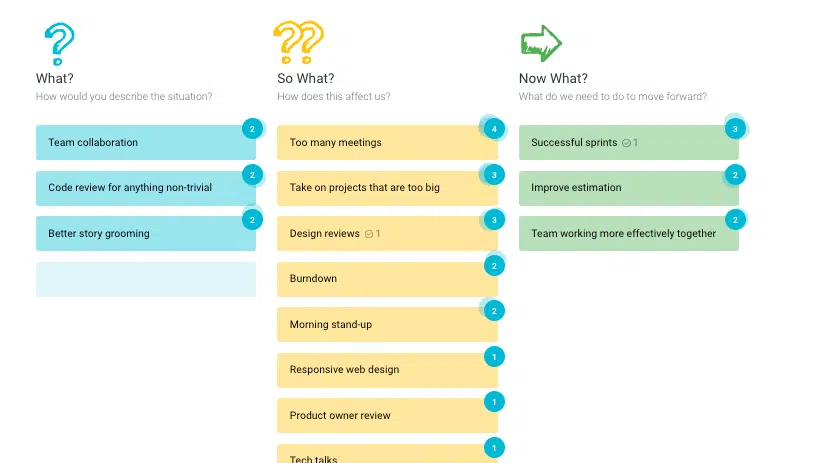
The What, so what, now what? retrospective was designed to bring a neutral pragmatism to the review of a sprint.
It helps your team suspend emotion and side-step bias in order to create a safely objective space to conduct your retrospective.
Arbeiten Nicht Arbeiten
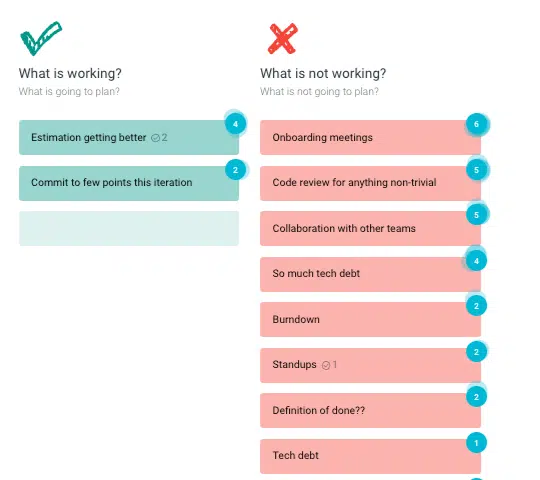
The Working Not Working retrospective gets straight to the point. Its simplicity makes it impactful.
If your team needs a direct approach to get them moving again, then this is the retrospective template you should use.
Einfache Retrospektiven, wenn es Zeit ist, Spaß zu haben
Es hat sich gezeigt, dass die Einführung eines spielerischen Elements am Arbeitsplatz zahlreiche Vorteile mit sich bringt. Sie trägt zur Teambildung bei und fördert sogar das individuelle Wohlbefinden.
Hexen und Hexenmeister
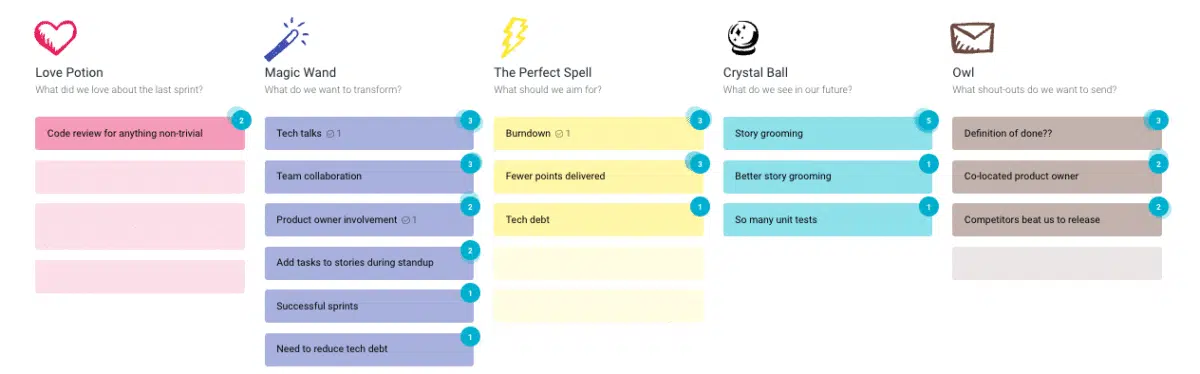
The Witches and Warlocks retrospective has been deliberately crafted to position team members to adopt an optimistic view of the sprint.
It’s a sprint retrospective idea that shows creativity and fun bring value to a project, and can be embraced without sacrificing productivity, focus or purpose.
Oscar Academy
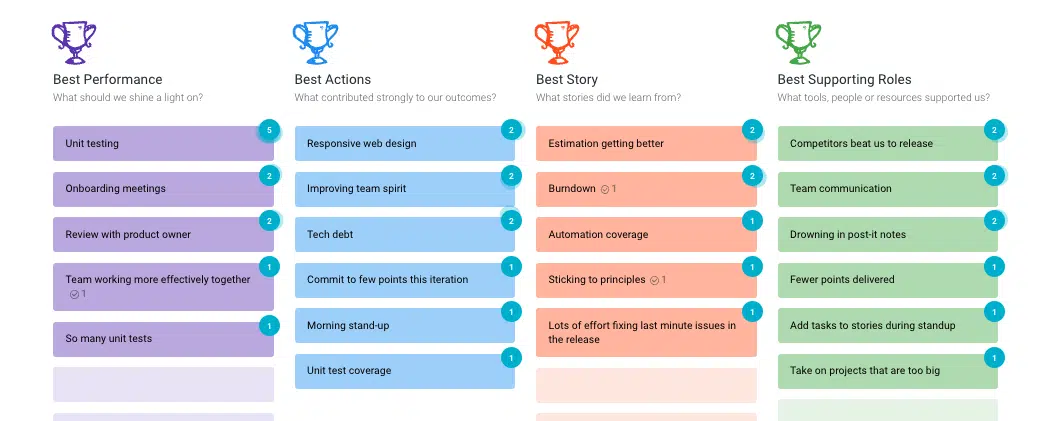
The Oscar Academy retrospective creates a stage where people can learn from stories, are recognized for their contributions, and celebrate their successes.
It embraces deliberate cheerfulness as a gentle reminder to team members to adopt a perspective of optimism when reflecting on the sprint.
Superhelden
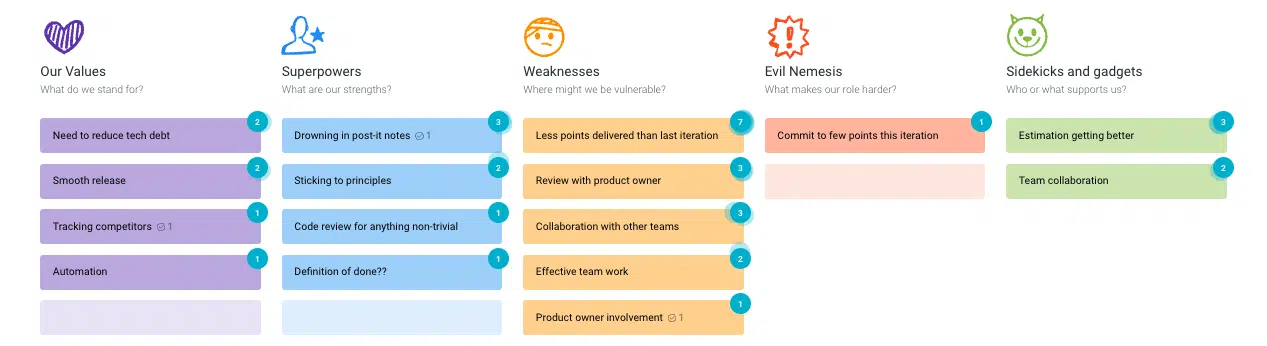
The Superhero retrospective is a fun, creative exercise that can be especially engaging for remote teams that have to come together to solve a common problem or work towards a goal.
Of course, each team has its own set of superpowers, but they will also have their vulnerabilities and this retrospective template can help uncover these.
You can check out more templates here.
 4,8 auf
 Capterra





Vertrauen von über 26.000 agilen Teams – und es werden immer mehr
Testen Sie es 30 Tage lang kostenlos, keine Kreditkarte erforderlich
Haben Sie noch Fragen? DEMO VEREINBAREN