Your team is running sprints. There’s a backlog, a definition of done, and regular retrospectives. On paper, everything looks agile.
But something still feels off.
Releases are unpredictable. The same retro themes keep resurfacing. And if someone asked, “How mature is your agile practice?” — it wouldn’t be an easy answer.
That hesitation is exactly why agile maturity assessments exist — and why running them well, with the right tool, makes all the difference between a conversation that produces a slide deck and one that produces real change.
What is an agile maturity assessment?
An agile maturity assessment is a structured way to evaluate how effectively a team or organisation applies agile principles in practice.
It goes beyond a count of how many agile ceremonies you run. It looks at whether the underlying thinking is actually there – examining areas like collaboration, delivery flow, technical quality, and continuous improvement to identify strengths and the highest-leverage opportunities for growth.
More broadly, maturity models are designed to measure how capable an organisation is at consistently improving its processes over time. As the team matures, this translates into more predictable, adaptable outcomes, not just faster sprints.
Why agile maturity assessments matter
Here’s a sobering stat: according to OutSystems’ State of Application Development report (which surveyed over 1,500 application development professionals), only around 15% of organisations consider themselves fully mature in agile practices. About 60% remain stuck at the second or third maturity stages, going through the agile motions without realising the full benefits.
Agile transformations often stall not because teams lack effort, but because there’s no shared, honest picture of what’s actually happening. Gaps stay invisible. And without visibility, it’s hard to know whether you’re genuinely improving or just staying comfortable.
Regular agile maturity assessments help teams and leaders in a few important ways:
- They surface what’s really going on. Day-to-day work makes it hard to see systemic issues. An assessment creates the structure and the pause, to look clearly at how your team is really operating, not just how it feels.
- They focus your improvement energy. Not every gap is equally worth fixing. Assessments help identify the changes that will move the needle most, so you stop spreading effort thin and start making targeted progress.
- They create a shared language. When everyone on the team rates the same dimensions, differences in perspective become visible. That honest gap between how different people experience the team’s ways of working can spark some of the most valuable conversations you’ll have.
- They make progress visible. Running assessments regularly turns individual snapshots into trends — and trends tell you whether your improvements are actually sticking, or quietly sliding back.
- They give leadership something to work with. For organisations running multiple agile teams, assessments enable cross-team comparisons and surface systemic blockers that no single retrospective can reveal.
What does an agile maturity assessment measure?
The specific dimensions your assessment covers depend on the model you choose. But across all well-structured assessments, the goal is the same: rating how your team actually operates across the areas that matter most for delivery and improvement — not just whether ceremonies are happening on schedule.
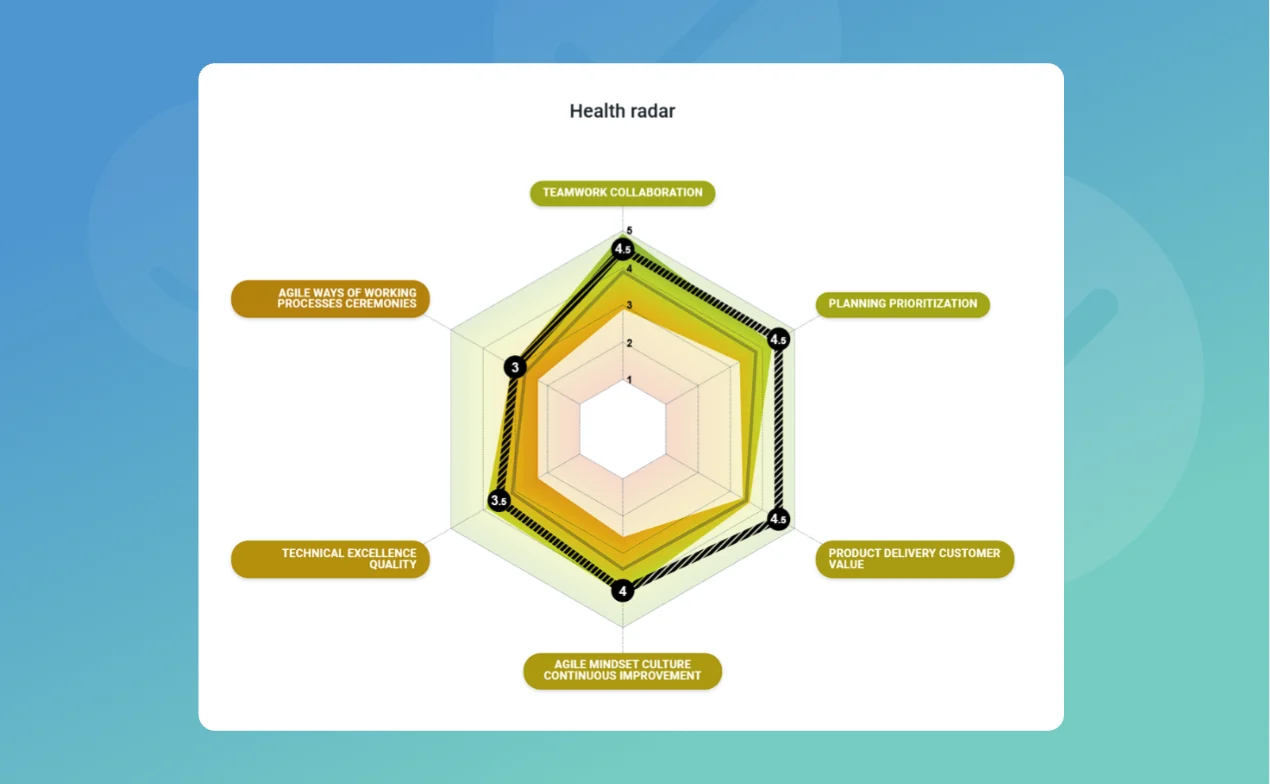
Here’s a concrete example. When a team uses the Agile Teams maturity model in TeamRetro, they’re rating themselves across six categories:
- Teamwork & collaboration — How well the team communicates, resolves conflict, and operates as a self-organising unit.
- Agile ways of working — Whether ceremonies are happening consistently and driving real value, not just filling a calendar.
- Planning & prioritisation — Whether the backlog is well-groomed, work is prioritised by value, and capacity planning is realistic.
- Technical excellence & quality — How technical debt is managed and whether quality is built in from the start.
- Product delivery & customer value — Whether the team is shipping things that matter, and tracking outcomes not just outputs.
- Agile mindset, culture & continuous improvement — Whether the team genuinely embraces agile values, and whether psychological safety exists to surface problems early.
A team running the DevOps & continuous delivery model would rate themselves on CI/CD pipeline maturity, release and deployment practices, reliability and operations, security and compliance automation, and platform and infrastructure readiness — a completely different lens, built for a different context.
This is why model selection matters. The dimensions shape the conversation. Choosing the right one for your team’s current focus is what turns an assessment into a useful discussion rather than a generic survey.
How agile maturity is measured: the 5-level scale
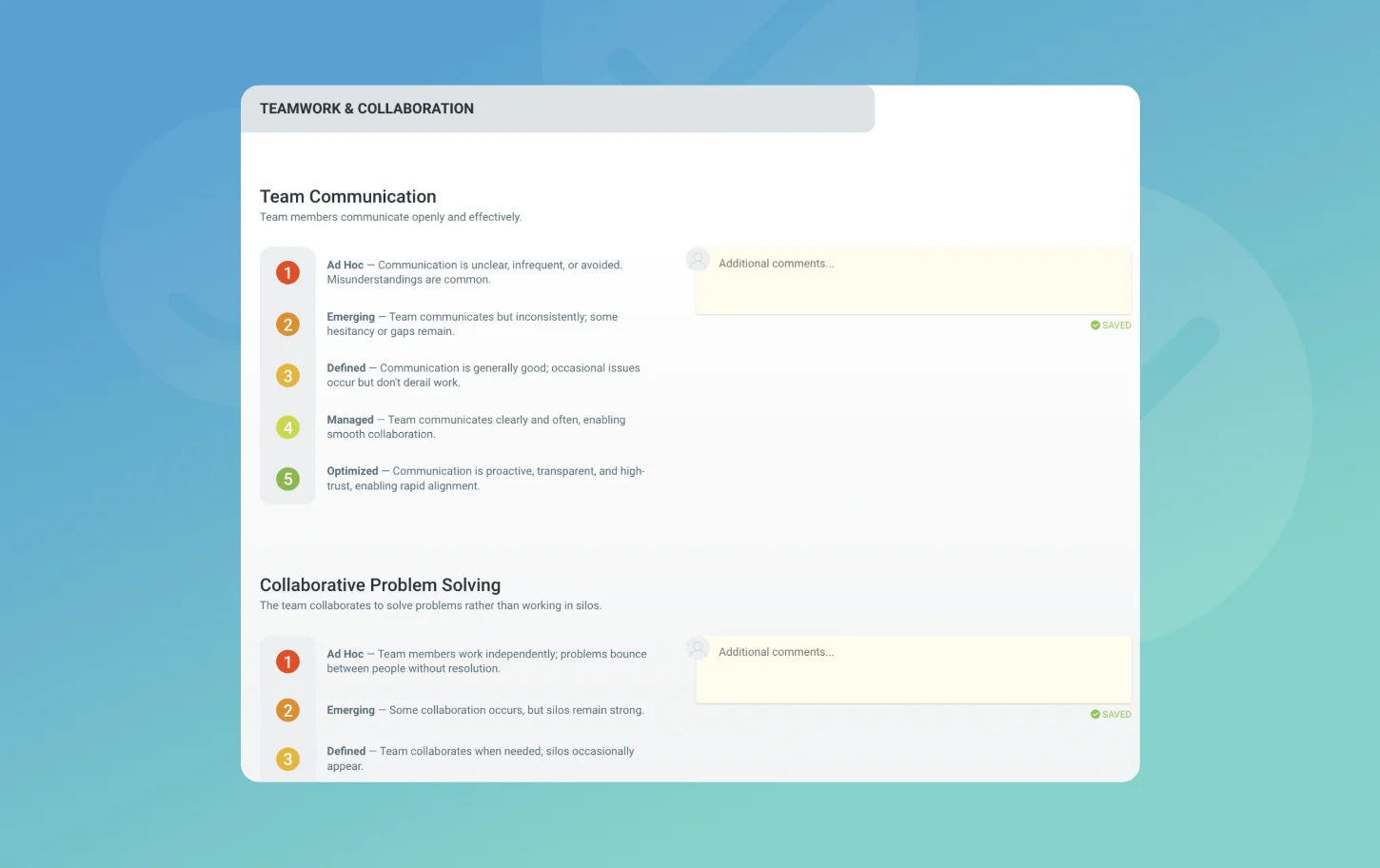
Once you know what dimensions you’re assessing, you need a scale to score them against. The most widely used structure organises maturity into five levels — each describing a specific pattern of behaviour, not just a number:
- Level 1 — Initial / Ad hoc. Processes are unpredictable and reactive. Agile may exist in name only.
- Level 2 — Developing. Some agile practices are in place but inconsistent. There’s intent, but limited discipline.
- Level 3 — Defined. Practices are standardised and consistently followed. The team understands not just what they do, but why.
- Level 4 — Managed. Performance is measured and decisions are data-driven. Feedback loops are tight.
- Level 5 — Optimising. Continuous improvement is embedded in the culture. The team innovates its own practices and consistently delivers real customer value.
Each level within a dimension comes with a clear written description of what that level looks like in practice — so team members aren’t guessing what a “3” means. That consistency is what makes the results worth discussing.
Pssst…. Not every team needs to reach Level 5 in every dimension. What matters is knowing where you are and having a deliberate plan for the next step. A team that constantly rates at 5 might be the shining star in the organisation or they may lack the benchmarking needed.
TeamRetro’s maturity assessment models
A maturity model is the framework your assessment runs against. It defines which dimensions are being rated and what each level looks like in your specific context. Choosing the right model for your team’s current situation is what makes the difference between a focused, useful session and a generic exercise that produces a list of things everyone already knows.
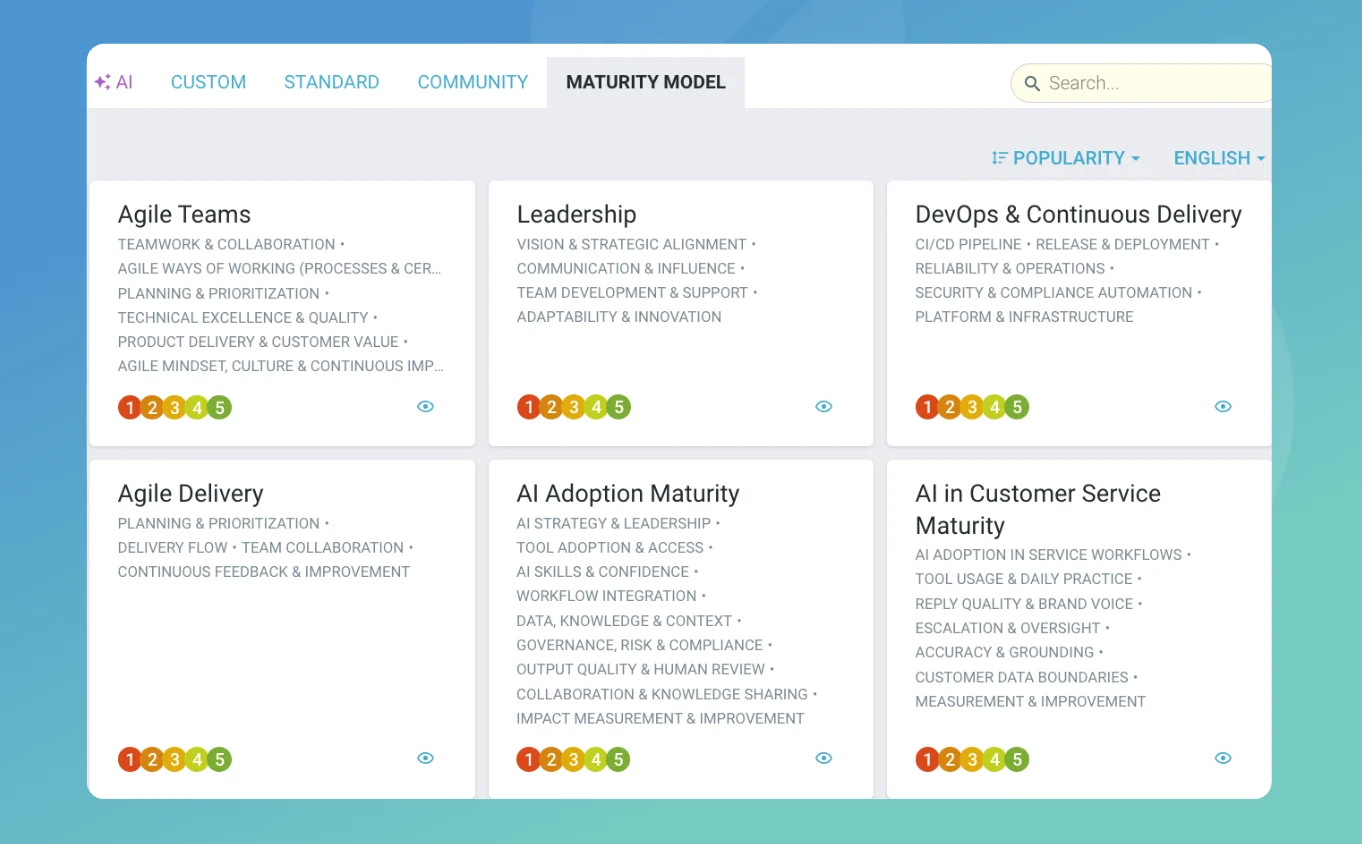
TeamRetro offers 20 purpose-built models across the areas agile teams actually care about, along with the opportunity to create your own or to co-create one with AI.
Here are 5 that our team have used recently at our last round of team meetings –
- Agile teams — Measures how well our team collaborates, plans, and delivers value through agile ways of working.
- Leadership — Assesses how effectively our leaders inspire vision, communicate strategy, and develop us.
- DevOps & continuous delivery — Evaluates our pipeline reliability, deployment speed, and operational resilience across our engineering team to deliver outputs to you.
- Agile delivery — Understands how consistently our team plans, flows work, and improves delivery cycle over cycle.
- AI adoption maturity — Tracks how confidently our team integrates AI tools into daily workflows with proper governance in place to ensure focussed AI features that bring the you benefit, without compromising on security.
At the industry level, assessments tend to fall into 3 broader categories. Let’s take a deep dive into these.
Agile delivery
Designed for scrum teams and delivery-focused squads. It assesses how well the team plans and prioritises work by value; how smoothly and predictably work flows from idea to done; how effectively the team collaborates and self-organises; and how consistently feedback loops drive genuine improvement. Teams using this model typically run it quarterly, using the results to focus their retrospectives on the dimensions that scored lowest.
Engineering excellence
Built for engineering managers and senior developers who want to go beyond process and assess technical health. It covers code quality and standards, architecture and scalability decisions, how actively technical debt is being managed, and how well the team enables and supports each other as engineers. It’s particularly useful for teams that score well on agile process metrics but still struggle with delivery predictability — the root cause is often here.
DevOps & continuous delivery
Built around the practices that separate teams who ship confidently from those who dread release day. It assesses CI/CD pipeline maturity, release and deployment processes, reliability and operations, security and compliance automation, and platform and infrastructure readiness. Teams working toward DORA metric improvements often find this model maps directly to where the friction actually lives.
How to run an agile maturity assessment effectively
The key is to focus on insight and action, not just measurement. TeamRetro’s built-in flow walks teams through each of these steps automatically — but here’s the thinking behind them.
1. Choose relevant focus areas
Start with dimensions that are meaningful for your team’s current context. You can choose from purpose-built maturity models covering agile delivery, engineering excellence, DevOps, product management, and more — or build your own from scratch. A Scrum team early in their agile journey has different priorities to a scaled product organisation, and your model should reflect that.
2. Collect responses privately
Honest feedback only happens when people feel safe giving it. You can collect responses anonymously before any results are shared with the group, removing the social pressure that skews ratings toward what people think leadership wants to hear. Every team member rates each dimension independently — the aggregated picture only surfaces once everyone has contributed.
3. Review results as a radar chart
When results surface in TeamRetro, they appear as a radar chart — showing the shape of your team’s maturity at a glance. High scores, low scores, and gaps between dimensions are immediately obvious. There’s no manual aggregation or waiting. You can sort dimensions from most positive to most negative to most mixed, so the conversation starts in the right place.
4. Walk through results as a team
TeamRetro’s Presentation Mode syncs screens across the team — in-person or distributed — so the facilitator can walk through results dimension by dimension without losing the room. At Culture Amp, a core company value is “learn faster through feedback.” Their engineering teams run both maturity assessments and health checks in TeamRetro precisely because Presentation Mode keeps the conversation anchored to what the data is showing, rather than drifting into anecdotes.
5. Prioritise a small number of high-impact improvements
Resist the urge to fix everything at once. With TeamRetro’s AI summaries — which generate commentary for each dimension and across the whole session — patterns emerge quickly, even across teams with a lot to say. Identify the areas where the gap is biggest and where closing it would move the needle most. One well-executed change builds more confidence than five half-finished ones.
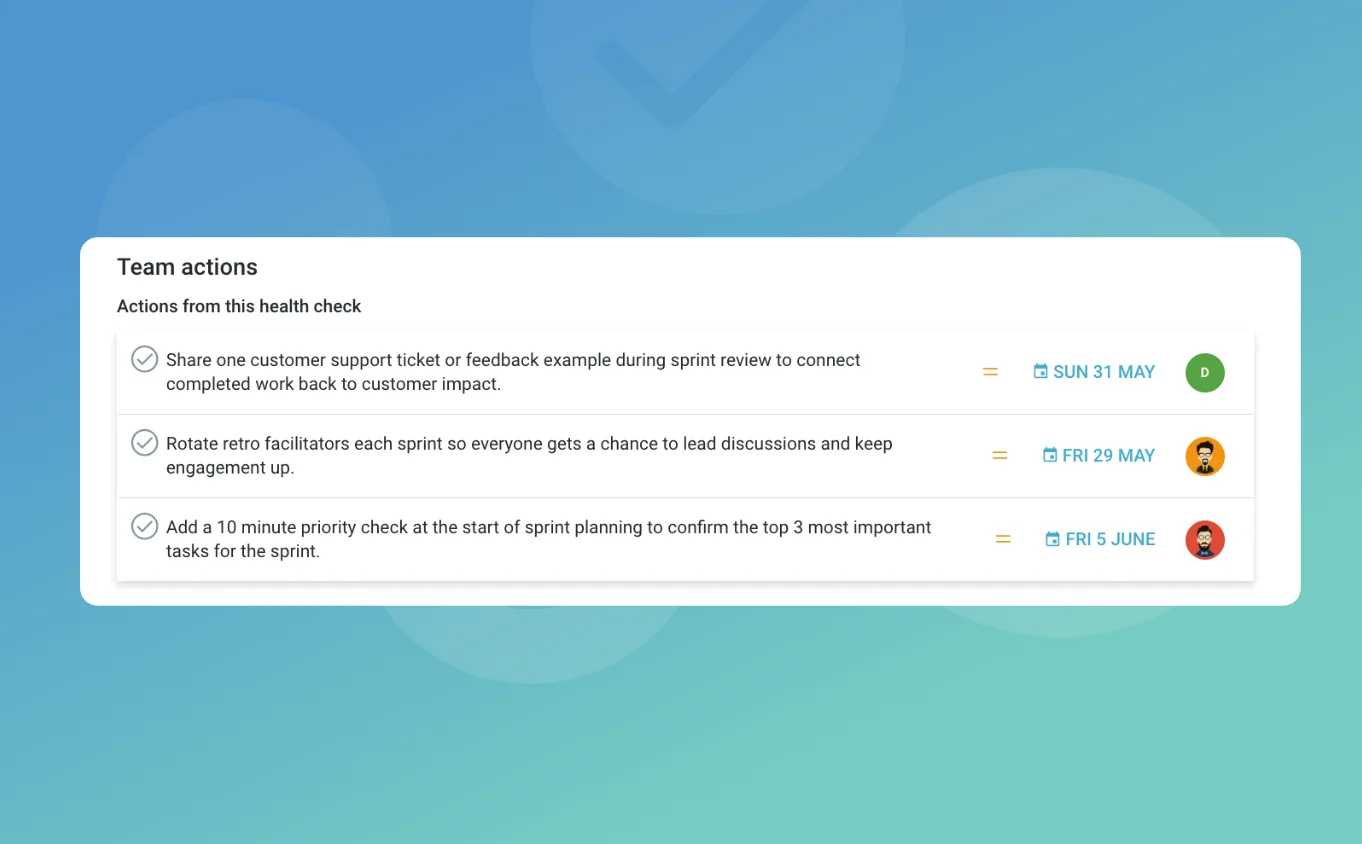
6. Create accountable actions before you leave the room
This is where most assessments fall apart — the insights evaporate without owners or due dates. Actions are created directly within the session with an owner and a due date assigned before anyone closes their laptop. Those actions carry forward to the next session automatically, so nothing quietly falls off the radar. For teams using Jira, Asana, Trello, or Azure DevOps, action items can be pushed directly to your existing workflow.
7. Track trends across sessions
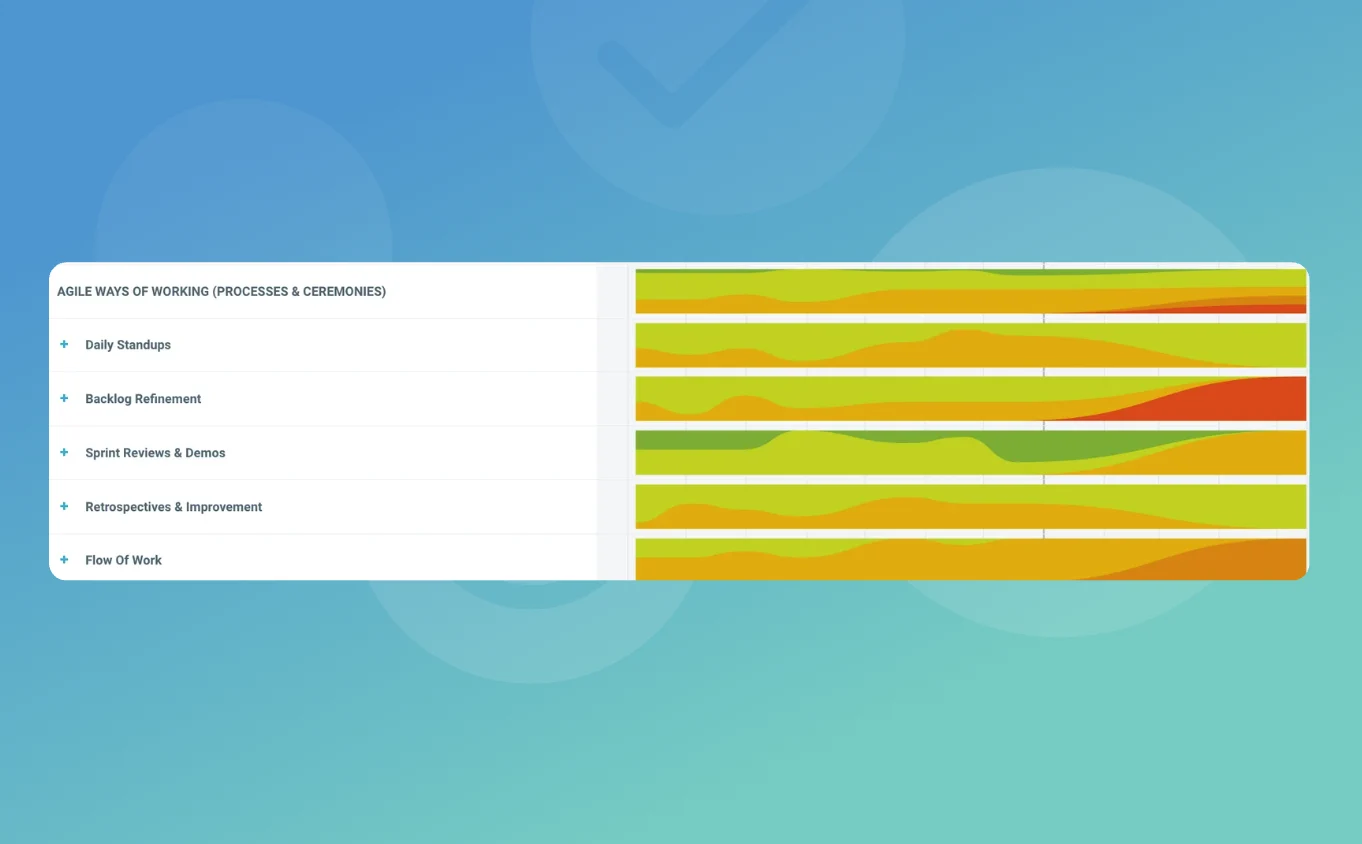
Run the same assessment every quarter or at major milestones. TeamRetro tracks how each dimension moves over time, displaying trend lines directly on the radar so you can see at a glance whether a dimension is improving, static, or regressing. When Ibrahim Abram, Procurement Specialist at Culture Amp, reflected on what he values most in TeamRetro, it was this: “I love the graph that shows the trends.” That’s the difference between a tool and a process.
Common mistakes to avoid
Even well-intentioned assessments can go sideways. Watch out for these:
- Treating it as a one-time event. A single assessment gives you a starting point. The real value is in the trend — knowing whether you’re moving in the right direction and how fast.
- Letting it become a performance review. The moment people feel their individual performance is on the line, honest input disappears. Frame it clearly as a tool for the team to improve together. TeamRetro’s anonymous response mode exists specifically for this.
- Optimising for scores rather than outcomes. Teams can game maturity assessments if the incentives are wrong. What matters is whether actual practices and delivery outcomes are improving — not whether the numbers look better.
- Skipping the action planning. An assessment without actions is just an interesting conversation. If the session ends without clear next steps and owners, the insight evaporates within a week. TeamRetro makes this the last required step before closing a session.
- Running it in isolation from retrospectives. Agile maturity assessments and retrospectives work better together. In TeamRetro, you run both from the same platform — so the themes that keep surfacing in your retros can inform what you focus on in your next maturity assessment, and vice versa.
Why teams use TeamRetro for agile maturity assessments
Most teams that try to run maturity assessments without a dedicated tool hit the same wall: the survey gets built in a spreadsheet, results get pasted into a slide, actions get noted down somewhere, and by the next quarter nobody can remember what was agreed. The insight doesn’t compound — it resets.
Why teams choose TeamRetro for maturity assessments
Manual assessments often fail because data is scattered across spreadsheets and slides, causing insights to reset every quarter. TeamRetro prevents this by centralizing the process with these key features:
- Private feedback: Anonymous responses ensure honest data and a safe environment for teams.
- AI summaries: Automated reports for each dimension save time on manual write-ups.
- Persistent actions: Assigned tasks carry over between sessions with reminders to ensure accountability.
- Visual trends: Radar charts display historical direction to track real improvement over time.
- Workflow integrations: Syncs directly with tools like Jira, Asana, and Azure DevOps.
- Enterprise reporting: Organizations like Culture Amp use team tagging to compare trends and surface systemic blockers without losing local context.
Ready to run your agile maturity assessment?
Understanding how your team really works today is the first step toward improving it.
An agile maturity assessment surfaces the gaps you’ve been sensing but couldn’t quite name — and gives your team a shared, honest foundation for doing something about them.
TeamRetro gives you proven templates, private feedback, radar chart results, trend tracking, AI summaries, and built-in action planning — all in one place, with zero setup required.
Start your free assessment today — no credit card required.