


Running your retrospective with an online tool can be an ideal way to build psychological safety by providing a way for the team to share their ideas safely, celebrate success and find ways to improve, without playing the blame game.
They provide a platform where ideas can be safely and anonymously shared about what went well, what did not, and what they want to improve. By choosing the right tool with features that support this such as independent input and voting, it can create the perfect setting for continuous improvement.
Los Scrum Masters que facilitan adecuadamente las reuniones con estas herramientas pueden ayudar a reducir el miedo al juicio o a las represalias. By following up with any issues quickly, this lets the team know what they are being heard.
Si bien nunca puede reemplazar las habilidades y los rasgos del líder servidor que es el Scrum Master, tener la herramienta de retrospectiva en línea adecuada que tenga en cuenta la seguridad establecerá protocolos acordados en las reuniones, se adaptará a sus necesidades y realizará un seguimiento de las acciones acordadas.
Here’s our take on how to build psychological safety through the humble retrospective.
Helps the team understand what psychological safety is
Online retrospective tools that include team health checks can help people better understand what psychological safety means for them.
The health checks offer team members questions to support individual reflection. The questions included in the Psychological Safety health check, for example, connect to the indicators of safety used by researcher, Professor Amy Edmondson. An online tool also offers a team the flexibility to decide and define what safety means for them with a custom health check.
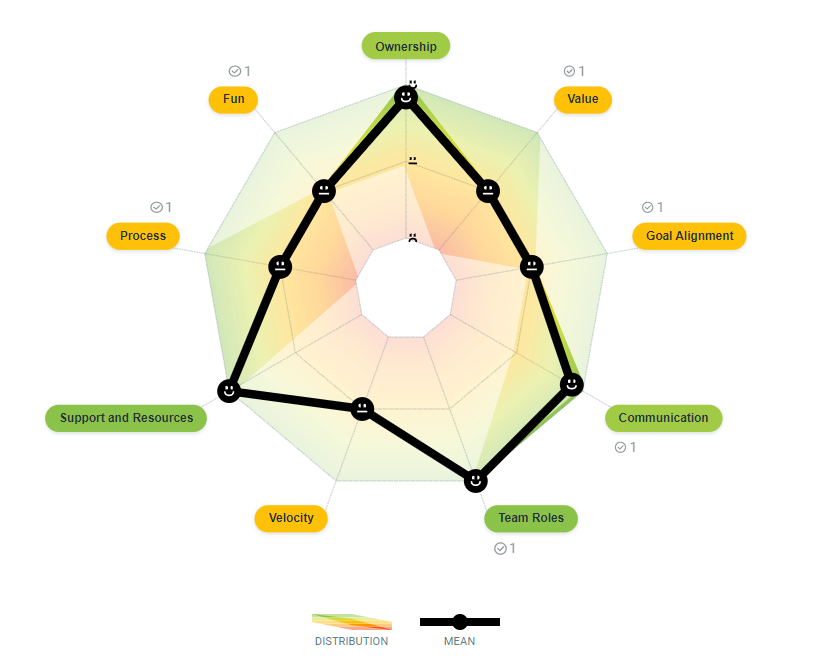
Los valores de Scrum también se pueden explorar utilizando una herramienta de retrospectiva en línea. La revisión de estado de los valores de Scrum puede ayudar a un equipo a medir y realizar un seguimiento de su alineación de valores. This can then help support conversations around development and growth as well as helping to improve relationships within the team.
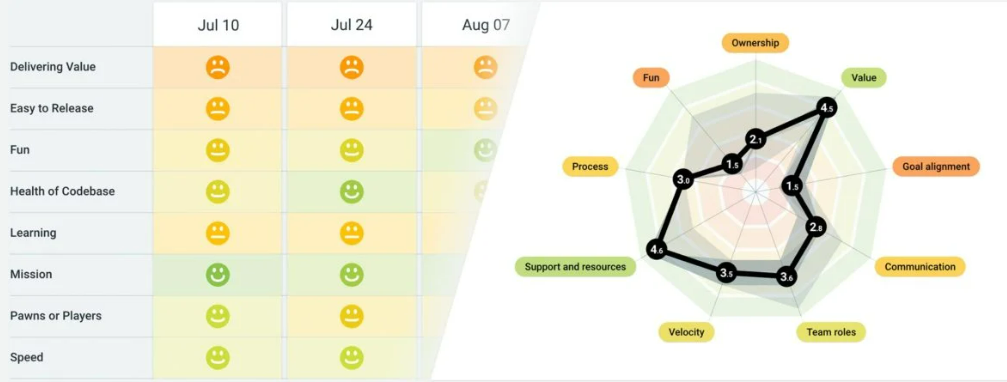
Importantly, team health checks can help measure and track psychological safety within the team. This means that decisions around actions made to support safety can be informed by data. The impact of those actions can be tracked over time.
Helps you set the stage for your retro
An online retrospective tool can provide templates that support the needs of your team. If that need is fostering psychological safety, it can inform the choice of template you make. Adding headings to your retro that ask people how they can build safety in their team means you are already providing a space for ideas to be heard.
A Welcome Message can be used to help set the tone for the meeting. It can remind people of the helpful habits that build safety.
Mostrar la Directiva Principal de la Retrospectiva al comienzo de su retrospectiva le recuerda al equipo la mentalidad necesaria para garantizar que la reunión sea positiva y esté orientada a la mejora.
Having a facilitated workflow that can be customized can also build psychological safety.
Being able to set the stage includes
- Making it anonymous or semi-anonymous to make it more safe for people to share their ideas
- Allowing independent voting on ideas that is not biased
- Having a familiar and effective workflow from brainstorming to generating action items
Being able to propose and give feedback on ideas as well as actions
Levels the playing field
An online retrospective tool gives each person the chance to have the opportunity to contribute, rather than just about being the most dominant person in the room.
Simply put this means that each person can share their own ideas, comment on others, have an equal number of votes for discussion, and to support specific proposed actions. All voices are heard at the same volume and are of equal importance.
Anonymous input helps with this. Submitting ideas anonymously means team members aren’t influenced by the person who suggested it. Instead, the idea is viewed on its own merits.
Using independent voting to decide on what is discussed and which actions are taken forward is an effective way of supporting psychological safety. Each person has a fixed number of votes with equal weight as part of a “dot-mocracy”
The way in which an online retrospective tool allows for input to be captured also helps maintain a level playing field. All participants have the same opportunity to submit the same type of input at the same time. It’s not dependent on having room to stick ideas on a physical board, nor for people to wait their turn. People can record their questions, comments and feedback simultaneously while discussion is taking place. Again, this means that all ideas can be captured and the whole team can see all comments that have been offered. See an example here.
Helps remove fear and bias
One of the most effective ways online retrospective tools help to support psychological safety is by reducing the opportunities for judgment. When team members fear being judged, they are more likely to self edit their input in order to avoid it. This may result in fewer, less varied ideas being generated.
When the retrospective is set to anonymous names are removed from all input. Nadie sabe quién envió qué; ni siquiera el Scrum Master (a diferencia de las notas escritas a mano). Such anonymity lets team members share their ideas without fear of judgment or retaliation. This means people are more likely to be more honest and more creative.
Fosters feedback
As well as capturing questions without the fear of interrupting discussions, online tools allow participants to visually reflect their thoughts. Emojis and GIFs can be used to offer a sense of what a participant feels without the pressure of going into detail. When it comes to deciding on proposed actions, using a thumbs up, thumbs down, or up and down, is a quick indication of a preference without having to offer a reason.
Otras características, como un ROTI (retorno de la inversión de tiempo), también pueden respaldar la seguridad psicológica. As it is yet another simple way team members can provide feedback and feel heard.
Creates a space for ideas to be shared openly – beyond space and time
Online retrospective tools are particularly well placed to support asynchronous meetings. This is because members of the team are able to determine the time that best suits them to offer their input.
It also means that one time one isn‘t being favored over another. Additionally, remote, hybrid and in-person teams have the same retro experience.
Helps set ground rules for the team
Online retrospective tools can also include a mechanism to build Team agreements. Esto ayuda a la seguridad psicológica, ya que tales reglas básicas reflejan los comportamientos que un equipo promete demostrar cuando trabaja entre sí. They can cover what the team feels is important when working together. This can include a range of understandings such as how to deal with noise up to how conflicts are to be addressed. The clarity and shared understandings about behavior they deliver makes the workspace a psychologically safe one in which to participate.
Helps build team connectedness
An online retrospective tool can help build team connectedness. From sharing ideas, proposing and accepting actions, through to adding topics about acknowledgement and kudos. The tool gives each person their own space to think, and also the chance to share and listen.
When it comes to remote teams, an online tool is a real game-changer. It overcomes the barriers of distance and puts everyone on the same virtual page.
Allows you to identity anti-patterns
Online retrospective tools are able to address a number of issues that can reduce the safety of traditional meetings. They are able to counteract bias by supporting equitable, inclusive input.
Specifically, the anti-patterns they can help identify –
- Teams are not holding retrospectives
- Team members are not participating during the meeting
- Action items are not being followed up
Online tools can capture data that could be missed during the retrospective itself. They can reflect participation rates, with low rates pointing to the possibility of low levels of safety.
They also facilitate transparent processes that foster divergence and encourage openness.
Run a retro today
¡Pruebe la gama de retrospectivas que ofrece TeamRetro o regístrese para una prueba gratuita (sin tarjeta de crédito) hoy mismo!